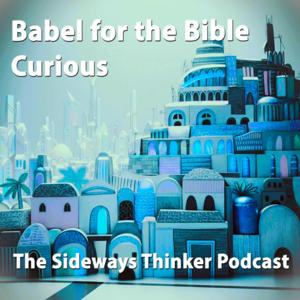
What if the Tower of Babel isn’t about a skyscraper at all, or trying to ‘reach God,’ but about language, thought and power? We begin our series with the strange little story - consisting of only nine verses- situated between the Noah episode and the great patriarch Abraham — and why it might be one of the few (if any) political passages in the Bible.
In the series, we’ll be taking a deep dive into Genesis 11 (1-9) the Babel story to open up its valuable teaching. We’ll discover the Bible’s take on free speech, freedom, and human flourishing. We’ll encounter God in sarcastic mode, and we’ll consider whether or not the people in the story were actually punished or not. We will consider how the story speaks so clearly to us today – with some surprising conclusions about the way we live and the choices we make. And the danger we are in.
In this episode, we consider the Babel Builders’ desire to make a name for themselves.
It could be said that the whole Babel story is about names, naming and places. What is the original idea of fame? What does fame mean in the ancient world? To have a great name was to have achieved significance that would survive beyond one’s immediate life.
Babel is not the story of people wanting to be famous as such. It is the story of people wanting to achieve greatness on their own terms, establish their own name, and secure their own remembrance. This aspect of the story is better understood when considered alongside what comes next with the patriarch and matriarch, Abraham and Sarah whose names are changed by God and whose names will be blessing to others.
Thanks for reading! Subscribe for free to receive new posts and support my work.
Images are AI adaptations of the author’s own sketches and drawings, in addition to adaptations from Breugel’s renowned paintings of the Tower of Babel.
Music is Stars and Laurels by Shane Ivers for Silverman Sounds.
https://www.silvermansound.com
Dr Caroline Kaye (The Sideways Thinker) presents this series aimed at non believers and believers alike exploring the West’s foundational texts - in order to see them anew. Dr Kaye holds graduate and post graduate qualifications in Religions and Theology from the University of Wales Trinity St. David and the University of Manchester She also holds an interdisciplinary PhD in Art History with Biblical themes from the Manchester Metropolitan University.
Books consulted or referred to in this episode:
James Austin, The Tower of Babel in Genesis: How the Tower of Babel Narrative Influences the Theology of Genesis and the Bible, Bloomington, Westbow Press, 2012.
Yoram Hazony, The Philosophy of Hebrew Scripture, Cambridge, Cambridge University Press, 2012
Leon R. Kass, The Beginning of Wisdom:Reading Genesis, Chicago, University of Chicago Press, 2006.
Judy Klitsner, Subversive Sequels in the Bible: How Biblical Stories Mine and Undermine Each Other, Philadelphia, JPS, 2009.
Jordan B.Peterson, We who Wrestle with God: Perceptions of the Divine, London, Allen Lane, 2024.
Dennis Prager, (Ed. Joseph Telushkin), Genesis: God, Creation and Destruction, The Rational Bible Series, Alperson Edition, Washington, Regenery Faith, 2019.
Nahum M. Sarna, Understanding Genesis: The World of the Bble in the light of History, New York, Schocken Books, 1966, reprinted 1970.
Thank you for listening. Please feel free to comment and share. If you find my work interesting and worthwhile, I would be glad to receive one-off donations through the Buy me a Coffee scheme. Do subscribe if you haven’t already, subscribing alone supports my work.
https://www.buymeacoffee.com/SidewaysThm
This is a public episode. If you would like to discuss this with other subscribers or get access to bonus episodes, visit thesidewaysthinker.substack.com