
Sign up to save your podcasts
Or

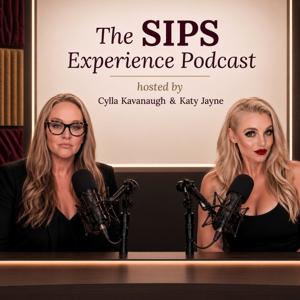


"Just get over it" is the advice that keeps people stuck. In this episode of The SIPS Experience, Cylla breaks down why healing does not run on anyone else's timeline, what grief and change actually ask of us, and how to answer that phrase when it gets aimed at you.
Take the free quiz: https://sips.media/quiz
New episodes of The SIPS Experience drop Tuesdays and Thursdays.
New episode of The SIPS Experience is live. Some people were trained by silence, some by mockery, some by fear. In this solo episode I talk about why I talk about sex plainly, like it is not a big deal, and what it costs when nobody will say the words out loud. Watch or listen here: https://www.youtube.com/watch?v=KROxzykU2io — also on Spotify and everywhere you get podcasts. Then take the free Intimacy Archetype Quiz at https://sips.media/quiz and find out which archetype runs your love life.
Hello loves! Welcome to a brand new episode of The SIPS Experience. Brit Santangelo joins Cylla and Katy for a warm, honest conversation about coming out of retirement and back into business on completely new terms, and what stress, rooms, and other people's energy were doing to her body, and what she does differently now. Then take the free Intimacy Archetype Quiz at https://sips.media/quiz and find out which archetype runs your love life.
This is the companion practice to Mirror, Mirror, and it is meant to be done, not just heard. Stand in front of your mirror, press play, and let me walk you through ten quiet minutes of seeing the person instead of the parts. If this practice steadies you, share it with a sister who needs it and tell me in the comments what your one kind sentence was.
Content note: this episode talks about grief, loss, and the physical side of bereavement. Nothing graphic. If you are in the early days of a loss, be gentle with yourself as you listen.
Grief is not only an emotion. In this solo, Cylla walks through where grief takes up residence in the body: the chest, the throat, the shoulders and jaw, the gut, and the sleep that stops giving anything back. She walks through what bereavement research actually shows about hearts, inflammation, sleep, and yearning, and how to treat a grieving body like what it is: a body in recovery.
In this episode:
- The year my body told the truth: exhaustion sleep did not fix, waking at 3am, a tight chest, and getting sick every time life slowed down
- Where grief takes up residence, address by address, and how to recognize your own
- What the research actually shows, including the 2007 Lancet review on the health outcomes of bereavement, the physiology studies of early grief, inflammation findings, broken heart syndrome, and the brain science of yearning, all framed as reported in the studies themselves
- What to do with a grieving body: five practices, including grief dosage and the oscillation between loss and life
- The companion guided practice, Where Grief Lives, arrives here in Bloom tomorrow, Fri Nov 13
Journal prompts from this episode:
- Where does my grief live in my body right now? Be specific. Draw it if words are hard.
- What is that place holding that hasn't been said, or cried, or witnessed yet?
- What's one kind, physical thing I can do for this body today? Small counts. Small is the assignment.
- What would change if I treated my grief like a physical recovery instead of a personal failure?
This episode is education, not medical advice; new or worrying physical symptoms deserve a clinician's eyes. If grief ever feels unsafe to hold alone, call or text 988 in the U.S.
Take the free Intimacy Archetype Quiz: https://sips.media/quiz
Everything SIPS: https://sips.media
Sources cited in this episode:
- Stroebe, M., Schut, H., & Stroebe, W. (2007). Health outcomes of bereavement. The Lancet, 370(9603), 1960–1973. Bereavement is associated with excess risk of mortality, highest in the early weeks and months, and with decrements in physical health.
- Buckley, T., et al. (2009, 2011, 2012). Studies and reviews of early bereavement physiology: acutely bereaved participants showed higher heart rate and blood pressure than non-bereaved comparison groups, with cortisol activation, altered sleep, and immune changes reported, especially in the early months.
- Fagundes, C. P., et al. (2019). Grief, depressive symptoms, and inflammation in the spousally bereaved. Psychoneuroendocrinology, 100, 190–197. In 99 recently widowed adults, higher grief severity was associated with higher inflammation, independent of depressive symptoms.
- Templin, C., et al. (2015). Clinical features and outcomes of takotsubo (stress) cardiomyopathy. New England Journal of Medicine, 373, 929–938. International Takotsubo Registry: about nine in ten patients were women, and an emotional trigger preceded about 28 percent of cases.
- O'Connor, M.-F., et al. (2008). Craving love? Enduring grief activates brain's reward center. NeuroImage, 42(2), 969–972. In a small imaging study of bereaved women, reminders activated pain regions in everyone, and reward circuitry in those whose grief stayed intense, tracking with yearning rather than time passed.
- Lundorff, M., et al. (2017). Prevalence of prolonged grief disorder in adult bereavement. Journal of Affective Disorders, 212, 138–149. Pooled estimate: about one in ten bereaved adults.
- Stroebe, M., & Schut, H. (1999). The dual process model of coping with bereavement. Death Studies, 23(3), 197–224. The oscillation framing used in the practices section.
That feeling in your stomach, that ache in your chest when you see your partner laugh a little too hard at someone else's joke, or you catch sight of a text you were not meant to see. If jealousy has ever run a room in your relationship, this episode is for you. Jealousy is not a character flaw. It is not proof you are toxic, broken, or too much. Jealousy is information. Most emotions are just data, and jealousy is a messenger. Once you learn to read the message, it stops running your life.
In this episode:
- Why jealousy shows up in every dynamic, vanilla, lifestyle, and kink alike, and where the insecurity underneath it actually comes from
- What "I am jealous" usually means underneath: I am afraid of losing you. I need to feel like I am chosen. I need to know I matter more in this moment. I am scared I am not enough
- Why "you are making me jealous" starts a fight, while "I feel jealous when this happens because I need this" starts a conversation
- The client who thought she had a jealousy problem and actually had a translation problem, and how every accusation adds one more brick to the wall
- A boundary versus a cage. A boundary says here is what I need to feel safe. A cage tries to control your partner, boundaries create safety, cages create resentment, and control is fear
- Why burying the feeling does not make it disappear. Resentment builds, and it can show up in your body and your mental health as well as in your relationship
- When the messenger brings real news: boundaries pushed, agreements broken, actions that do not match words, and why the honest conclusion that a relationship is not working is clarity, not failure
- My own story of giving up ten years of boundaries in one moment, under an ultimatum, and why this work should never be used to talk yourself into staying somewhere that hurts
- The practice that makes it easier: pause before you speak, name the need out loud, and let the fiftieth honest conversation feel nothing like the awkward first one
Jealousy does not make you a bad partner. It makes you a human one. The couples who last are not the ones who never feel it. They are the ones who stopped fighting about the feeling and started resolving the real thing underneath it, because real things can actually be resolved.
If you and your partner need help having these conversations, that is the work I do in coaching, one on one or with the two of you together, and you can book through my site in the show notes.
Send this episode to the couple who keeps having the same fight. They may be fighting about the way they fight, not about the jealousy at all.
Take the free Intimacy Archetype Quiz: https://sips.media/quiz
Go deeper with us in the Bloom community on Patreon: https://sips.media
What dharma actually means, and how to find yours when life has rearranged everything. New episodes of The SIPS Experience with Cylla and Katy every week. Join the Bloom community on Patreon for the after-show conversation.
I spent 20 years on the other side of the camera, so when urologist Dr. Rena Malik went viral for saying porn is not sex education, I felt that one in my bones. She is right. In this episode I take you inside a scene I shot years ago, one that looked effortless from the outside, and show you everything the edit hid: the stops, the breaks, the staging, and a finish that was filmed at a completely different point in the day.
In this episode:
- The four stops inside one "effortless" scene, and why the big finish was not the end of anything
- Why a scene is a construction project where sex is the building material
- Lie one: bodies. Performers are cast, lit, angled, and still edited. Comparing your body to a screen body is comparing a person to a product
- Lie two: performance. Stamina on a set is managed. Real arousal does not run on a production schedule, and a body that needs time is not broken
- Lie three: the instant finish. Why the clitoris is the main event and not a detail, and how the edit teaches people to call a normal response a malfunction
- How the screen became the teacher when homes and schools offered a warning or a silence instead
- The consent infrastructure on a professional set, and what would happen if viewers copied the set's habits instead of the screen's choreography
Porn is entertainment built by professionals, me included, to look effortless. Real sex is a conversation between bodies, and conversations have pauses, questions, and adjustments. One of those is a product. The other one is a life. Stop grading the life by the product.
Send this episode to one person who learned everything they know from a screen. It might be the first honest lesson they ever got.
Take the free Intimacy Archetype Quiz: https://sips.media/quiz
Go deeper with us in the Bloom community on Patreon: https://sips.media
This is the episode I have been carrying for a long time.
Twenty years inside the adult industry: building a studio, losing it, taking my name back. The numbers nobody puts in the headlines. Who really owns the machine. The managers who became pimps with laptops. And where I stand now, which comes down to two words: consent and control.
I will never shame the people who work in this industry. Creators are some of the hardest working people I know. What I am criticizing is the machine.
Listen here, or watch the full episode on YouTube today. And Bloom members: this is exactly the conversation we keep having. Bring your thoughts to the circle. 🪷
Every yes has a driver. Desire. Obligation. Fear. Love. Habit. Guilt.
The word sounds the same either way — but a yes from desire and a yes from duty live on different planets. One builds intimacy. The other quietly drains it.
In this episode of The SIPS Experience, Cylla sits down with Katy Jayne (@thekatyjayne) to pull apart the yeses we give in our relationships, our work, and our everyday lives — where they actually come from, how to tell a real yes from a compliant one, and why a check-in is an act of care, not an accusation.
We talk about the clenched-teeth yes. The yes that keeps the peace but abandons the self. And the question every couple should be asking more often: "What do you need that you haven't asked for?"
This isn't theory. It's two women with decades of lived experience — in relationships, in the adult industry, and in the rooms where consent actually gets negotiated — telling the truth about what a yes costs when it isn't real.
🎧 New episodes of The SIPS Experience every week.
👇 START HERE — take the free Intimacy Archetype Quiz:
https://sips.media/quiz
Four archetypes. One honest mirror. Find out how you really show up in love.
🌿 Go deeper with us in Bloom, our Patreon community (bonus practices, exclusive audio, monthly Q&A) — find the door at:
https://sips.media
💬 Coaching, courses & everything SIPS:
https://sips.media
Featuring Katy Jayne — @thekatyjayne
Cylla Kavanaugh is an ICF Professional Certified Coach (PCC), dual-certified in Spiritual Life Coaching and Soul Purpose Coaching, an ACOS Certified Sex Educator, and an ambassador for the Hassl global anti-harassment movement. SIPS = Siren Intimate Purpose Studios.
Sip. Heal. Bloom. 🪷
00:00 The yes behind the yes
01:41 Every yes has a driver
02:24 The desire yes vs. the duty yes
05:35 Your body votes first — gut instinct & the clenched-teeth yes
09:00 The patterns we inherit
11:31 When "consent" wasn't even a word
12:50 Why nobody teaches us this
14:08 Having the conversation with our kids
18:48 Sex-shop stories (the lighter side)
20:20 Check-ins & testing — normalize the conversation
24:48 Consent outside the bedroom
25:50 The Promising Young Woman conversation
29:04 Silence is not a yes — freeze & fawn
30:04 When one partner pushes the other
33:12 What kink communities get right
34:57 The one question every couple should ask
36:38 A no is information, not rejection