
Sign up to save your podcasts
Or

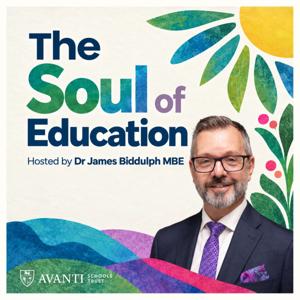


What happens when we stop labelling children by ability and start trusting in their potential?
In this episode of The Soul of Education, James Biddulph, CEO of Avanti Schools Trust, is joined by Professor Dame Alison Peacock, Chief Executive of the Chartered College of Teaching. Before leading the professional body for teachers, Alison was Executive Headteacher of The Wroxham School, where her work on Learning Without Limits challenged fixed ideas of ability and showed what schools can become when they are built on trust.
Together they explore:
Why fixed notions of ability hold children back
What it means to treat teaching as a true profession
How we keep great teachers in the classroom
Building school communities where both pupils and staff can flourish
What education is ultimately for
An honest, hopeful conversation for teachers, leaders, parents and anyone who believes education should nourish the whole child.
🎧 Listen to The Soul of Education wherever you get your podcasts
🔔 Subscribe for new episodes
#SoulOfEducation #Education #Teaching #SchoolLeadership #LearningWithoutLimits
Ask a child to draw nature and most will draw something they are standing outside of.
Richard Dunne left headship to found The Harmony Project, convinced that the way we structure learning teaches children a quiet falsehood: that they are separate from the living world rather than part of it. In this episode he tells James Biddulph what prompted that decision, and what a curriculum looks like when it is built around the principles that govern the natural world instead of around subject boundaries.
The conversation moves from theory to the ordinary detail of running a school. Harmony principles applied to curriculum design. What changes when interconnection is the organising idea rather than an occasional topic. Why school food and the menu are not a side issue but a daily lesson in the same argument.
Richard also makes a case that will land with anyone teaching climate to teenagers. Young people are not short of information about the state of the planet. They are short of agency. An education built on anxiety produces paralysis. One built on hope, and on the evidence that children can act, produces something else entirely.
The episode closes on the harder question: what would need to change across the sector for this to move beyond individual schools willing to try it.
Somewhere between Reception and Sixth Form, the joy goes missing.
James Biddulph and Nitesh Gor both describe waking up to the same question: where has all the joy gone? In this opening episode they trace that question through the evidence and into the harder argument underneath it.
Edurio's 2025 research found that only 45% of secondary pupils feel physically and mentally well, falling to 31% by the age of 18, with interest in lessons collapsing across the same years. Anthony Seldon puts it more bluntly, describing a system in which the joy is squeezed out of school and replaced by fear and anxiety. He calls it deeply sad and entirely avoidable.
So which is it? Is joy a soft outcome, the reward that arrives once the real work is done? Or is it the precondition for any learning at all? James makes the practitioner's case from two decades in schools. Nitesh argues that joy is not a feeling to be engineered but a spiritual state to be uncovered.
The conversation ends where the word itself begins. To educate, from the Latin, means to lead out. Not to fill a child, but to draw out what is already there.
From the publisher's feed
We have built a system that measures everything a child can do and almost nothing of who they are becoming. We test knowledge and neglect character. We track progress and lose sight of purpose.…
Each episode, Dr James Biddulph MBE, CEO of Avanti Schools Trust, sits down with educators, scientists, artists and thinkers who are asking the harder question: not how do we raise attainment, but how do we raise well-rounded human beings.
This is not nostalgia, and it is not criticism from the sidelines. It is a serious attempt to put the inner life back at the centre of schooling, grounded in the work of running real schools.