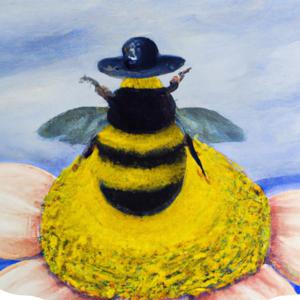
Meet the underground champions you've never heard of: Squash Bees! These native specialists have been perfectly pollinating our pumpkins for 10,000 years. Find out how they stack up against honeybees and why your garden needs both.
www.secretpollinators.com
KEY SOURCES
Squash bee vs. honey bee effectiveness
- Tepedino, V. J. (1981). The pollination efficiency of the squash bee (Peponapis pruinosa) and the honey bee (Apis mellifera) on summer squash (Cucurbita pepo). Journal of the Kansas Entomological Society, 54(2), 359–377. — individual visits to pistillate flowers by each species were equivalent; honey bees preferred pistillate flowers while squash bees preferred male flowers; most pollination was accomplished by squash bees before honey bees appeared in numbers.
- Martinez, M. I. Cucurbit specialist, Peponapis pruinosa, is a more effective pollinator than generalist, Apis mellifera, for cultivated squash. UC San Diego (Holway lab). escholarship.org/uc/item/8m03w8tn — female squash bee visitation had greater positive effects on pollen removal, pollen deposition, fruit set, and seed set; notes that previous studies report conflicting results.
- Warner, J. (2017). Pollinator effectiveness of Peponapis pruinosa and Apis mellifera on Cucurbita foetidissima. UC San Diego. escholarship.org/uc/item/2k10f84m — single-visit trials on buffalo gourd; female P. pruinosa produced 57.9% fruit set, males 23.5%, honey bees none.
- Artz, D. R., & Nault, B. A. (2011). Performance of Apis mellifera, Bombus impatiens, and Peponapis pruinosa as pollinators of pumpkin. Journal of Economic Entomology, 104(4), 1153–1161. — the Cornell work on comparative pumpkin pollination.
- Cane, J. H., Sampson, B. J., & Miller, S. A. (2011). Pollination value of male bees: the specialist bee Peponapis pruinosa at summer squash. Journal of Economic Entomology, 104(2), 614–620.
- Willis Chan, D. S., & Raine, N. E. (2021). Sharing the wealth: pollen partitioning in a Cucurbita crop pollination system with reference to the wild hoary squash bee. Journal of Pollination Ecology.
Squash bee biology and nesting
- Hurd, P. D., Linsley, E. G., & Whitaker, T. W. (1971). Squash and gourd bees (Peponapis, Xenoglossa) and the origin of the cultivated Cucurbita. Evolution, 25(1), 218–234.
- Hurd, P. D., & Linsley, E. G. (1964, 1966). Revisions of Peponapis and Xenoglossa — pollen collected exclusively from Cucurbita; 11 species north of Mexico.
- Mathewson, J. A. (1968). Nest construction and life history of the eastern cucurbit bee, Peponapis pruinosa. Journal of the Kansas Entomological Society, 41, 255–261.
- Julier, H. E., & Roulston, T. H. (2009). Wild bee abundance and pollination service in cultivated pumpkins: farm management, nesting behavior and landscape effects. Journal of Economic Entomology, 102(2), 563–573.
- Ullmann, K. S., Meisner, M. H., & Williams, N. M. (2016). Impact of tillage on the crop pollinating, ground-nesting bee, Peponapis pruinosa, in California. Agriculture, Ecosystems & Environment, 232, 240–246. DOI: 10.1016/j.agee.2016.08.002
- USDA Forest Service, Squash Bees pollinator profile. fs.usda.gov — if numerous, squash bees thoroughly pollinate all available flowers, rendering later honey bee visits superfluous.
Domestication history and range expansion
- López-Uribe, M. M., Cane, J. H., Minckley, R. L., & Danforth, B. N. (2016). Crop domestication facilitated rapid geographical expansion of a specialist pollinator, the squash bee Peponapis pruinosa. Proceedings of the Royal Society B, 283(1833): 20160443. DOI: 10.1098/rspb.2016.0443
#secretpollinators #squashbees #nativebees #pollinators #wildbees
#natureeducation #savethepollinators #organicgardening #fallgardening #gardening #rewilding #regenerativefarming #nativespecies



 View all episodes
