
Sign up to save your podcasts
Or



Hey! I'd love to hear your thoughts, send me a voice note.
In 1878, a traveling father of two young boys brought home a rubber-band toy that flew across the room, hit the ceiling, and broke. Twenty-five years later, the two boys who played with it were flying at Kitty Hawk.
Tim and Andrea take on the toy helicopter that hooked young Wilbur and Orville Wright on flight, and follow it from a Dayton printing press and bicycle shop to the sand dunes of North Carolina. With two aerospace engineers at the mic (and Andrea, by Tim's own admission, the far better one), this episode gets into the engineering: why twisting the wings the way a bird does beat Otto Lilienthal's method of swinging his legs to steer, how the early gliders failed, and how a homemade wind tunnel exposed a mistake in the Smeaton coefficient that experts had relied on for more than a century. Then it's Kitty Hawk in December 1903, picked in part for its privacy: no reporters, no competitors. That privacy came back to bite them, because outside of five witnesses on the beach, almost no one believed what had happened. From there it's lawsuits, the patent wars, and a decades-long feud with the Smithsonian over who deserved the credit. And they close with how far pieces of the Wright Flyer have traveled since, all the way to the Moon and Mars.
A broken toy, a bike shop, and a few seconds over the sand. Imperfect people. Extraordinary things.
Hey! I'd love to hear your thoughts, send me a voice note.
A white cloth belt covered in a thousand red knots, sewn by women inside an American incarceration camp, and carried through World War II by a soldier who never told a single friend he had it.
Tim and Andrea take on Sus Ito's senninbari, a Japanese "thousand-stitch" good-luck belt his mother made for him while the family was held at the Rohwer camp in Arkansas. Andrea's first question is the right one: why is a Japanese object on a U.S. history podcast? The answer opens onto one of the hardest chapters of the war at home. For the first time on the show, you'll hear the object's owner in his own voice, in a short clip of Sus Ito recorded in 2015. From there it's Pearl Harbor, Executive Order 9066, and the removal of roughly 120,000 people of Japanese ancestry from the West Coast, most of them American citizens, and Andrea asks what a lot of listeners will: why only the Japanese, when the U.S. was also at war with Germany and Italy? Then it's Sus himself, a farm kid from Stockton who was already in the Army before Pearl Harbor, served as an artillery forward observer with the 442nd Regimental Combat Team, and came home to a PhD and a career at Harvard Medical School. They cover the 442nd, the most decorated unit of its size in American history, the rescue of the Lost Battalion, and the hard irony of Japanese American soldiers helping free Dachau survivors while their own families sat behind barbed wire at home. They close with the federal commission that blamed the incarceration on "race prejudice, war hysteria, and a failure of political leadership," and the formal apology President Reagan signed in 1988. It took the country 46 years to say it was wrong.
A thousand stitches, sewn behind barbed wire, for a son fighting for the country that put them there.
Hey! I'd love to hear your thoughts, send me a voice note.
A man built an entire form of entertainment because his mother couldn't get comfortable in a regular movie seat, and it's still not the strangest part of this object's story.
Tim and Andrea take on the drive-in movie speaker, the little metal box on a post that hung off a rolled-down car window and is directly responsible for a genuine slice of American culture. They trace it from Richard Hollingshead's 1933 driveway experiment in New Jersey, through the terrible, neighbor-annoying sound of the earliest drive-ins, to RCA's 1941 fix that let the format explode into thousands of theaters nationwide. From there it's the postwar boom, the family-night economics of paying by the carload, and yes, the "passion pit" reputation, teenagers are going to do teenage things, drive-in or not, and Tim has his own off-the-cuff confession about a childhood double feature that went sideways the second Animal House came on. They follow the object right up until car stereos quietly replaced it, then into the decline, and land on two genuine history rhymes: the polio-era drive-in boom echoing in the COVID-era one, and a 1973 energy crisis law that made daylight saving time permanent for about ten months, a law Andrea remembered and Tim did not. They close by taking the drive-in global, Canada had one within 13 years, and land back where they started: one more small, ordinary object that turned into a genuine piece of Americana.
A speaker box on a post. A whole American summer, packed into a parking lot.
Hey! I'd love to hear your thoughts, send me a voice note.
A commuter ferry that runs between New Jersey and Manhattan is named after a man who never captained a ship in his life.
Tim and Andrea take on an object related to September 11, 2001, not a piece of wreckage, but the Father Mychal Judge, a NY Waterway ferry named for the FDNY chaplain who became Victim 0001, the first certified death of the attacks. They trace Judge's own story first: a Brooklyn kid who shined shoes at Penn Station, was ordained as a Franciscan priest, got sober through AA in the 1970s, spent his life ministering to the people the church and the country were least comfortable with, and ran straight into the North Tower to pray with the dying. Then they discuss a piece of history most people have never heard of, the largest maritime evacuation in American history, a Dunkirk-scale rescue of Lower Manhattan on 9/11 by hundreds of ordinary boat captains with no orders and no plan, a story that surprised even Tim (Andrea already knew it). The same boat later turned up pulling passengers out of the Hudson during Capt. Sully's landing. From there they widen out to the country's immediate reaction, the grounded skies, the filled blood banks, the sold-out flags, and close on the 9/11 Commission's own hard verdict on itself: the attacks "should not have come as a surprise."
A ferry that runs the same river every day, named for a man who ran the other direction on the worst morning in the city's history.
Hey! I'd love to hear your thoughts, send me a voice note.
Nobody can actually agree on who invented the "I Voted" sticker, and that might be the most American thing about it.
Tim and Andrea trace the sticker back past its familiar 1987 design, sketched at a dining room table by a geologist named Janet Boudreau, through a 1920 women's suffrage button and a wave of "VOTE" branded gear made for a newly-enfranchised generation of 18 year olds in the 1970s. Then they zoom out from the sticker to the messier history underneath it, the open, sometimes violent public voting of the mid-1800s, and the slow shift to a private, secret ballot by the turn of the century. Along the way they run the actual numbers on who's eligible to vote versus who actually shows up, and the gap is worse than either of them expected going in. The episode closes back where the series started, tying the sticker to Episode 1's "all men are created equal" line through five constitutional amendments and the Voting Rights Act, the better part of two centuries spent trying to make that promise literally true at the ballot box.
A two-cent sticker. A much bigger, still-unfinished argument about who actually gets a say.
Hey! I'd love to hear your thoughts, send me a voice note.
Before the famous signed parchment existed, there was a rushed overnight print job that actually told America independence had been declared.
Tim and Andrea open the series with the Dunlap Broadside, the first printed copy of the Declaration of Independence, run off overnight by a 29 year old Irish immigrant printer working against a deadline set by men who had just committed treason.
No signatures except two printed names. Ink smudges from being folded before it dried. A print run that historians still can't nail down to an exact number. And two of the best true stories in the whole 100 object list riding along with it: a $4 flea market frame that turned out to be worth 8.14 million dollars, and a spy's copy that sat quietly in British archives for 250 years before a researcher found it in 2026, catalogued as evidence against the very rebellion it now helps commemorate.
It's history, plus marriage, plus an honest look at what "all men are created equal" didn't quite mean yet in 1776. Imperfect people. Extraordinary things. That's the whole show, starting right here.
Hey! I'd love to hear your thoughts, send me a voice note.
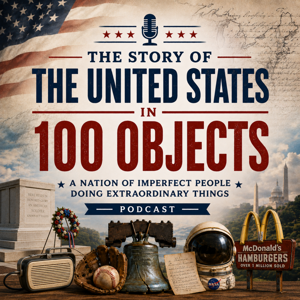
Welcome to The Story of the United States in 100 Objects. Before we get into the objects, artifacts, and arguments, Tim and Andrea sit down to introduce the show: what it is, why they're doing it, and what you can expect from the next 100 episodes.
In this episode:
Thanks for being here for the introductory episode. Subscribe now so you don't miss Object #1.
From the publisher's feed
Married non-historians Tim and Andrea dig through 250 years of American history, one object at a time. A rushed, ink-smudged broadside. A pair of Olympic running shoes. A rock from another world.…