
Sign up to save your podcasts
Or

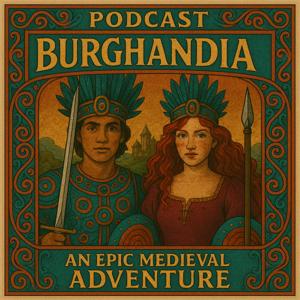


King Knylis rules from the Falls of Northa—the most magnificent castle in the West. Hidden beneath its keep lies an undiscovered deposit of red crystals a valuable raw material, a secret yet to be revealed. Knylis dreams of uniting the twin islands—a goal that has long fueled the bitter rivalry between the North and South.
Among these rulers, King Victor the first stood out as both competent and stable—even though his ambition for war and conquest had earned him a reputation as an expansionist and ruthless leader. He was deeply devoted to his daughter, Iora, whom he publicly celebrated as his favorite and intended to succeed him as queen. Although Victor also had a son, Ioro, it was Iora who held his heart. To prepare her for the role, he secretly appointed Pretorian Lord Klascus as her trainer and educator—a confidential arrangement known only to a select few. Tragically, both Victor the First and his son Ioro were assassinated by Surkian assassins who infiltrated the palace, leaving Iora as the sole survivor. Initially, it was believed that Surkia alone was responsible for the regicide. However, it was later revealed that Surkian Lord Garcio had been scheming with disaffected Vikorian nobles to kill the royals and replace the dynasty.
Ruberc and Lariss ascended to authority following the death of their father, Romerk Claudius—Vikoria’s ruler who presided over the Pax Maxima. With Romerk’s passing, a once-stabilized realm looked to his offspring to uphold the prosperity he had ushered in. In stark contrast to more tumultuous eras, these siblings found themselves steering a thriving city-state that boasted secure trade routes, strong alliances, and a loyal populace.
After the swift overthrow of King Manork, Romerk Claudius wisely chose not to claim the royal title. Instead, he accepted the mantle of “Matatάn,” or “the war of the people,” granting him broad authority without stoking rival ambitions.
This cunning stance stabilized the throne and earned him the respect of both nobles and commoners. The people of Burghandia call this era, the Pax MaXima, an era of internal peace, administrative reforms, and unprecedented prosperity, and growth for Vikoria. Romerk masterfully balanced the interests of patricians, merchants, and soldiers. By granting pardons to nobles who pledged loyalty, he eased any lingering resentment from the Manork era, transforming potential threats into enthusiastic allies. Rejecting the violence, and incompetence that had marred the previous reign, Romerk believed Vikoria’s future lay in commerce and cultural unification. Monthly open forums allowed citizens to petition directly, forging a sense of inclusivity unseen in earlier reigns.
The Rise of the Lord Romerk Claudius was an aspiring noble from a small yet affluent family. With both political and military ambitions, he proved to be a master tactician, exploiting the failures of a weak Luna king. Romerk was a tall, tan man with braided brown hair flowing over his shoulders like the winds that carried his ships. His smile and sense of humour were said to light up any room, endearing him to peasants and nobles alike. He won favour by easing burdens, paying off debts, and distributing fish and bread to the needy.
Throughout Burghandian lore, The Karys Book stands as the single greatest compendium of the realm’s history, laws, and theological knowledge. Its origins trace back to Domo, where Aeliana compiled centuries of accounts into a unified manuscript. Over time, successive Maximi and priests in Krastia continued to update and annotate its pages, transforming it into an ever-evolving record of Burghandia’s collective heritage.
Welcome to a journey deep into the spiritual heart of Burghandia—a realm where ancient faiths, divine legacies, and celestial rituals merge to shape destiny. Long before the compassionate rise of Krassus the Eternal or the miraculous birth of the twins, Vikoria’s early inhabitants worshiped six revered goddesses.
The mystic rites of the Luna Monarchs add a luminous facet to Burghandia’s spiritual mosaic. These enigmatic rulers embraced the cyclical power of worshipping six revered goddesses, a symbol of constant renewal and the delicate balance with nature. Their nocturnal ceremonies, held beneath the silver glow of a full moon, weave together celestial symbolism and earthly leadership, reminding the people that every ending births a new beginning and that even in the darkest night, hope endures.
Krassus was a young peasant boy who lived with his father and younger brother on the Isle of Krastia. The origins of Krassus and his ancestors remain unknown to the people of Burghandia, tracing back to an era simply called the “Blind Times,” a period that precedes all recorded history. It was a gloomy age of chaos: people barely lived beyond thirty, rapidly aging and deteriorating. No one understood the root of this affliction, and most accepted it as an unchangeable curse and part of life; some even thrived in these circumstances.
Wood in Sigurd is not merely a building resource; it is the backbone of their survival and sovereignty. Timber forms the walls of their homes, furnishes their farms, stokes their fires, and even shapes their defenses. It was in part thanks to these wooden ramparts—reinforced with stone—that the Fortress of Thilek could withstand countless assaults, for it was here that a hero named Nerthys once stood against overwhelming odds to protect the Sigurdian forest.
Season 2 of Burghandia will be exhilarating!
Ready to go indepth, into the world of Burghandia. Get to know the characters individually, and explore the lore of the world of Burghandia in detail. Follow the great stories of Burghandia influenced by Dominican Republic folklore and classical history.
From the publisher's feed