
Sign up to save your podcasts
Or

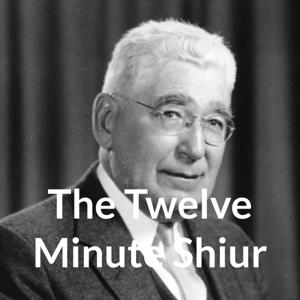


We begin our close reading of Rambam's הקדמה (Hakdamah), the Introduction to the Mishneh Torah, his great compilation of Jewish law and arguably *the* most impressive work of halakhah ever written. In this installment: Rambam on the origin and the history of the תורה שבעל פה (Torah sheb`al peh), the "Oral Torah."
Get the source sheet at www.freehofinstitute.org/podcast.
The second and concluding installment of our look at Rabbi Moshe Feinstein's introduction to his collected responsa, where he sets forth his theory of why the contemporary posek (halakhic authority) is entitled - and even obligated - to undertake the daunting task of speaking in the name of Torah and halakhah. Does his view of the matter have anything to teach us? Does it have anything in common with our own progressive outlook?
Get the source sheet at www.freehofinstitute.org/podcast.
Rabbi Moshe Feinstein, one of the leading Orthodox poskim(halakhic authorities) of the 20th century, was certainly no liberal or progressive. But his theory of halakhic decision has much to teach us. At least… we think so, and in the next several episodes we’re going to explore that theory, which he sets forth in the הקדמה (introduction, preface) to his collected responsa.
Part 1: why maybe I shouldn’t have been a posek!
Download the source sheet at www.freehofinstitute.org/podcast.
Most Orthodox poskim will tell you that, to be a valid ("kosher") witness, a person must be an Orthodox Jew, that is, observant of ritual halakhah according to Orthodox standards. So: a Jewish wedding ceremony is valid kiddushin only if it is witnessed by two Orthodox Jews. We have two questions: 1) how do they know this? and 2) is it true?
Download the source sheet at www.freehofinstitute.org/podcast
It's a typical halakhic discussion among the rishonim (medieval Talmudic scholars): an analysis of texts concerning the laws of aninut, the period of time that extends from the death of a loved one to the moment of burial.
Typical? Could there be more to it? Does this back-and-forth over seemingly dry and technical details conceal an emotional dispute among members of a grieving family?
An exercise in reading between the lines of our halakhic texts.
Download the source sheet at www.freehofinstitute.org/podcast.
Do you like creative liturgy - poems and thought-pieces and readings that add to or replace the traditional siddur text ? If you do, you probably know that Orthodox Jews claim that such creativity with the liturgy is a violation of the halakhah.
Hmm - it seems that we've been through all this before.
A look at how today's innovations in public prayer are simply the latest round in a centuries-old halakhic controversy.
Reform congregations make a point to recite Sh'ma on their feet: they either rise or remain standing, if able. Most everybody else recites it in a seated position. Many say (wouldn't you know it?) that the Reform practice violates the halakhah.
Here's an argument to the contrary.
It's a well-known minhag (custom) to require that the wedding ring be a plain band, with no precious stones. But is this a requirement of halakhah? Most authorities say "yes," but their argument is open to... well, argument!
Download the source sheet at www.freehofinstitute.org/podcast
Most say "three." Some say "two." Why the disagreement? And what's behind the two positions? We go back to the Mishnah and survey 1500 years of debate. Not so bad, we not-so modestly think, for twelve-plus minutes!
Download the source sheet at www.freehofinstitute.org/podcast
In traditional Ashkenazi siddurim, you'll find this instruction, right before Sh'ma Yisrael: "when praying in private, add 'El Melekh Ne'eman.'" Is this a big deal? Well, when you say "El Melekh Ne'eman" you're adding material to k'ri'at Sh'ma (the recitation of Sh'ma and its accompanying b'rakhot), without any authorization in the classical sources, and the halakhah has a big problem with that. It shouldn't be there... but it is! And that fact tells us something about the capacity of Jewish law to change, to accommodate itself to the needs of those who pray. So yes, it is a big deal!
Download the source sheet at www.freehofinstitute.org/podcast.
From the publisher's feed