
Sign up to save your podcasts
Or



Join Jeffrey and Steve for a free live webinar on shame, Tuesday, October 20, at drjeffreyrutstein.com/links.
What if some of the things you've always called your personality are really ways you learned to make yourself small?
In this episode, Jeffrey and Steve get into shame. Steve brings his own story: one offhand comment from Jeffrey that showed him something he'd been doing his whole life, something he'd always thought was just who he was.
Shame rarely feels like shame. It feels like being easy-going. Not needing much. Getting everything just right. Saying yes before anyone finishes asking. For most of us it has worked for years, so well that we'd call it one of our better qualities. Jeffrey says it plainly about his own people-pleasing: it was nice for everyone else. It wasn't so nice for him. This episode is about what shame looks like when it's hiding in plain sight, and why trying harder on ourselves never quite gets us out of it.
Want to go deeper? Join Jeffrey and Steve for a free live webinar on how shame hides and how it shapes us across a lifetime. Tuesday, October 20, 8 pm Eastern / 5 pm Pacific. Register at drjeffreyrutstein.com/links.
Have a question you'd like answered on the podcast? Call (866) 357-5156 or email [email protected] — we would love to feature it in a future episode.
This podcast is for informational purposes only and isn't a substitute for professional mental or physical health care. If you're struggling, please reach out to a qualified healthcare provider.
Get Jeffrey's free 20-minute video, "Why Do I Feel Stuck?" at drjeffreyrutstein.com/links.
What if being hard on yourself has never once made you better at anything?
In this episode, Jeffrey and Steve get into self-compassion. Steve brought the question himself. Editing the last few episodes, he kept hearing the same answer sitting underneath Jeffrey's other answers, and he wanted to know what's actually happening in the nervous system when we turn on ourselves.
Most of us are running on an idea we never chose: that being hard on ourselves is what keeps us honest. It has a logic to it. Get there first, and nobody else can get there before us. And it doesn't always sound like a voice — for a lot of us it's quieter than that. The break we don't take. The rest we don't allow. Jeffrey says something here worth sitting with: we'll call ourselves flexible people, and be completely rigid about the one relationship we can never leave. This episode is about what that rigidity costs us, and why saying kinder things to ourselves usually isn't what changes it. If you've ever gotten to the end of a long day and still couldn't let yourself stop, this conversation is for you.
Want tools to help you move from dysregulation toward regulation? Grab Jeffrey's free 20-minute video, "Why Do I Feel Stuck?" at drjeffreyrutstein.com/links.
Have a question you'd like answered on the podcast? Call (866) 357-5156 or email [email protected] — we would love to feature it in a future episode.
This podcast is for informational purposes only and isn't a substitute for professional mental or physical health care. If you're struggling, please reach out to a qualified healthcare provider.
Get Jeffrey's free 20-minute video, "Why Do I Feel Stuck?" at drjeffreyrutstein.com/links.
Have you ever tried to talk yourself out of worrying, and ended up worrying about why you can't stop?
In this episode, Jeffrey and Steve answer a voicemail from Jasmine. She's losing her housing, may lose her small business, and is living with long COVID. She ruminates day and night, even during guided meditations. She's asking for more profound tools to make it stop.
When the problem is real, rumination feels like the responsible thing to do. Something this big deserves our attention, right? But the loop keeps checking the same few places for an answer that isn't there yet. This episode is about what our nervous system is really trying to do when it won't let go, and why fighting the thoughts rarely quiets them. If you've ever lain awake with a problem you can't think your way out of, this conversation is for you.
Want tools to help you move from dysregulation toward regulation? Grab Jeffrey's free 20-minute video, "Why Do I Feel Stuck?" at drjeffreyrutstein.com/links.
Have a question you'd like answered on the podcast? Call (866) 357-5156 or email [email protected] — we would love to feature it in a future episode.
This podcast is for informational purposes only and isn't a substitute for professional mental or physical health care. If you're struggling, please reach out to a qualified healthcare provider.
Get your free gift on the nervous system at drjeffreyrutstein.com/links
Want to leave a question? Call 866-357-5156
You already know what would help. Move your body. Get outside. Do the practice. But when you're deep in nervous system shutdown, the energy all of that requires is exactly the thing you don't have — and pushing harder only drives you further down. That's the trap of dorsal collapse: it takes away the very resource you'd need to climb out of it.
Drawing on polyvagal theory, nervous system science, and decades of trauma-informed clinical work, Jeffrey explains why trauma recovery so often includes long stretches of shutdown and collapse, when persistent exhaustion deserves a medical workup for chronic fatigue syndrome or inflammation, and why the "second arrow" — the self-blame that lands on top of the state — is what deepens the collapse and lengthens our stay in it. He then walks through what actually raises our energy so we can move from "I can't" to "I can.
Have a question for Jeffrey? Leave a voicemail at 866-357-5156. If you can't reach that number, record a voice memo or email [email protected].
Claim your free 20-minute video on the three nervous system states and practices for moving from dysregulation back to regulation at drjeffreyrutstein.com/links.
The content in this podcast is for informational purposes only and is not intended as professional mental health advice. Always consult a qualified healthcare provider for medical or mental health concerns.
Get Jeffrey's free 20-minute video, "Why Do I Feel Stuck?" at drjeffreyrutstein.com/links.
In this episode, Jeffrey and Steve answer a voicemail from Peter, who's lived with chronic low-level depression most of his life. He's found something that works — a slow breathing practice that shifts his whole state in under two minutes. But, somehow it never lasts.
Jeffrey and Steve get into what's actually happening when something works and still doesn't hold. Feeling weighed down isn't a personal failing — it's often a nervous system doing exactly what it learned to do to keep you safe. The harder question isn't why the calm works. It's why we keep leaving it.
If you've ever found the thing that helps and still can't hang onto it, this conversation is for you.
Want tools to help you move from dysregulation toward regulation? Grab Jeffrey's free 20-minute video, "Why Do I Feel Stuck?" at drjeffreyrutstein.com/links.
Have a question you'd like answered on the podcast? Call (866) 357-5156 or email [email protected] — we might feature it in a future episode.
This podcast is for informational purposes only and isn't a substitute for professional mental or physical health care. If you're struggling, please reach out to a qualified healthcare provider.
Get Jeffrey's free 20-minute video, "Why Do I Feel Stuck?" at drjeffreyrutstein.com/links.
What do you do when you can see exactly what your resentment is costing you — and still can't put it down?
In this episode, Jeffrey and Steve answer a voicemail about resentment. The caller is in her 70s, the oldest of eleven. The younger kids got what she didn't. Fifty years later she still resents them, and she knows what it does to her — it closes her heart.
Jeffrey helps us ask what resentment has been protecting us from. Because it is protecting something. Staying angry is cheaper than feeling what sits underneath it, and for most of us that has worked — for years. But a closed heart doesn't only keep other people out. It keeps us out too.
This episode is about what opens up when we stop fighting the resentment and get curious about what it's guarding. Not forgiving anyone. Not letting anyone off the hook. Just looking.
If you've carried something long enough that it now feels like part of your personality, this conversation is for you.
Want tools to help you move from dysregulation toward regulation? Grab Jeffrey's free 20-minute video, "Why Do I Feel Stuck?" at drjeffreyrutstein.com/links.
Have a question you'd like answered on the podcast? Call (866) 357-5156 or email [email protected] — we might feature it in a future episode.
This podcast is for informational purposes only and isn't a substitute for professional mental or physical health care. If you're struggling, please reach out to a qualified healthcare provider.
Get Jeffrey's free 20-minute video, "Why Do I Feel Stuck?" at drjeffreyrutstein.com/links.
Is your anger trying to tell you something you keep talking yourself out of?
In this episode, Jeffrey and Steve get into anger — where it actually comes from, why it can sit in you for days or weeks after the moment has passed, and why the hardest anger to deal with is often the anger you're not sure you have a right to feel. Steve brings a recent betrayal by someone he considered a friend and the question underneath it: is this hurt, disappointment, or something bigger — and how do you know the difference when shame keeps insisting you're overreacting?
Jeffrey lays out his four pillars of anger — the four kinds of emotional, mental, and moral pain that every angry moment is built on — and why betrayal in a relationship lands so much harder than ordinary disappointment. Along the way, they explore: why shame and anger so often arrive together and turn the anger back on you, what venting really does to resentment, the role blame plays in keeping conflict alive, and how much nervous system regulation you actually need before any of this becomes possible — the answer is far less than you'd think.
Want tools to help you move from dysregulation toward regulation? Grab Jeffrey's free 20-minute video, "Why Do I Feel Stuck?" at drjeffreyrutstein.com/links.
Have a question you'd like answered on the podcast? Call (866) 357-5156 or email [email protected] — we might feature it in a future episode.
This podcast is for informational purposes only and isn't a substitute for professional mental or physical health care. If you're struggling, please reach out to a qualified healthcare provider.
Grab Jeffrey's free 20-minute video, "Why Do I Feel Stuck?" at drjeffreyrutstein.com/links.
What if the guilt that floods in after you finally draw a line isn't proof you did something wrong — but proof of how you learned to survive?
In this episode of Wired for Well-Being, Steve brings his own question to Dr. Jeffrey Rutstein: why is setting boundaries so hard, why do so many of us get it wrong, and why does doing it right so often feel terrible? Jeffrey approaches boundaries from a nervous system perspective, explaining that trouble with setting healthy boundaries in relationships is rarely a communication problem or a character flaw — it's fear. He walks through the main patterns that block us: how boundaries were modeled in childhood, how shame and trauma teach us to lose track of our own needs, how people-pleasing gets confused with love, and how a blocked relationship with anger keeps us from reading the signal that a boundary is needed at all.
Jeffrey and Steve also unpack resentment as information rather than a character defect, and name the shame spiral that hits afterward — the drive where you replay the conversation and convince yourself you've damaged the relationship. The reframe at the heart of it: setting a boundary is an act of self-care, not an act of aggression.
Want tools to help you move from dysregulation toward regulation? Grab Jeffrey's free 20-minute video, "Why Do I Feel Stuck?" at drjeffreyrutstein.com/links.
Have a question you'd like answered on the podcast? Call (866) 357-5156 or email [email protected] — we might feature it in a future episode.
This podcast is for informational purposes only and isn't a substitute for professional mental or physical health care. If you're struggling, please reach out to a qualified healthcare provider.
Want tools to help you move from dysregulation toward regulation? Grab Jeffrey's free 20-minute video, "Why Do I Feel Stuck?" at drjeffreyrutstein.com/links.
What happens when you stop trusting your own feelings — and start monitoring your partner's instead?
In this episode, Jeffrey and Steve answer a voicemail from Chris, who married a partner who also came from a difficult family background, and now finds himself constantly tracking her emotional state — trying to read her reactions, second-guess his own, and keep the relationship harmonious. He describes feeling like an "auditor" of her nervous system, exhausted by the vigilance, and unsure whether he can trust what he's feeling or what he's seeing in her.
Jeffrey unpacks why that vigilance isn't really about being a good partner — it's a nervous system-rooted trust breakdown that shows up on both sides: not trusting your own state, and not trusting your read on someone else's. He walks through what it actually takes to rebuild that trust, starting with yourself, and why real connection depends on being met in your feelings rather than managed out of them. If you've ever found yourself monitoring someone you love instead of actually being with them, this conversation is for you.
Get your free gift, "Why Do I Feel Stuck?" at drjeffreyrutstein.com/links.
Have a question you'd like answered on the podcast? Call (866) 357-5156 or email [email protected] — we might feature it in a future episode.
This podcast is for informational purposes only and isn't a substitute for professional mental or physical health care. If you're struggling, please reach out to a qualified healthcare provider.
What do you do when your own grief keeps getting pushed aside by someone else's pain?
In this episode, Jeffrey and Steve answer a listener whose husband spent years as a functional alcoholic before crashing completely — burnout, depression, car accidents, hospital visits, unpaid bills, lost jobs — and eventually left her to single-parent their three teenage sons. She's not struggling to understand what happened. She's struggling because every book and podcast she turns to for healing seems to center his pain — his childhood, his depression, his addiction — as the explanation, leaving her feeling like her own hurt isn't allowed to count as much as his.
Jeffrey draws a clear line between understanding someone's behavior and excusing it, names the nervous system dynamic behind why she's been carrying her ex-husband's unowned shame as her own, and makes the case that she doesn't have to arrive at compassion before she's fully honored her own grief and anger. If your pain has ever felt like it has to compete with — and lose to — someone else's story, this conversation is for you.
Want tools to help you move from dysregulation toward regulation? Grab Jeffrey's free 20-minute video, "Why Do I Feel Stuck?" at drjeffreyrutstein.com/links.
Have a question you'd like answered on the podcast? Call (866) 357-5156 or email [email protected] — we might feature it in a future episode.
This podcast is for informational purposes only and isn't a substitute for professional mental or physical health care. If you're struggling, please reach out to a qualified healthcare provider.
From the publisher's feed
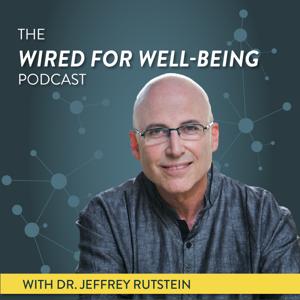
Wired for Well-Being is a podcast devoted to viewing our lives through a nervous system perspective—so we can better understand what’s really happening inside us and how to shift it.
Hosted by Dr. Jeffrey Rutstein, a clinical psychologist with over 40 years of experience treating trauma, dissociation, chronic pain, and chronic illness, the podcast takes you beyond theory and into real-life application. Each episode includes listener questions about the struggles we all face—relationships, healing journeys, fear, overwhelm, or anger—and offers fresh insights from the science of the nervous system.
With warmth and clarity, Jeffrey unpacks what’s going on beneath the surface: why certain situations trigger us, how old patterns linger in the body, and what it actually takes to move toward healing and connection.
Joined by producer and friend Steve Lessard, Jeffrey brings compassion, practical tools, and decades of clinical wisdom to every conversation. The goal is simple but profound: to help you stop seeing yourself as broken, and instead discover how you are inherently wired for well-being, resilience, and deeper connection.