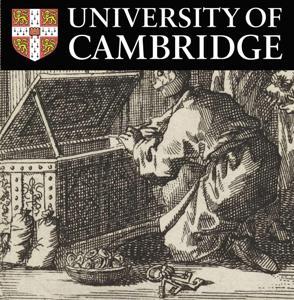
Things Seminar

Things Seminar

By Cambridge University
Download on the App Store

Things Seminar episodes

  • Matter and Materiality in the Early Modern World - 12 June 2015 - Materials I
    Materials I
    Alice Dolan (University of Hertfordshire)
    'A kind of coarse linen': Material Ambiguities in Eighteenth-Century England
    Anna Reynolds (University of York)
    'A Waste and Roaring Wilderness': Scriptural Wastelands and Early Modern Wastepaper
    Heidi Carlson (University of Cambridge)
    Thatch, stone and brick: the domestic buildings of early colonial Ireland
    59 min
  • Matter and Materiality in the Early Modern World - 12 June 2015 - Ephemera and the Body
    Ephemera and the Body
    Michelle Wallis (University of Cambridge)
    Papering Over the Past: Ephemeral Print and the History of Medicine in England before 1720
    Nailya Shamgunova (University of Cambridge)
    European perceptions of penis bells as a method of prevention of sodomy among the peoples of South East Asia in the 17th Century
    Miranda Clow (Royal College of Art)
    Negotiating Value: Printed Paper and the Beginning of the Fire Insurance Industry
    35 min
  • Things - 3 June 2015 - Sexy Things
    Dr Jen Evans (History, University of Hertfordshire)
    Kindling Cupid’s Fire: Aphrodisiacs in early modern England
    Abstract
    Dr Jen Evans: Some ‘things’, like foods, are unfortunately ephemeral; they are produced and consumed leaving little of their materiality behind. Yet food can have multiple meanings and can be engaged with as a range of things – as sustenance, as medical remedies, as enhancers of sexual pleasure. It was common knowledge in early modern England that sexual desire was malleable, and could be increased or decreased by a range of foods, including artichokes, oysters and parsnips. This paper will explore the understanding of some early modern aphrodisiacs and show that they were understood not just to be titillating sexual curiosities, but were a crucial element in medical regimes designed to restore and improve fertility. Moreover, in this paper I will begin to unpick the different ways in which aphrodisiacs might have been approached as material objects by considering not just the foods that were eaten, but those that were used as gifts, those used as dildos, and the pungent foods and substances that were used as fumes and fragrances. This paper will reveal that the world of early modern aphrodisiacs was very varied but was nearly always substantially influenced by medical ideas about the fertility of the body.
    41 min
  • Things - 20 May 2015 - Reproduced Things
    Professor Helen King (Classical Studies, Open University)
    The Material Womb
    Professor Michelle O’Malley (Art History, University of Sussex)
    Botticelli and Reproduction
    Abstracts:
    The material womb
    In the western tradition of thinking about the body, wombs have not only been illustrated in a variety of shapes, but been made in a variety of materials: ancient terracotta ‘votive wombs’ meet today’s brightly coloured, perky knitted wombs, while eighteenth-century glass wombs give way to nineteenth-century rubber wombs. In this paper, as an aspect of a wider project concerning what has been thought to constitute a body ‘part’, I will consider the colours and materials used for wombs. I shall be arguing that something more than factual knowledge guides the visual representation of the womb, and that taking the long view changes the assumptions we now make, and the questions we put to the past.
    Botticelli and Reproduction
    In the art historical tradition of thinking about Renaissance painting, we conceptualise pictures as ‘autograph’ and ‘workshop’, admiring the former as, say, a Botticelli, and often denigrating the latter as a slavish and dull copy. But these two strands of production were not divergent: both were outputs of the business of a master painter, and both involved, in varying degrees, the input of the master and his assistants. In this paper, I will consider the production of Botticelli’s ‘workshop’ works, drawing particularly on technical analysis to discuss approaches to the manufacture of these material objects created for the Renaissance home. I will argue that ‘workshop’ work—Botticelli’s re-produced things—represent decisions he made about manufacture in the business and that their construction calls into question some of our most fundamental tools for assessing attribution and understanding how Renaissance painters worked.
    1 hr 5 min
  • Things - 6 May 2015 - Containing Things
    Dr Anne Secord (History and Philosophy of Science, Darwin Correspondence Project, University of Cambridge)
    Containing the World: Boxes, Books, and Botany in late C18th and C19th England
    Dr Lucy Razzall (English, Centre for Material Texts, University of Cambridge)
    Containing the Word: Books and Boxes in Early Modern England
    Abstract
    Dr Lucy Razzall. Containing the Word: Books and Boxes in Early Modern England.
    In this paper I want to think about the material and imaginative connections between books and boxes in early modern England. Books were often kept in boxes in this period, but there are further material connections between them – while boxes might be lined with paper, books might well be bound by the same craftsmen who make leather-covered boxes. Early modern material culture furnishes us with plenty of (often playful) objects which draw on the evocative overlap between books and boxes, such as lockets, hand warmers, and instruments, which look like books but which function as vessels for things other than words. Early modern authors were certainly alert to the visual and imaginative similarities between books and boxes, often playing on them in their choice of metaphors for their own writing. Focussing on a late Elizabethan epigram collection, this paper explores the playful capacity of print to manipulate the identity of the material text, and to remind us of the material and imaginative connections between poems, books, and other boxes of tricks.
    1 hr
  • Things - 11 March 2015 - Moving Things
    Professor Lisa Jardine (Director of the Centre for Humanities Interdisciplinary Research Projects and the Centre for Editing Lives and Letters, UCL)
    "An Important Piece of Jewellery worth 80,000 Florins": Moving Gems for Occasions around Early Modern Europe
    Professor Evelyn Welch (Vice Principal of Arts and Sciences, KCL)
    Furs and Feathers in the Early Modern World: Moving Fashion across Global Borders
    1 hr
  • Things - 25 February 2015 - Postcolonial Things
    Dr Robbie Richardson (English, University of Kent)
    “[T]he most mysterious thing in the World”: British Interpretations of First Nations Material Culture
    Abstract
    This paper will look at the relationship between British people in the eighteenth century and the North American cultural objects that they privately collected or viewed in museums, cabinets of curiosities, coffeehouses, and other venues. More specifically it will look at the body of First Nations material culture that arrived in large amounts throughout the century and the ways that these objects shaped British perceptions of Native people and their own sense of identity. There has been little scholarship on the ways in which this material, imbued with First Nations skill, knowledge, and memory, was perceived by British people and interacted with other forms of representation in print and visual culture. While we must remember, as Susan Stewart suggests, that cultural objects in collections “are naturalized by the erasure of labor and the erasure of context of production,” at the same time wampum, calumets, and tomahawks were regularly written into fictional texts and came to be understood for both their physical appearance and symbolic functions; furthermore, they became metonymic for Indians, whose perceived fetishistic relationship to their own material culture both reflected on and critiqued British consumer culture.
    36 min
  • Things - 11 February 2015 - Drinking Things
    Dr Angela McShane (Victoria & Albert Museum, Royal College of Art)
    Nigel Jeffries (Museum of London Archaeology)
    Joint paper: I say "shard", you say "sherd": Contrasting and Complimentary Approaches to an Early Modern "Venice Glass"
    48 min
  • Things - 28 January 2015 - Anonymous Things
    Dr Sara Pennell (Independent Scholar)
    Roisin Inglesby (Assistant Curator, Victoria & Albert Museum)
    Abstracts
    Dr Sara Pennell
    ‘A cake of beeswax, which I knew to be mine’: materiality and identification amongst the mundane in eighteenth-century England
    Beyond fine and decorative art histories, wherein the work of scholars is in part to provide the objects (the ‘art’) with contexts and provenance that make them fully legible within a culture which values the artist/maker, as well as the role of the known owner/patron, objects which lack these identifiers, or a paper trail that can supply such evidence, often recede in our accounts of material pasts. Many of these objects lack distinguishing aesthetic or formal features which tie them into discourses of art and design; or have, in the documentary sources so often utilised by socio-economic historians to populate the early modern past with ‘things’, resided in the category of ‘lumber’ and ‘small things forgotten’, or indeed evaded most such records by their ephemerality.
    Very few of these things, however, were truly anonymous to their owners, users, makers. The efforts made to identify, and claim ownership of, seemingly mundane things or objects of very small value, by victims of robbery, theft and burglary at the Old Bailey and in newspaper advertisements of the period, reveal the profound attention paid to surface detail, the wear and tear evident on objects, and even the transient material states goods might pass through, as ways of identifying possessions. Such attention to materiality, in the face of high-velocity urban circuits of new and used goods, both licit and illicit, can tell us much about how chattel property, be it ever so modest and perhaps on first glance, indistinguishable from others of its type, was claimed, owned and made ‘mine’ by early moderns.
    Roisin Inglesby
    Women’s needlework and the expectations of biography
    Anonymous objects pose a problem for museums. Without knowing who made something, how can it convincingly be displayed, interpreted and explained? In a context overwhelmingly dependent on attribution to an artist, designer or maker, where do you start when there is no hope of biography?
    This talk considers an anonymous 17th-century embroidery of Mary Magdalene, recently discovered in the V&A’s stores. Iconographically unique, the embroidery cannot simply be assimilated into standard interpretations of women’s domestic needlework, yet as an ‘orphan’ object, we have no way of tracing its provenance or original context. I will suggest that while anonymity can obscure meanings and demoralise researchers, it also creates new opportunities for interpretation. By forcing scholars to consider them without prior reference to their creators, anonymity can liberate things from the expectations of biography.

    1 hr 7 min

About Things Seminar

From the publisher's feed

Graduate Group - Things: Material Cultures of the Long 18th Century

More shows like Things Seminar

Philosophy by Cambridge University

Philosophy

19 Listeners

McDonald Institute for Archaeological Research by Cambridge University

McDonald Institute for Archaeological Research

0 Listeners

Moral Sciences Club by University of Cambridge, Faculty of Philosophy

Moral Sciences Club

3 Listeners

Smallholder Farming and the Future of Food by Cambridge University

Smallholder Farming and the Future of Food

0 Listeners

Faculty of Classics by Cambridge University

Faculty of Classics

5 Listeners

Cambridge Institute of Criminology Podcast by Institute of Criminology, University of Cambridge

Cambridge Institute of Criminology Podcast

0 Listeners

LCIL International Law Centre Podcast by LCIL, University of Cambridge

LCIL International Law Centre Podcast

11 Listeners

Medieval History Seminars by Cambridge University

Medieval History Seminars

16 Listeners

Treasuries of Knowledge by Cambridge University

Treasuries of Knowledge

0 Listeners

The State of the Universe - Stephen Hawking 70th Birthday Symposium by Cambridge University

The State of the Universe - Stephen Hawking 70th Birthday Symposium

9 Listeners