
Sign up to save your podcasts
Or

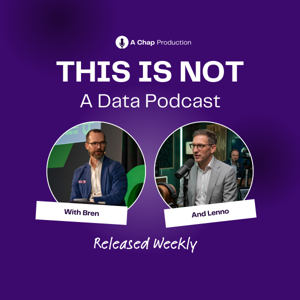


This week, Bren and Lenno ask whether security is finally the burning platform that data has been waiting for. When fridges across Europe were remotely switched from freezing to forty degrees, it showed how far an attack can travel down a supply chain.
Lenno shares a CISO’s firefighting analogy which perfectly captures the sentiment and makes us consider the question of who makes the call on what to save?
Most firms can’t simply burn down the platform and start again, and every department believes its own work is critical. Does protecting the business need a cross-departmental view, with functional leaders owning their processes and data from start to finish?
Takeaways
Chapters
This week, Bren and Lenno get into what we lose when AI starts doing our thinking for us. Lenno is seeing more and more slick, AI generated slides at work, and they leave him disengaged rather than inspired.
The tells are everywhere. Documents that look polished until you read them, a LinkedIn chat that turned out to be a bot, AI singers who never stop to breathe. One keynote speaker called AI the intellectual GPS of our generation, and like satnav, most of us follow it without checking if it’s right.
The harder question is accountability. When a Dutch Prime Minister was caught posting AI content, it was his credibility that took the hit, not the tool’s. “AI did it” isn’t an excuse once you’ve hit send.
In a world moving this fast, authenticity might be the one thing that still makes a leader stand out.
Takeaways
Chapters
This week, Bren and Lenno ask why so many stuck projects appear to be as a result of people problems.
Lenno’s programme was blocked, with every supplier working to their own contract and their own reading of the documentation. Then he found them all at the same event, opened his laptop at one booth, dialled in the next, and got them solving it together. Within days the updates started flowing.
Bren brings it back to South Africa, where the checkpoint crews shouting his name did more for him than any screen could. Would 100 metres of Zoom calls have had the same effect?
The harder question is what happens to trust as more of our work goes virtual and AI writes more of our messages. Their answer is to meet people properly first, because a relationship started face to face is the one that picks up the phone later.
Takeaways
Chapters
This week, Bren and Lenno ask whether data leaders need to be in the code, or whether the job is something else entirely.
Lenno shares why vibe-coded output makes him want to understand code well enough to check it, and why a team of five pulls him closer to the detail than a team of 140 ever did. Bren, an accountant by trade, admits he's never written code and has always wondered when he'd be found out.
They land on the harder question. If specialist work and leading people are different muscles, why do so many companies still treat management as the only way up?
Their answer keeps coming back to trust, and whether your team picks up the phone when things go wrong.
Takeaways
Chapters
This week, Bren and Lenno, ask what happens when we rename things that already had an established name. Yes, here's looking at you "super intelligence"...
Lenno tells the story of how a team renaming an SAP table in plain business terms made data easier to read and harder to build on. Whilst Bren recalls a business that had seven names for the same report.
The bigger question starts with governance and both discussion how agrees what the words mean and how much of it does a business actually need?
Their answer keeps coming back to one word.
Takeaways
Chapters
This week Bren is joined by guest Jamie Fry as Lenno is enjoying some well-earned time off. Jamie runs the Hawkfry Group, a consortium of senior cloud and data specialists, as the conversation dives into the real returns made on using AI.
Jamie puts a real number on it and explains where his teams lean on AI the most. But the real question is where does the human still have the biggest impact?
The discussion looks at the conundrum faced by AI speeding up the technical work but the human work being a bottleneck. And what should companies do to get started with AI?
It's a cracker as we learn the revenue uplift this year for the Hawkfry group from AI and why Jamie has taken more holidays now than the previous 3 years.
Hawkfry Group: https://hawkfry.com/
Jamie Fry Linkedin: https://www.linkedin.com/in/fryjamie/
Takeaways
Chapters
This week, Bren and Lenno are still reminiscing about the CXO Data Summit in Crete, but they dive straight into a question that follows them into every boardroom...what does "data first," "AI first," or "cloud first" actually mean?
Lenno questions whether it's really just about fixing whatever's in front of you and calling it a plan. And Bren lays out his theory that 80% of businesses are successful enough to never really need to change, so they throw money at data and AI initiatives without ever fully believing in them.
The episode revolves around what really drives change, and what happens to the companies that keep buying the buzzwords instead of tackling problems?
Takeaways
Chapters
This week, Bren and Lenno are joined by Peter Laflin, a chief data officer who's spent the summer researching what it takes for neurodivergent leaders to thrive in data and AI teams.
Peter shares what he's learned about building high-performing teams and creating genuinely inclusive environments for neurodivergent individuals.
The conversation also touches on the leadership challenges and opportunities in managing a neurodiverse team. One question stands out...how many teams have been quietly built in one leader's image, filtering out the very differences that would have solved their hardest problems?
This is a conversation about building teams that think differently on purpose, not by accident.
Takeaways
Chapters
This week, Bren and Lenno record face-to-face for the first time at the CXO Data Summit in Crete, on what makes a transformation succeed.
Lenno tells the story of the first SAP program, one that had to be pulled apart mid-flight. This painful lesson meant the next one, built on those battle scars, came in pain-free, on time and under budget.
That's the essence of the episode...real capability comes from getting it wrong first. So what happens when AI removes the junior roles where those mistakes used to be made before becoming a data leader?
Takeaways
Chapters
This week, Bren and Lenno are joined by their first guest, Alberto Gonzalo Otero, a purpose coach who helps leaders and teams reconnect daily work with why they do it.
Alberto talks through the power of "why," the questions he uses to get people past surface answers like money, and the team assessment he built to measure purpose and psychological safety alongside trust and clarity.
The conversation also looks at courage and the relationship with purpose, and why staying in a role that doesn't fit your purpose is usually the bigger risk.
They discuss how understanding and aligning with your purpose can lead to greater fulfilment, better decision-making, and navigating technological changes like AI.
Guest
Alberto Gonzalez Otero - https://www.linkedin.com/in/albertogotero/
Chapters
00:00 Introduction to Alberto Gonzalo Otero and Purpose
00:59 What is Purpose and Why It Matters
03:04 Purpose During the COVID-19 Pandemic
05:03 AI, Technology, and the Future of Work
07:05 The Midlife Crisis and Purpose
08:07 Purpose Across Generations
09:01 The Impact of AI on Jobs and Society
10:57 Using Purpose to Make Better Decisions
13:12 The Role of Leadership and Team Dynamics
15:57 The Value of Purpose in Innovation and Technology
20:09 Balancing Technology and Human Values
24:05 Aligning Work with Personal Purpose
28:04 The Power of Asking 'Why' and Purpose
32:58 Team Dynamics and Purpose
37:08 The Courage to Follow Your Purpose
41:09 Overcoming Societal and Personal Barriers
43:57 Practical Steps to Discover Your Purpose
44:55 Closing Remarks and Final Thoughts
From the publisher's feed
We get too bogged down in thinking data is the be all and end all. It's all nonsense. The real power is when people bring it to life.
That's what this podcast is all about. Data…