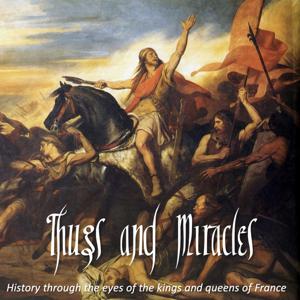
This week, welcome to Charles “The Hammer” Martel. I’ll be honest, up until this point you would be excused if you hadn’t heard of most of the names we’ve covered on this show. Clovis, Chlothar, Brunhilda, Fredegunda and Theuderic are not exactly household names; hell, even in France, the name of Dagobert is really mostly remembered because of the nursery rhyme associated with him and putting his pants on backwards. Charles Martel, however, is a name that most people are at a minimum aware of, and for many, the name is quite well known.
With that said, however, I offer a disclaimer: Charles Martel, as we’ll see in just a few episodes, is best known for his defeat of the Saracens at the Battle of Poitiers in 732. It is because of this victory that many far-right groups in our current day and age have appropriated the memory of Charles Martel as a symbol of armed resistance to “invaders.” This has sickeningly manifested to a point wherein the Christchurch, New Zealand, perpetrator of two mosque shootings claimed to have been inspired by Charles Martel, and in the United States, the Charles Martel Society is an American white nationalist organization that is apparently quite active to this day. Honestly, I found a few things in the research that turned my stomach, so be careful and be aware if you decide to look up things about Charles yourself. Beyond that, let me just say right now that we think that the entire notion of white extremism is gross, reprehensible and idiotic, so if you’re here in the hopes of hearing us glorify Charles Martel as some sort of medieval protector of whiteness, well, you’ve come to the wrong place. You’re gross and reprehensible, and you can go away; to paraphrase signs from what you probably think was a “better time”: we don’t serve your kind here.
Okay, moving past that unfortunate disclaimer, let’s look at the actual history of the man who would come to be known as “the Hammer.” And let’s start with that awesome, WWE-like surname. Here’s the thing: it actually is a WWE-like surname that was bestowed on Charles, especially after his victory in Poitiers in 732. At the time we’re talking about Charles in the opener he would have simply been known as Charles, a 26-year-old last-best-hope to keep Austrasia from being wiped off of the map altogether.
* * *
Links to social media and the website:
Listenable: History of the Merovingians, 451-613
Site: https://www.thugsandmiracles.com/
Email: [email protected]
Twitter: @thugsandmiracle (with no “s” on the end)
Facebook: @ThugsAndMiracles
Instagram: @ThugsAndMiracles
YouTube: Thugs and Miracles
Patreon: Who We Support