
Sign up to save your podcasts
Or



This episode explores how the umbrella evolved from a symbol of power into an everyday tool of protection. In ancient civilizations like Egypt and China, early umbrellas were parasols used to block sunlight and signify status, often carried by servants for royalty. They were decorative and symbolic rather than practical.
The transformation began when Chinese craftsmen developed waterproof versions using oiled paper, allowing umbrellas to protect against rain. However, in Europe, umbrellas were initially unpopular and even mocked — especially for men. It wasn’t until the 18th century, when Jonas Hanway began using one publicly despite criticism, that social attitudes started to shift.
Over time, improvements in materials and design made umbrellas lighter, foldable, and more accessible. They became widely used in cities, allowing people to move freely regardless of weather. Beyond function, umbrellas also became fashion accessories and cultural symbols, often associated with elegance, romance, and personal expression.
The umbrella’s true impact lies in its portability — giving individuals the ability to carry their own protection. Instead of avoiding the weather, people could continue their daily lives uninterrupted.
A simple object, the umbrella represents a quiet shift in human behavior: from adapting to nature, to shaping a small space of comfort within it.
This episode explores how the wheelbarrow transformed human labor by allowing one person to move heavy loads efficiently. Before its invention, most work depended on physical strength — people carried materials by hand, limiting how much could be transported and slowing construction and agriculture. Even with carts, movement required animals and open space.
The wheelbarrow, first developed in ancient China during the Han Dynasty, introduced a powerful idea: balance the load over a single wheel so that most of the weight is carried by the machine, not the person. This allowed individuals to move far heavier materials with less effort. Later, medieval Europe developed a front-wheel version optimized for construction and farming tasks.
By increasing efficiency, the wheelbarrow accelerated building projects, expanded agriculture, and supported military logistics. It allowed societies to do more with fewer workers, freeing people for specialized roles and contributing to the growth of complex civilizations.
At its core, the wheelbarrow demonstrates the power of leverage — replacing brute strength with smart design. Its simple structure has remained largely unchanged for centuries, proving its effectiveness.
A small, humble tool, the wheelbarrow quietly multiplied human capability — turning individual effort into large-scale progress.
This episode explores how the compass transformed human exploration by giving travelers a reliable sense of direction. Before its invention, sailors and travelers relied on natural cues such as the sun, stars, coastlines, and landmarks. These methods worked only under clear conditions, making long-distance journeys risky and limiting exploration beyond familiar territories.
The compass originated in ancient China, where scholars discovered that lodestone, a naturally magnetized mineral, consistently aligned itself in a north–south direction. By the 11th century, Chinese sailors began using magnetized needles for navigation, allowing ships to determine direction even when the sky was cloudy or land was out of sight.
As the compass spread to the Islamic world and Europe, it revolutionized maritime travel. Sailors could venture into open oceans with confidence, making long voyages possible and helping launch the Age of Exploration. This led to global trade networks, cultural exchanges, and the connection of distant civilizations.
Over time, the compass became part of a broader system of navigation alongside maps, sextants, and later GPS technology. Yet its basic principle remains unchanged: using Earth’s magnetic field to reveal direction.
More than a navigational tool, the compass expanded human ambition. By providing a stable reference point, it allowed people to travel beyond the limits of sight and memory — guiding humanity toward a truly global world.
This episode explores how the candle transformed human life by turning nighttime into usable time. Before portable lighting, darkness ended most daily activities. While fire existed in hearths and torches, it was large, smoky, and difficult to move, limiting what people could do after sunset.
The invention of the candle — a simple combination of solid fuel and wick — created the first reliable portable flame. Early candles made from animal fat (tallow) allowed ordinary households to extend work, cooking, and social life into the evening. Wealthier communities used cleaner-burning beeswax candles, which became important in religious ceremonies and symbolized purity and knowledge.
Candles also played a crucial role in intellectual history. Scholars, monks, and writers often worked by candlelight, allowing reading, writing, and study to continue long after daylight. In some cultures, candles even served as early timekeeping devices, marked to measure the passing hours.
Later innovations in materials like spermaceti and paraffin improved candle quality and mass production. Although electric lighting eventually replaced candles as the primary source of illumination, candles never disappeared. Today they remain important in rituals, celebrations, and moments of reflection.
The candle’s true revolution was portability. By allowing light to travel with people, it extended the human day and helped civilization grow beyond the limits of sunlight.
This episode explores how the invention of the wheel transformed human civilization by overcoming the physical limits of carrying and dragging heavy objects. Before the wheel, progress depended on strength — transporting goods, building structures, and traveling long distances required enormous human or animal effort, keeping communities small and isolated.
The earliest wheel appeared as a potter’s wheel in Mesopotamia around 3500 BCE, introducing the idea that motion could replace force. The real breakthrough came with the axle, allowing platforms to roll instead of scrape against the ground. This drastically reduced friction and made transportation efficient, enabling trade, agriculture expansion, and larger settlements.
The wheel led to the creation of roads, connecting regions and supporting specialization and commerce. It also made large empires possible by allowing supplies and communication to move across long distances. Over time, the principle of rotation inspired machines such as mills, gears, clocks, and eventually engines and generators — forming the mechanical foundation of the modern world.
More than a transport device, the wheel changed human thinking: instead of working harder, people could design smarter solutions. By turning movement into efficiency, the wheel allowed civilization to grow beyond local limits.
A simple rotating circle became the invisible engine of progress — a small invention that made human ambition scalable and set the world in motion.
This episode explores how the simple act of standing in line transformed social behavior by introducing fairness among strangers. Before queues existed, access to services was chaotic — the strongest, fastest, or highest-status individuals were served first, while others were ignored. Order depended on power rather than equality.
As cities and commerce grew in early modern Europe, especially with railways and busy shops, societies needed a peaceful system to manage crowds. The solution became “first come, first served.” The queue turned waiting into a shared sacrifice, replacing competition with patience and predictability.
Psychologically, people accept long waits if the process feels fair, but react strongly when someone cuts ahead. The queue therefore builds trust between strangers, temporarily placing everyone under the same rule regardless of status or wealth.
Over time, the concept expanded beyond physical lines into waiting lists, call centers, reservation systems, and digital progress bars — all forms of virtual queues. Civilization quietly depends on this shared understanding to avoid constant conflict in daily public life.
The queue has no single inventor, yet it became a powerful social agreement. By teaching people to wait their turn, it enabled cooperation in crowded societies — a small behavioral invention that replaced force with fairness.
This episode explores how the calendar transformed human society by allowing people to share and coordinate time. Before calendars, humans lived by natural cycles — daylight, seasons, and weather — but these varied by location and made large-scale planning impossible. Communities could not reliably schedule travel, trade, agriculture, or gatherings.
Early societies first used the moon to measure months, but lunar calendars drifted away from the seasons. Ancient Egyptians created a 365-day solar calendar tied to the Nile’s flooding, making agriculture predictable. Later, Julius Caesar introduced the Julian calendar to standardize time across the Roman Empire, enabling coordination over vast distances.
Because the Julian system was slightly inaccurate, the Gregorian reform in 1582 corrected the drift and established the calendar most of the world still uses today. At that moment, timekeeping became globally synchronized.
Calendars reshaped daily life by creating workweeks, holidays, deadlines, school schedules, contracts, and birthdays. They allowed long-term planning and turned human experience into a shared timeline, making history and future planning possible.
Although calendars can create pressure through schedules and deadlines, they also unite people emotionally — allowing shared celebrations like New Year’s and anniversaries.
The calendar did not change time itself; it changed cooperation. By giving humanity a common “today,” it enabled civilization to function together — a small invention that organized the entire human world.
This episode explores how the mirror transformed human self-awareness, identity, and culture. For most of history, people had no clear way to see their own faces. Reflections in water or polished metal were rare, distorted, and unreliable. Only wealthy individuals in ancient civilizations could access crude metal mirrors, leaving most people unaware of their true appearance.
The major breakthrough came in 15th-century Venice, where Murano glassmakers perfected high-quality glass mirrors backed with reflective metal. These mirrors were so valuable that their production secrets were closely guarded. For the first time, people could clearly observe themselves, practice expressions, adjust their appearance, and study their aging.
As mirrors became more affordable in later centuries, they spread into ordinary homes, shops, and public spaces. This changed social behavior, fashion, hygiene, and personal presentation. People became more conscious of how they looked and how others perceived them.
Psychologically, mirrors played a crucial role in human development by helping children recognize themselves and form a sense of identity. In art and literature, mirrors became powerful symbols of truth, illusion, and self-examination.
In the modern world, mirrors and digital screens surround us, shaping how we monitor, compare, and present ourselves. While they help with health, learning, and coordination, they also create pressure and self-judgment.
Ultimately, the mirror represents a tiny revolution that taught humanity to see itself — not only physically, but emotionally and philosophically — changing how people understand who they are.
This episode explores how the eraser quietly transformed learning, creativity, and human confidence by making mistakes reversible. For most of history, errors in writing, carving, and drawing were permanent and costly, discouraging experimentation and risk-taking. Being wrong often meant embarrassment or failure.
Before modern erasers, people removed pencil marks using bread crumbs, an unreliable and messy method. In 1770, English engineer Edward Nairne accidentally discovered that natural rubber could cleanly erase graphite. He began selling rubber “rubbers,” introducing the first true erasers. Later, in 1839, Charles Goodyear’s discovery of vulcanization made rubber durable and affordable, allowing erasers to become widely available and long-lasting.
With reliable erasers, learning changed dramatically. Students could try, fail, and try again without fear. Creativity flourished as artists, engineers, and writers used erasers to refine their work. Mistakes became part of the process rather than signs of weakness.
The eraser also shaped modern technology, inspiring the “undo” and “delete” functions in digital tools. Its philosophy — that nothing should be final too soon — remains central to how people work today.
More than a simple tool, the eraser represents psychological safety. It teaches that failure is not the end, but feedback. By allowing errors to be corrected, the eraser gave humanity permission to learn, improve, and grow — one erased line at a time.
This episode explores how the pencil transformed human thinking by making mistakes acceptable and creativity flexible. For much of history, writing was permanent — carved in stone or fixed in ink — making errors costly and discouraging experimentation. The pencil changed this by allowing ideas to be written lightly, erased, and revised.
The story begins in 16th-century Borrowdale, England, where pure graphite was discovered and soon wrapped in wood to create the first pencils. Initially rare and valuable, pencils became widely accessible after French engineer Nicolas-Jacques Conté developed a method of mixing graphite with clay, allowing pencils of different hardness to be mass-produced.
As pencils spread, they reshaped education, engineering, art, and science. Students could learn without fear, architects could revise designs, scientists could test ideas freely, and writers could draft without committing to permanence. The addition of the eraser reinforced a new mindset: mistakes were part of the process, not proof of failure.
Even in the digital age, pencils remain essential because thinking is rarely final. They require no power, respond instantly, and physically reflect effort as they wear down with use.
The pencil’s true revolution lies in its impermanence. By allowing ideas to change, it taught humanity that progress comes not from certainty, but from the freedom to rethink, revise, and begin again.
From the publisher's feed
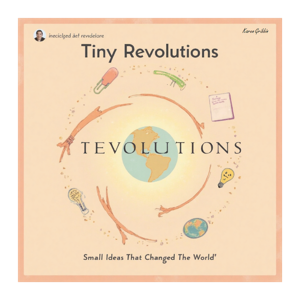
Sometimes, the smallest ideas spark the biggest changes. Tiny Revolutions is a podcast about the humble inventions, unnoticed habits, and small flashes of creativity that quietly…
Each episode reveals the story behind a seemingly simple idea: who created it, how it spread, and why it changed the world in ways no one expected. Blending history, creativity, and everyday life, this series celebrates the inventors, thinkers, and even accidents that made our daily world what it is today.