
Sign up to save your podcasts
Or



How do teachers, students and researchers carry on in a time of war. In February 2022, Russia invaded Ukraine, and life changed overnight.
Dniprotech University, in Dnipro, is in an area that has experienced power outages, bombing, drones and jets flying over. Yet, they have maintained a full education programme – utilising blended learning – and continue to build relationships with business and with international partners.
We spoke to Kseniia Tiukhmenova, Olena Krasovska and Tetiana Kuvaieva, from Dniprotech, in late 2025 about how they are operating in such a difficult situation.
Lancaster is twinned with Dniprotech as part of Universities UK’s Twin for Hope initiative, supporting Ukrainian universities through the crisis in matters relating to the brain drain, resilience, research, skills and knowledge exchange. We learn how this works, and the benefits both sides are gaining from the new relationship – even if our guests are too polite to admit they had not heard of Lancaster before the partnership started!
We find out about how a university in the industrial heart of Ukraine has grown and developed, how it has built expertise around sustainability, the enthusiasm of students for these topics, and the setting up a new rival (or partner) to the Pentland Centre.
Kseniia, Olena and Tetiana tell us about the power of universities in uniting people in a time of war, the importance of relationships with business, and the strength they gain from their endeavours now as they plan for post-war recovery.
Plus, Paul finds something positive to say about rankings, Jan smiles as the word benchmarking comes up unprompted, and there is talk of the legendary status of Ukrainian soil.
Find out more about the Twin for Hope initiative here: https://www.universitiesuk.ac.uk/what-we-do/creating-voice-our-members/campaigns/twinforhope-uk-universities-standing
Episode Transcript
What do you think of the economy? What would you do if you couldn’t afford insurance? What does a thriving community look like? And how can economic policy help that flourishing? These are all key questions when it comes to addressing societal equality and resilience.
Susan Murray is Director of the David Hume Institute, an Edinburgh-based economics-focused thinktank – despite not classing herself as an economist.
She joins us to talk about the importance of diversity in economic thinking, how resources are allocated across society, the changing nature of migration over the last 40 years, and three major projects the David Hume Institute is involved in.
We discuss the importance of local communities and place in contributing to shaping action and policy, how to reach and include ‘normal people’ in otherwise ignored places, the importance of recognising what we all have in common, and what it actually means to be thriving.
Susan introduces us to the Great Risk Transfer, how people consider risk in their own lives, the importance of having resources to manage those risks, and why people don’t always trust organisations such as insurance providers.
We look at public attitudes towards the economy and how they change; what people wanting to save rather than spend can tell us; and how economic and sustainability issues tie in with politics at a national level.
Plus, we discover how sustainability became a part of Susan’s life when she was young – via the media of Blue Peter and Raymond Briggs, the cause of Save the Whales, and under the threat of nuclear war.
And finally, we ask the important questions: When is an economist not an economist? What’s the difference between an accountant and an economist? Do accountants and economists ever walk into bars together? To hear if we ever get to the punchlines of these and other bad economics jokes, listen in.
To find out more about the David Hume Institute, visit: https://davidhumeinstitute.org/
Episode Transcript
We talk to a lot of researchers and businesspeople about sustainability, now bring on the politician!
On our 100th episode, we welcome Nik Nazmi bin Nik Ahmad, the former Minister of Natural Resources and Environmental Sustainability in the Malaysian government, to tell us about his career, and how he has seen governments around the world tackle sustainability challenges.
Nik has gone from the self-professed school geek to being an elected legislator in his homeland, a minister in government, and a part of major international climate meetings such as COP. Now he gets to take part in our podcast centenary celebrations.
Discover how the environment sits in the political world; how the youth voice and voters can be influential on politicians – and the risk for government of ignoring them and climate change issues; and the power of the people in making an impact in saving the planet.
Niks tells us about the major issue of waste – both plastic and electronic – in Malaysia, and how the world contributes to the issue; the attitudes across ASEAN to waste, and the challenges of finding a common voice; and his views of the attitudes of some leading global politicians that climate change is hokum.
We discuss whether Jan is the Kevin Bacon of the sustainability world – and discover Jan’s shocking lack of knowledge of Mr Bacon’s career; the parallels between BBC sitcom Yes Minister and real life; and how Nik has learned a lot from groundbreaking politicians from around the world.
Discover Nik’s book Saving the Planet here: https://www.penguin.sg/book/saving-the-planet/
And Nik even has his own Wikipedia page, so you can find out more about him here: https://en.wikipedia.org/wiki/Nik_Nazmi
Episode Transcript
Do you know your Omega 3 fatty acids from your Ultra Processed Foods? Your salmon from your sardinella? Dive in, as we look at the importance of seafood to the diets of millions of people – and how global industries and consumption patterns are taking it away from those who really need it.
Professor Christina Hicks, from Lancaster Environment Centre, is a leading expert on fisheries – particularly in Africa – and the broader food system, and she gives us an introduction to the global trade in nutrients. Her work in West Africa shows how fish provide otherwise unavailable nutrients in places where plants make up the bulk of the diet.
While in the UK seafood is recommended as part of a wider diet, in these countries it is a key source of micronutrients and protein for the population – especially those who are less well-off.
Find out the effects of fish farming and the fishmeal industry on ecosystems; the health, environmental, economic and social impacts of moving from local economies of fishers in canoes to bigger boats and factories owned by companies in countries thousands of miles away catching these fish; and the difficulties in policing fishing regulations designed to protect local waters.
We discover how large corporations build a presence on the Senegal coast – and how it is hard to uncover the ownership of vessels fishing in West African waters; the gender-related effects of machines replacing workers; why Jan is a big fan of haddock; and whether Christina will become a supervillain!
Plus, is there anything you can do as a consumer to help solve the problems?
See here for more details on Christina and her work: https://www.lancaster.ac.uk/lec/about-us/people/christina-hicks
Find out more about the People and the Ocean Knowledge and Action Hub of the Pentland Centre here: https://www.lancaster.ac.uk/pentland/activities/knowledge-and-action-hubs/people-and-the-ocean/
Episode Transcript
For a podcast from a nation obsessed with the weather, we’ve been remarkable restrained in discussing it so far. No more! We’re going full-on into weather forecasting and measurement, to discover what Lancaster can tell us about the world.
Dr James Heath, from Lancaster Environment Centre, is one of the team taking daily readings from the Hazelrigg Weather Station, which measure temperature and rainfall, and contributes to long-term Met Office records. He has always been obsessed with the weather, and recent years have brought a lot to think about in his role.
We learn about Hazelrigg’s origins; James’s family links to the Met Office – and the lack of Bill Giles and Michael Fish at mealtimes; why the way we manually measure the climate in the long-term has not changed in decades; and discover what the term ‘since records began’ when we hear about record-breaking weather events.
Find out the limits of weather stations when it comes to recording patterns beyond a small geographic area; the differences between the weather and the climate; and the changes Hazelrigg has tracked that are reflected across the globe – both for heat and for rainfall levels.
Plus, are the Norwegians – and their natural gloom – really so much better at forecasting weather in Lancaster? Is Jan always such a slacker when it comes to homework?
See links to the Hazelrigg Weather Station here: https://www.lancaster.ac.uk/environmental-science/facilities/
Read about the record breaking weather patterns from spring 2025 here: https://www.lancaster.ac.uk/news/lancaster-scientists-measure-record-breaking-spring-weather
And find out more about the lawnmower aurora incident here: https://www.bbc.co.uk/news/technology-37168678
Episode Transcript
Words matter. How you use them when you want to get your sustainability messaging across is key – especially when fossil fuel companies spend billions on advertising.
As we wonder whether sustainability is even the right word to reach right audience, Florencia Lujani, co-founder and Strategy Director of ACT Climate Labs, joins us to talk about language and communication in winning the battle.
Florencia works with the likes of Greenpeace and Friends of the Earth, bridging creativity and strategy to drive their messages home. She talks us through the campaigns ACT have worked on to shift attitudes and behaviours around the world – from Brazil to the West Midlands.
We learn about the Persuadables – the crucial middle ground of the population who believe in climate change but need to be drawn into action or change and away from climate denial. And we take optimism from companies continuing to pursue sustainability plans despite any changes in the political winds.
Florencia tells us about the key to effective advertising, the problem of false messaging, and the trap of communicating only with those who are already convinced – leaving other to think action is ‘not for people like me’. And she moves from local communities to the United Nations, working across all levels of society.
Paul admits his bafflement at the non-stop stream of sustainability messaging he is exposed to on his way to work. Jan’s pub discussions are in the spotlight. Roger Moore and Tony Curtis get long-overdue praise. And Jan struggles to accept Paul’s assertion she is an extremist.
For more details on the Overton Window concept, which is definitely nothing to do with stained glass, see here: https://www.mackinac.org/OvertonWindow
And find out more about ACT Climate Labs here: https://www.actclimatelabs.org/
How can net zero be built into major projects? Does being a trend setter in this area make it harder – but easier for those who follow?
Anna Cockman, Head of Estate Development (Project Delivery) at Lancaster University, was once the hands of BBC2 (really), but is now overseeing a huge project to build the Net Zero Energy Centre.
After discovering exactly what project management is, we discuss the challenges universities face when it comes to declaring a climate emergency, and achieving Net Zero targets, and how approaches to sustainability in project management have changed in recent years.
We discuss the importance of messaging for major construction projects and their impacts, the challenge – and criticality – of carrying out life carbon assessments, and find out what the Net Zero Energy Centre is and how it will impact Lancaster’s carbon footprint.
Among the big questions, we ask: Is Jan good at managing projects? How niche can specialist topics be on Mastermind? And, is watching energy silos being delivered a good use of your weekend?
We reminisce over old BBC trailers, Jan offends Australians (again), Paul discovers the person responsible for his workplace conditions, Anna bemoans the impact of The Apprentice on the image of project managers, and Shortland Street gets some more well-earned publicity.
Read an outline of Lancaster University’s Net Zero Energy Project here: https://www.lancaster.ac.uk/facilities/estates/net-zero-energy-project/
And find more background on Lancaster University’s approach to sustainability here: https://www.lancaster.ac.uk/sustainability/annual-report/
Episode Transcript
Broadsword calling Danny Boy. We’re going where eagles dare to investigate the sad fate of beautiful birds of prey in 19th century Scotland.
A concerted effort to hunt golden eagles led to a massive reduction in their numbers in the 1800s. But why were they persecuted? And what can we learn from how many were killed to tell us how many there used to be?
Jason Harrison, who combines being a PhD researcher at Lancaster University with being Jan’s husband, joins us to discuss his work on sustainable mountain development in Scotland, and the eagles who live there in particular.
We discover what was happening in the Scottish Highlands when the eradication efforts stared, skirt around the politics of the Highland Clearances, talk about why landowners wanted rid of eagles (and foxes), and how they drove golden eagles from their habitats.
Valuable bounties were offered on eagles, their chicks and eggs – and you needed gruesome proof to claim the rewards – and it led to up to 75% of the population being wiped out. This is a tale of man against beast, where man was the definite victor, and where – to Jan’s delight – accounting record keeping is the key to understanding historical biodiversity baselines.
We discuss how place names can tell us where eagles used to nest; look at the status of the birds in Scotland and England today – and how the fate of England’s hen harriers now harks back 200 years; and wonder why there is no specific Sustainable Development Goal for mountains.
How do Wordsworth and the Lord of the Rings fit into all this? And what’s the story with Balamory?
Discover more about the University of the Highlands and Islands’ Centre for Mountain Studies here: https://www.perth.uhi.ac.uk/subject-areas/centre-for-mountain-studies/
And see the paper by Agetsuma on estimating previous populations from hunting data: https://journals.plos.org/plosone/article?id=10.1371/journal.pone.0198794
Episode Transcript
How can courts enforce the right to a healthy environment? And how are international courts, individuals and companies shaping the laws that will affect our futures?
It’s time for us to bring the law back to Transforming Tomorrow, to look at how the legal system is evolving as the climate is changing.
Camilo Cornejo Martinez, a PhD researcher in Lancaster University School of Law, joins us once again to discuss how verdicts and advisory opinions from across Europe, the Americas, and the world are shaping nations’ attitudes and behaviours.
We look at how the courts view the impact of human activity on the seas, the responsibilities of states when it comes to climate change, why even advisory opinions – and we explain what those are – have weight in courtrooms and law-making, and ask how does denouncing climate treaties affect a country’s legal position?
We discover how a group of students from Pacific states have made a major impact on international rulings; the obligations of nations to abide by the likes of the Kyoto Protocol – whether or not they signed the agreement; and how the International Court of Justice has surprised even the most optimistic climate lawyers with their opinions.
Plus, pirate courts!
Discover more about Camilo and his work here: https://www.lancaster.ac.uk/pentland/about/meet-the-team/camilo-cornejo-martinez
And these are links to explanations about the various cases and advisory opinions that we discussed with Camilo:
Klimaseniorinnen case from the European Court of Human Rights (April 2024) - https://www.netzerolawyers.com/news-events/failure-to-act-on-climate-change-violates-human-rights-the-klimaseniorinnen-case
Advisory Opinion on Climate Change from the International Tribunal for the Law of the Sea -ITLOS- (May 2024) - https://www.biicl.org/blog/77/a-commentary-on-itlos-advisory-opinion-on-climate-change
Advisory Opinion on Climate Change from the Inter-American Court of Human Rights (July 2025) - https://blogs.law.columbia.edu/climatechange/2025/07/08/a-blueprint-for-rights-based-climate-action-the-inter-american-court-of-human-rights-advisory-opinion-on-the-climate-emergency/
Advisory Opinion on Climate Change from the International Court of Justice (July 2025) - https://commonslibrary.parliament.uk/research-briefings/cbp-10354/
Episode Transcript
It’s time to go back to outer space – and to explore another frontier region – as we push the boundaries of sustainability in new directions.
We bring together Donald Trump, satellites, Greenland, rocket launches, polar bears – and penguins – to explore the connections between the Arctic and Outer Space.
Dr Mia Bennett, from the University of Washington, has seen a polar bear in Svalbard, but her expertise is on the indigenous people of the Arctic and how the space industry has grown in their homeland and affected their lives.
She tells us how her dreams of being an astronaut evolved into an interest in the Earth’s poles, and then the links between them in the forms of satellites, inter-continental missiles, and spaceports.
We go back to the origins of the connections between the Arctic and space, when stars were used to navigate and to monitor the seasons; how the threats of the Cold War turned the Arctic into a region to monitor space, and the impacts of this development on the land and the local peoples.
We discover how populations have been displaced and damaged by colonial and militaristic expansions, how land and sea have been polluted by radioactive waste, how food systems have been disrupted, and how Trump’s Greenland obsession fits into the bigger historical picture.
But we also learn how the growth in the satellite industry – particularly Elon Musk’s Starlink network – has brought jobs to new areas through ground stations in the harsh environs of the far north, and that there are other benefits for the indigenous communities as well.
Jan dredges up her worst snow-related puns, Paul ponders why he keeps forgetting Greenland is an island, and we ask, what is the perfect number of penguins in a fight?
Mia and Klaus Dodds have written a book about the future of the Arctic, Unfrozen: The Fight for the Future of the Arctic. Discover it here: https://yalebooks.co.uk/book/9780300259995/unfrozen/
Read about the Outer Space Treaty here: https://www.unoosa.org/oosa/en/ourwork/spacelaw/treaties/introouterspacetreaty.html
And find out more about Mia and her work here: https://www.cryopolitics.com
Episode Transcript
From the publisher's feed
Sustainability is a key consideration for any contemporary business, from biodiversity to modern slavery, seabeds to factory floors. Transforming Tomorrow guides you through the complex, ever-changing and often exciting (yes, really!!) world of sustainability in business.
Alongside members of the Pentland Centre, international research experts, and business leaders, we cover the theory and practice of mainstreaming sustainability into purposeful business strategy and performance.
Whether you are leading change in your business, or just want to know more about how space weather, human trafficking or architecture may influence the future of sustainability, Transforming Tomorrow is the show for you.
Taking you through it all, hosts Jan and Paul bring insight, perspective, and more than occasional disagreement to their topics.
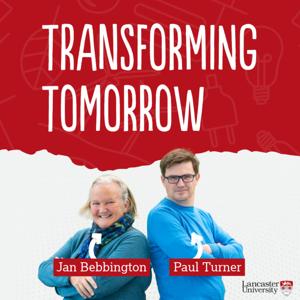
Professor Jan Bebbington is the Director of the Pentland Centre for Sustainability in Business at Lancaster University. Jan is an expert on accounting, benchmarking (to her co-host’s annoyance), and how business and sustainability intersect. She loves nature and wants to protect it – and hopes she can change the world (ideally for the better). She is also motivated to address inequality wherever it is found and especially to eliminate forced, bonded or child labour. Transforming Tomorrow is one small step on that quest.
Paul Turner is a former sports journalist who now works promoting the research activities in Lancaster University Management School – a poacher turned gamekeeper as his former colleagues would have it. He has always been interested in nature and the natural environment – it comes from growing up in Cumbria – and has been a vocal proponent of the work of the Pentland Centre since joining Lancaster University. He does not like rankings and benchmarking, and is not afraid to say so.
Join us every Monday to uncover new insights and become a little more inspired that you can make a difference in sustainability.