
Sign up to save your podcasts
Or

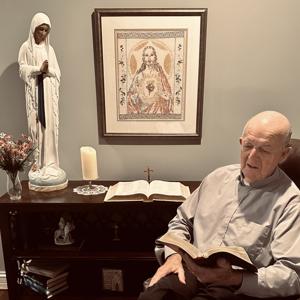


Today, January 20, as our church celebrates the optional Memorial of Fabian, Pope and Martyr, we are encouraged to read and reflect on a passage from the second letter of the apostle Paul to the Corinthians (4:7—5:8), entitled "The power of Christ is made manifest in our sufferings". Our treasure, which follows, is from a letter about the death of Saint Fabian, pope, by Saint Cyprian and the Roman Church.
Saint Fabian came to Rome after Pope Anteros died in 236. Being a farmer, a layperson, and not a very important one, he may have come for the same reason many still come to Rome today during a papal election: concern for the future of the faith, curiosity about the new pope, a desire to grieve for the pope who had passed. Seeing all the important people gathered to make this momentous decision must have been overwhelming. Which one would be the new pope? Someone known for power? Someone known for eloquence? Someone known for courage?
Suddenly during the discussion, a dove descended from the ceiling. But it didn't settle on "someone known" for anything at all. The dove, others said "settled on [Fabian's] head as clear imitation of the descent of the Holy Spirit in the form of a dove upon the Savior." There must have been something of the Holy Spirit working because everyone suddenly proclaimed Fabian as "worthy" to be pope and this stranger was elected. To us the dove signifies peace, and this dove was prophetic. Starting close to Fabian's election, the suffering and persecuted Church began a time of peace. The emperor, Philip, was friendly to Christians and not only was the persecution stopped but Christians experienced acceptance.
But, in a timeless story, the people who had always been in power were not happy to see the newcomers growing and thriving. There were many incidents of pagans attacking Christians and when Philip died so died the time of peace. The new emperor, Decius, ordered all Christians to deny Christ by offering incense to idols or through some other pagan ritual. In the few years of peace, the Church had grown soft. Many didn't have the courage to stand up to martyrdom. But Fabian, singled out by a symbol of peace, stood as a courageous example for everyone in his flock. He died a martyr in 250 and is buried in the Cemetery of Calixtus that he helped rebuild and beautify. A stone slab with his name can still be found there.
Saint Cyprian is important in the development of Christian thought and practice in the third century, especially in northern Africa. Highly educated and a famous orator, he became a Christian as an adult. He distributed his goods to the poor and amazed his fellow citizens by making a vow of chastity before his baptism. Within two years he had been ordained a priest and was chosen, against his will, as Bishop of Carthage.
Cyprian complained that the peace the Church had enjoyed had weakened the spirit of many Christians and had opened the door to converts who did not have the true spirit of faith. When the Decian persecution began, many Christians easily abandoned the Church. It was their reinstatement that caused the great controversies of the third century and helped the Church progress in its understanding of the Sacrament of Penance.
The Second Letter to the Corinthians is the most personal of all of Paul's extant writings, and it reveals much about his character. In it he deals with one or more crises that have arisen in the Corinthian church. The confrontation with these problems caused him to reflect deeply on his relationship with the community and to speak about it frankly. One moment he is venting his feelings of frustration and uncertainty, the next he is pouring out his relief and affection. The importance of the issues at stake between them calls forth from him an enormous effort of personal persuasion, as well as doctrinal considerations that are of great value for us.
On Monday of the Second Week in Ordinary Time our Church invites us to read and reflect on a passage from the book of Deuteronomy (4:1-8, 32-40) entitled "The words of Moses to the people". Our treasure, which follows, is from a letter to the Ephesians by Saint Ignatius of Antioch, bishop and martyr.
Saint Ignatius was a successor of Saint Peter as the bishop of Antioch. Condemned to death by being thrown to wild animals, he was brought to Rome for execution and was martyred there under the emperor Trajan in 107. On the journey to Rome, he wrote seven letters to different churches. In these he discussed Christ, the structure of the Church, and the Christian life in a manner at once wise and learned. At Antioch, this day was observed in his memory as early as the fourth century.
The book of Deuteronomy ends the five books of the Torah or Pentateuch with a retrospective account of Israel's past—the exodus, the Sinai covenant, and the wilderness wanderings—and a look into Israel's future as they stand poised to enter the land of Canaan and begin their life as a people there.
The book consists of three long addresses by Moses. Each of these contains narrative, law, and exhortation, in varying proportions. In an expansion of the first commandment of the decalogue, Moses tells the Israelites how to make a success of their life as a people once they are settled in the land. The choice presented to Israel is to love the Lord and keep his commandments, or to serve "other gods." That choice will determine what kind of life they will make for themselves in the land. Whichever choice they make as a people carries consequences, which Deuteronomy terms "blessing" and "curse." Thus, the book can be seen as a kind of survival manual for Israel in their life as a people: how to live and what to avoid. This gives the book its hortatory style and tone of life-or-death urgency.
On the Second Sunday in Ordinary Time our Church invites us to read and reflect on a passage from the beginning of the book of Deuteronomy (1:1, 6-18) entitled "The last words of Moses in Moab". Our treasure, which follows, is from a letter to the Ephesians by Saint Ignatius of Antioch, bishop and martyr.
Saint Ignatius was a successor of Saint Peter as the bishop of Antioch. Condemned to death by being thrown to wild animals, he was brought to Rome for execution and was martyred there under the emperor Trajan in 107. On the journey to Rome, he wrote seven letters to different churches. In these he discussed Christ, the structure of the Church, and the Christian life in a manner at once wise and learned. At Antioch, this day was observed in his memory as early as the fourth century.
The book of Deuteronomy ends the five books of the Torah or Pentateuch with a retrospective account of Israel's past—the exodus, the Sinai covenant, and the wilderness wanderings—and a look into Israel's future as they stand poised to enter the land of Canaan and begin their life as a people there.
The book consists of three long addresses by Moses. Each of these contains narrative, law, and exhortation, in varying proportions. In an expansion of the first commandment of the decalogue, Moses tells the Israelites how to make a success of their life as a people once they are settled in the land. The choice presented to Israel is to love the Lord and keep his commandments, or to serve "other gods." That choice will determine what kind of life they will make for themselves in the land. Whichever choice they make as a people carries consequences, which Deuteronomy terms "blessing" and "curse." Thus, the book can be seen as a kind of survival manual for Israel in their life as a people: how to live and what to avoid. This gives the book its hortatory style and tone of life-or-death urgency.
Today, January 17, as our Church celebrates the Memorial of Saint Anthony, abbot, we are first invited to read and reflect on a passage from the first letter of the apostle Paul to the Philippians (3:7---4:1, 4-9) entitled "Rejoice in the Lord always". Our treasure, which follows, is from the Life of Saint Anthony by Saint Athanasius, bishop.
St. Anthony was born in Egypt around the year 250.After his parents died, he distributed his property to the poor. He sold almost everything he had, leaving enough for his younger sister to live a good life. He went into the desert and became a hermit. After almost 30 years of living in solitude, he came back to provide guidance to a growing community of hermits, thus marking the beginning of modern-day monasticism. He attracted disciples and labored on behalf of the Church, giving support to believers during the persecution of Diocletian and assisting Saint Athanasius against the Arians. Most of what we know of Saint Anthony is from a book entitled the Life of Anthony, written by St. Athanasius shortly after St. Anthony's death in 356.
Saint Athanasius was born in Alexandria in 295. He accompanied Alexander to the Council of Nicaea and succeeded him as Bishop of Alexandria. He fought courageously against the Arian heresy. The Arian heresy taught that Jesus was not divine. For this he suffered many hardships and was exiled several times. His writings are outstanding in their explanation and defense of the true teachings of the faith. Saint Athanasius is a Doctor of the Church. He died in 373.
Philippians is written to a group of believers with whom Paul founded a church, during his second missionary journey in approximately AD 49. Philippi was a Roman colony, with believers consisting primarily of Gentiles. This letter, written about 12 years after the founding of the Philippian church, is largely a thank you letter to the Philippians. The main message of the Book of Philippians is for the Christian community in Philippi to be steadfast in faith and to express joy. Philippians is recognized as Paul's joyous epistle and is also known as the "friendship letter" because of its tone. However, because Paul wrote this letter during the time of house arrest in Rome, it includes the major theme of rejoicing during suffering.
On Friday of the First Week in Ordinary Time our Church invites us first to read and reflect on a passage from the book of Sirach (43:13-35), entitled.
"All creation gives praise to God". Our treasure, which follows, is from a Discourse Against Pagans by Saint Athanasius, bishop.
Saint Athanasius was born at Alexandria in 295. He accompanied Alexander to the Council of Nicaea and succeeded him as Bishop of Alexandria. He fought courageously against the Arian heresy. The Arian heresy taught that Jesus was not divine. For this he suffered many hardships and was exiled several times. His writings are outstanding in their explanation and defense of the true teachings of the faith. Saint Athanasius is a Doctor of the Church. He died in 373.
In Discourse Against the Pagans, Saint Athanasius argues that the world's order and beauty are evidence of God's existence. He says that if the world were irrational and random, people would be justified in disbelieving what is said. Instead, he argues that the world is founded on reason, wisdom, and science, and that it must owe its order to God.
The Wisdom of Ben Sira derives its title from the author, "Yeshua [Jesus], son of Eleazar, son of Sira". The author, a sage who lived in Jerusalem, was thoroughly imbued with love for the wisdom tradition, and for the law, priesthood, Temple, and divine worship. As a wise and experienced observer of life he addressed himself to his contemporaries with the motive of helping them to maintain religious faith and integrity through study of the books sacred to the Jewish tradition.
The book contains numerous well-crafted maxims, grouped by affinity, and dealing with a variety of subjects such as the individual, the family, and the community in their relations with one another and with God. It treats friendship, education, poverty and wealth, laws, religious worship, and many other matters that reflect the religious and social customs of the time. Written in Hebrew in the early years of the second century B.C., the book was finished by ca. 175. The text was translated into Greek by the author's grandson after 117 B.C.
Though not included in the Jewish Bible after the first century A.D., nor, therefore, accepted by Protestants, the Wisdom of Ben Sira has been recognized by the Catholic Church as inspired and canonical. The Foreword, though not the proper part of the book, is always included with it because of its antiquity and importance.
On Thursday of the First Week in Ordinary Time our Church invites us first to read and reflect on a passage from the book of Sirach (42:15---43:12), entitled "All creation gives praise to God". Our treasure, which follows, is from a Discourse Against Pagans by Saint Athanasius, bishop.
Saint Athanasius was born at Alexandria in 295. He accompanied Alexander to the Council of Nicaea and succeeded him as Bishop of Alexandria. He fought courageously against the Arian heresy. The Arian heresy taught that Jesus was not divine. For this he suffered many hardships and was exiled several times. His writings are outstanding in their explanation and defense of the true teachings of the faith. Saint Athanasius is a Doctor of the Church. He died in 373.
In Discourse Against the Pagans, Saint Athanasius argues that the world's order and beauty are evidence of God's existence. He says that if the world were irrational and random, people would be justified in disbelieving what is said. Instead, he argues that the world is founded on reason, wisdom, and science, and that it must owe its order to God.
The Wisdom of Ben Sira derives its title from the author, "Yeshua [Jesus], son of Eleazar, son of Sira". The author, a sage who lived in Jerusalem, was thoroughly imbued with love for the wisdom tradition, and for the law, priesthood, Temple, and divine worship. As a wise and experienced observer of life he addressed himself to his contemporaries with the motive of helping them to maintain religious faith and integrity through study of the books sacred to the Jewish tradition.
The book contains numerous well-crafted maxims, grouped by affinity, and dealing with a variety of subjects such as the individual, the family, and the community in their relations with one another and with God. It treats friendship, education, poverty and wealth, laws, religious worship, and many other matters that reflect the religious and social customs of the time. Written in Hebrew in the early years of the second century B.C., the book was finished by ca. 175. The text was translated into Greek by the author's grandson after 117 B.C.
Though not included in the Jewish Bible after the first century A.D., nor, therefore, accepted by Protestants, the Wisdom of Ben Sira has been recognized by the Catholic Church as inspired and canonical. The Foreword, though not the proper part of the book, is always included with it because of its antiquity and importance.
On Wednesday of the First Week in Ordinary Time our Church invites us first to read and reflect on a passage from the book of Sirach (24:1-22), entitled." Wisdom in creation and in the history of Israel". Our treasure, which follows, is from a treatise Against Heresies by Saint Irenaeus, bishop.
Saint Irenaeus was a late second century Greek bishop noted for his role in guiding and expanding Christian communities in the southern regions of present-day France and, more widely, for the development of Christian theology.
On Jan. 21, 2022, Pope Francis named a Saint Irenaeus as a Doctor of the Church. Although he has just now been named a doctor of the Church, St. Irenaeus has always been known as a brilliant and orthodox teacher of the faith. The documents of the Second Vatican Council cite 14 references to his work, and the Catechism of the Catholic Church cites him 29 times.
Pope Francis assigned St. Irenaeus the title "doctor of unity" for his efforts to unite the Church, which was competing against the heresy of Gnosticism. Gnosticism taught that the world was created and ruled by a lesser divinity, the demiurge, and that Christ was an emissary of the remote supreme divine being, esoteric knowledge (gnosis) of whom enabled the redemption of the human spirit.
Against Heresies is a work of Christian theology written in Greek about the year 180 by Irenaeus, bishop of Lyon in France. In it, Irenaeus identifies and describes several schools of Gnosticism, and other schools of Christian thought, whose beliefs he rejects as heresy. He contrasts them with orthodox Christianity.
The Wisdom of Ben Sira derives its title from the author, "Yeshua [Jesus], son of Eleazar, son of Sira". This seems to be the earliest title of the book. The designation "Liber Ecclesiasticus," meaning "Church Book," appended to some Greek and Latin manuscripts, is perhaps due to the extensive use the church made of this book in presenting moral teaching to catechumens and to the faithful. The title "Sirach" comes from the Greek form of the author's name.
The author, a sage who lived in Jerusalem, was thoroughly imbued with love for the wisdom tradition, and for the law, priesthood, Temple, and divine worship. As a wise and experienced observer of life he addressed himself to his contemporaries with the motive of helping them to maintain religious faith and integrity through study of the books sacred to the Jewish tradition.
The book contains numerous well-crafted maxims, grouped by affinity, and dealing with a variety of subjects such as the individual, the family, and the community in their relations with one another and with God. It treats friendship, education, poverty and wealth, laws, religious worship, and many other matters that reflect the religious and social customs of the time.
Written in Hebrew in the early years of the second century B.C., the book was finished by ca. 175. The text was translated into Greek by the author's grandson after 117 B.C. He also wrote a foreword which contains valuable information about the book, its author, and himself as translator. Until the close of the nineteenth century the Wisdom of Ben Sira was known to Christians in translations, of which the Greek rendering was the most important. From it the Latin version was made. Between 1896 and 1900, again in 1931, and several times since 1956, incomplete manuscripts were discovered, so that more than two thirds of the book in Hebrew is available; these Hebrew texts agree substantially with the Greek. One such text, from Masada, is pre-Christian in date. The New American Bible provides a critical translation based on the evidence of all the ancient texts.
Though not included in the Jewish Bible after the first century A.D., nor, therefore, accepted by Protestants, the Wisdom of Ben Sira has been recognized by the Catholic Church as inspired and canonical. The Foreword, though not the proper part of the book, is always included with it because of its antiquity and importance.
On Tuesday of the First Week in Ordinary Time our Church invites us first to read and reflect on a passage from the book of Sirach (11:12-28), entitled "Put your trust in God alone." Our treasure, which follows, is from the Detailed Rules for Monks by Saint Basil the Great, bishop.
Saint Basil the Great was a fourth century Church Father and a Doctor of the Church. Because of the majesty and keenness of his eloquence, he is honored as "the revealer of heavenly things" and "the Great". He was Bishop of Caesarea Mazaca in Asia Minor. He was an influential theologian who supported the Nicene Creed and opposed heresies of the early Christian church, especially Arianism. (Arianism taught that Jesus Christ was not divine). In addition to his work as a theologian, Saint Basil was known for his care of the poor and underprivileged.
Saint Basil the Great's detailed rules for monks, known as the Rule of Basil, emphasized:
Other aspects of the Rule of Basil include:
The Rule of Basil was a major source for the Rule of St. Benedict and was followed by some Western monasteries. It was first accepted by the monasteries of Cappadocia and gradually spread to the monasteries of the East.
The Wisdom of Ben Sira derives its title from the author, "Yeshua [Jesus], son of Eleazar, son of Sira". This seems to be the earliest title of the book. The designation "Liber Ecclesiasticus," meaning "Church Book," appended to some Greek and Latin manuscripts, is perhaps due to the extensive use the church made of this book in presenting moral teaching to catechumens and to the faithful. The title "Sirach" comes from the Greek form of the author's name.
The author, a sage who lived in Jerusalem, was thoroughly imbued with love for the wisdom tradition, and for the law, priesthood, Temple, and divine worship. As a wise and experienced observer of life he addressed himself to his contemporaries with the motive of helping them to maintain religious faith and integrity through study of the books sacred to the Jewish tradition.
The book contains numerous well-crafted maxims, grouped by affinity, and dealing with a variety of subjects such as the individual, the family, and the community in their relations with one another and with God. It treats friendship, education, poverty and wealth, laws, religious worship, and many other matters that reflect the religious and social customs of the time.
Written in Hebrew in the early years of the second century B.C., the book was finished by ca. 175. The text was translated into Greek by the author's grandson after 117 B.C. He also wrote a foreword which contains valuable information about the book, its author, and himself as translator. Until the close of the nineteenth century the Wisdom of Ben Sira was known to Christians in translations, of which the Greek rendering was the most important. From it the Latin version was made. Between 1896 and 1900, again in 1931, and several times since 1956, incomplete manuscripts were discovered, so that more than two thirds of the book in Hebrew is available; these Hebrew texts agree substantially with the Greek. One such text, from Masada, is pre-Christian in date. The New American Bible provides a critical translation based on the evidence of all the ancient texts.
Though not included in the Jewish Bible after the first century A.D., nor, therefore, accepted by Protestants, the Wisdom of Ben Sira has been recognized by the Catholic Church as inspired and canonical. The Foreword, though not the proper part of the book, is always included with it because of its antiquity and importance.
On Monday of the First Week in Ordinary Time our Church invites us first to read and reflect on a passage from the book of Sirach (1: 1-18), entitled "The mystery of divine wisdom" Our treasure, which follows, is from a letter to the Corinthians by Saint Clement 1, pope.
Saint Clement of Rome is primarily known for being the fourth Pope and one of the Apostolic Fathers, a group of early Church leaders who personally knew the apostles. He is also famous for writing a letter to the Church in Corinth, known as "1 Clement". This letter is one of the oldest surviving Christian writings outside the New Testament and is a valuable piece of early Christian literature. It addressed a dispute within the Corinthian community and emphasized the importance of unity and obedience to church leadership.
St. Clement is considered one of the earliest Christian leaders who had a direct connection to the apostles, particularly St. Peter. He served as the fourth Pope, succeeding St. Peter, St. Linus, and St. Cletus. Tradition holds that St. Clement was martyred during the reign of Emperor Trajan in the year 100 by being thrown into the sea with an anchor tied around his neck.
Saint Clement's letter to the Corinthians is one of the earliest documents of Christianity that we have, after the Epistles and the Acts, to show us how the Church was developing. It was written shortly after Apostolic times, the scholars put it at between 80 and 100 AD. Its main subject - Clement's answer to a problem that the church of Corinth had raised with him - shows the relationship of the local churches to each other. The church of Corinth had obviously written to the bishop of Rome for advice, and the latter answered admonishing them, using references to the letter of Paul to those same Corinthians, written some decades earlier and obviously still familiar to them, as well as other passages from various writings of the Apostles that are now part of the New Testament (which was not compiled yet.) The letter shows us two things: (1) the local churches were in unity with each other, and the Bishop of Rome had enough authority to be asked for advice by the community in Corinth (Greece) and for his advice to be followed. (2) that various writings of the Apostles - later to be "canonized" in the New Testament - were already circulating among the churches and known by all of them.
The Wisdom of Ben Sira derives its title from the author, "Yeshua [Jesus], son of Eleazar, son of Sira". The author, a sage who lived in Jerusalem, was thoroughly imbued with love for the wisdom tradition, and for the law, priesthood, Temple, and divine worship. As a wise and experienced observer of life he addressed himself to his contemporaries with the motive of helping them to maintain religious faith and integrity through study of the books sacred to the Jewish tradition.
The book contains numerous well-crafted maxims, grouped by affinity, and dealing with a variety of subjects such as the individual, the family, and the community in their relations with one another and with God. It treats friendship, education, poverty and wealth, laws, religious worship, and many other matters that reflect the religious and social customs of the time. Written in Hebrew in the early years of the second century B.C., the book was finished by ca. 175. The text was translated into Greek by the author's grandson after 117 B.C.
Though not included in the Jewish Bible after the first century A.D., nor, therefore, accepted by Protestants, the Wisdom of Ben Sira has been recognized by the Catholic Church as inspired and canonical. The Foreword, though not the proper part of the book, is always included with it because of its antiquity and importance.
Today, Sunday, as our Church celebrates the Feast of the Baptism of the Lord, we are invited to first read and reflect on a passage from the book of the prophet Isaiah (42:1-9; 49:1-9) entitled "The gentle servant of the Lord is a light to the nations". Our treasure, which follows, is from a sermon by Saint Gregory of Nazianzus, bishop.
Saint Gregory of Nazianzus, was an early Roman Christian theologian and prelate who served as Archbishop of Constantinople from 380 to 381. He is known for instituting the first recorded large-scale mission from Rome, the Gregorian mission, to convert the then largely pagan Anglo-Saxons to Christianity. Gregory is also well known for his writings, which were more prolific than those of any of his predecessors as pope. He is widely considered the most accomplished rhetorical stylist of the patristic age. Gregory's most significant theological contributions arose from his defense of the doctrine of the Trinity. He is especially noted for his contributions to the field of pneumatology—that is, theology concerning the nature of the Holy Spirit. He died in 390.
Isaiah, one of the greatest of the prophets, appeared at a critical moment in Israel's history. The Northern Kingdom collapsed, under the hammerlike blows of Assyria, in 722/721 B.C., and in 701 Jerusalem itself saw the army of Sennacherib drawn up before its walls. In the year that Uzziah, king of Judah, died, Isaiah received his call to the prophetic office in the Temple of Jerusalem. Close attention should be given to chapter six, where this divine summons to be the ambassador of the Most High is circumstantially described.
The vision of the Lord enthroned in glory stamps an indelible character on Isaiah's ministry and provides a key to the understanding of his message. The majesty, holiness and glory of the Lord took possession of his spirit and, at the same time, he gained a new awareness of human pettiness and sinfulness. The enormous abyss between God's sovereign holiness and human sinfulness overwhelmed the prophet. Only the purifying coal of the seraphim could cleanse his lips and prepare him for acceptance of the call: "Here I am, send me!"
From the publisher's feed