
Sign up to save your podcasts
Or

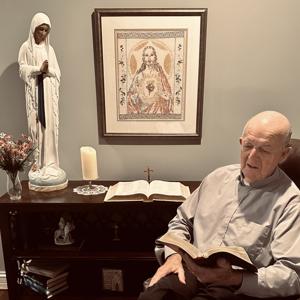


Today, December 11, as our Church celebrates the Memorial of Damasus I, pope, we are encouraged to read and reflect on a passage of the apostle Paul to Titus (1:7-11:2:1-8), entitled "The teaching of the Apostle on the qualities and duties of bishops". Our treasure, which follows, is from a treatise against Faustus by Saint Agustine. bishop.
The son of a Roman priest, possibly of Spanish extraction, Damasus was born around the year 305. He started as a deacon in his father's church, and served as a priest in what later became the basilica of San Lorenzo in Rome. He served Pope Liberius (352-366) and followed him into exile. He was admitted to the Roman clergy and in 366, during a period of upheaval in the Church, he was ordained bishop of Rome; but a minority elected and consecrated another deacon, Ursinus, as pope. The controversy between Damasus and the antipope resulted in violent battles in two basilicas, scandalizing the bishops of Italy.
As pope, his lifestyle was simple in contrast to other ecclesiastics of Rome, and he was fierce in his denunciation of Arianism and other heresies. A misunderstanding of the Trinitarian terminology used by Rome threatened amicable relations with the Eastern Church, and Damasus was only moderately successful in dealing with that challenge.
During his pontificate, Christianity was declared the official religion of the Roman state, and Latin became the principal liturgical language as part of the pope's reforms. His encouragement of Saint Jerome's biblical studies led to the Vulgate, the Latin translation of Scripture which 12 centuries later the Council of Trent declared to be "authentic in public readings, disputations, preaching."
He summoned synods to work against schismatics and heretics and widely promoted the cult of martyrs whose burial places he adored with sacred verse. He died in 384.
Saint Augustine was born at Tagaste in Africa in 354. He was unsettled and restlessly searched for the truth until he was converted to the faith at Milan and baptized by Ambrose. Returning to his homeland, he embraced an ascetic life and subsequently was elected bishop of Hippo. For thirty-four years he guided his flock, instructing it with sermons and many writings. He fought bravely against the errors of his time and explained the faith carefully and cogently through his writings.
Augustine is perhaps the most significant Christian thinker after St. Paul. He adapted Classical teaching and created a powerful theological system of lasting influence. He also shaped the practice of biblical exegesis and helped lay the foundation for much of medieval and modern Christian thought.
Augustine is recognized as a saint in the Catholic Church, the Eastern Orthodox Church, the Lutheran churches, and the Anglican Communion. Saint Augustine is viewed as one of the most important Church Fathers of the Latin Church in the Patristic Period. He is also a preeminent Catholic Doctor of the Church and the patron of the Augustinians. He died in 430.
Against Faustus is Augustine's takedown of the Manichean bishop, Faustus. He met Faustus long before he was even a Christian. When he was trying to figure out what life was all about, he spent some time with a religious group known as the Manicheans. He thought most of their ideas were kind of silly, but they insisted that if he just waited for Faustus, their renowned intellectual bishop, he would be able to answer everything. When Faustus finally came, Augustine finally asked him his biggest questions, to which Faustus answered, "I guess I never really thought about any of that that. I don't know." Needless to say, Augustine was not impressed and didn't spend so much time with the Manicheans anymore
Later in his life, Augustine found out that Faustus wrote a whole book about why Christianity was ridiculous and nobody should waste time on it. In true Augustinian fashion, he republished what many people assume to be the entire text of Faustus's book with a line-by-line refutation of every one of Faustus's attacks. A lot of the concerns Faustus raised are the same ones we hear today, and Augustine's defenses still hold steady.
Saint Paul's letter to Titus is the third of the Pastoral Epistles in the New Testament and is addressed to a different co-worker of Paul than are First and Second Timothy. The situation is different, too, for Titus is addressed as the person in charge of developing the church on the large Mediterranean island of Crete, a place Paul had never, according to the New Testament, visited. The tone is closer to that of First Timothy as three topics of church life and structure are discussed: presbyter-bishops, groups with which one must work in the church, and admonitions for conduct based on the grace and love of God that appeared in Jesus Christ. The warmer personal tone of Second Timothy is replaced by emphasis on church office and on living in the society of the day, in which deceivers and heretics abound.
Today, December 10, as our Church celebrates the Memorial of the Our lady of Loreto we are invited to read and reflect on a passage from the letter of the apostle Paul to the Galatians (3:22 – – 4:7), entitled "Through faith we are the sons and heirs of God". Our treasure, which follows, is from a letter by Pope John Paul II.
This title of Mary, Our Lady of Loreto, refers to the house in which she was born and raised, and in which the angel Gabriel visited her in the Annunciation. Tradition holds that angels miraculously transported the house from Palestine to Loreto, Italy, in the 13th century.
It is now believed that this legend came from the fact that a patron family with the name "Angelo" either had the house moved or had stones for a replica home imported from the Holy Land. The stones in the shrine in Italy match the stones of a structure that still stands in Nazareth that is believed to be another part of Mary's home.
The history that we have for the house—legendary or factual—states that after Jesus' ascension, the apostles had the home converted to a church. During her pilgrimage to the Holy Land in 336, the Empress Helen had a large basilica built over it. At the close of the Crusades, European forces feared that the house would be destroyed, and it was moved. Miracles attended it wherever it went, and the house finally rested in Italy. A basilica encases the home once again, and the town of Loreto has grown around the shrine.
Just before opening the Second Vatican Council in 1962, Pope John XXIII made a pilgrimage to Loreto. Fifty years later, in 2012, Pope Benedict XVI made a second pilgrimage to the site to mark the anniversary of the council and to dedicate the Year of Faith to Our Lady of Loreto.
A portion of Mary's house is kept in the reliquary chapel in the Basilica on campus, and the campus church for St. Mary's College is named after Our Lady of Loreto. Because of the legend of the angelic flying house, Our Lady of Loreto is patron of airplane pilots and attendants, and of those serving in the Air Force. She is also patron of construction workers.
Our Lady of Loreto, who teaches us to make a home for Jesus in the world, pray for us!
On October 16, 1978, Cardinal Karol Wojtyla, Archbishop of Krakow, was elected the 263rd successor to Saint Peter and chose the name John Paul II in honor of the late John Paul I. Pope John Paul II was the first ever Slavic pope elected, was the first non-Italian pope in 455 years, and at 58-years-old, he was youngest pope in over a century. Pope John Paul II was head of the Catholic Church and sovereign of the Vatican City State from 1978 until his death in 2005. He travelled abroad extensively in an effort to promote greater understanding between countries and religions, and he campaigned against political oppression, violence, and materialism During his twenty-six-year pontificate, he visited over 129 countries, which included seven visits to the United States. He survived an assassination attempt in 1981. He died on April 2, 2005, beatified in St. Peter's Square on May 1, 2011, by Pope Benedict XVI, and canonized on April 27, 2014, by Pope Francis.
"Everyone knows John Paul II: his face, his characteristic way of moving and speaking; his immersion in prayer and his spontaneous cheerfulness. Many of his words have become indelibly engraved in our memories, starting with the passionate cry with which he introduced himself to the people at the beginning of his pontificate: 'Open wide the doors to Christ, and be not afraid of him!' Or this saying: 'No one can live a trial life; no one can love experimentally.' An entire pontificate is condensed in words like these. It is as though he would like to open the doors for Christ everywhere and wishes to open up to people the gate that leads to true life, to true love." - Pope Emeritus Benedict XVI
The Galatians to whom the letter is addressed were Paul's converts, most likely among the descendants of Celts who had invaded western and central Asia Minor in the third century B.C. and had settled in the territory around Ancyra (modern Ankara, Turkey). Paul had passed through this area on his second missionary journey and again on his third.
Today, December 9, as our Church celebrates the optional memorial of Juan Diego, we are invited to first read and reflect on a passage from the book of Revelation (15:5---16:21) entitled "The seven bowls of God's wrath". Our treasure, which follows, is from a decree of Pope John Paul II.
Juan Diego Cuauhtlatoatzin (1474–1548), also known simply as Juan Diego was a Nahua peasant and Marian visionary. He is said to have been granted apparitions of Our Lady of Guadalupe on four occasions in December 1531: three at the hill of Tepeyac and a fourth before don Juan de Zumárraga, then the first bishop of Mexico. The Basilica of Our Lady of Guadalupe, located at the foot of Tepeyac, houses the cloak (tilmahtli/talmud) that is traditionally said to be Juan Diego's, and upon which the image of the Virgin is said to have been miraculously impressed as proof of the authenticity of the apparitions.
Juan Diego's visions and the imparting of the miraculous image, as recounted in oral and written colonial sources are together known as the Guadalupe event and are the basis of theveneration of Our Lady of Guadalupe. This veneration is ubiquitous in Mexico, prevalent throughout the Spanish-speaking Americas, and increasingly widespread beyond. As a result, the Basilica of Our Lady of Guadalupe is now one of the world's major Christian pilgrimage destinations, receiving 22 million visitors in 2010.
Juan Diego is the first Catholic saint indigenous to the Americas. He was beatified in 1990 and canonized in 2002 by Pope John Paul II, who on both occasions traveled to Mexico City to preside over the ceremonies.
On October 16, 1978, Cardinal Karol Wojtyla, Archbishop of Krakow, was elected the 263rd successor to Saint Peter and chose the name John Paul II in honor of the late John Paul I. Pope John Paul II was the first ever Slavic pope elected, was the first non-Italian pope in 455 years, and at 58-years-old, he was youngest pope in over a century. Pope John Paul II was head of the Catholic Church and sovereign of the Vatican City State from 1978 until his death in 2005. He travelled abroad extensively in an effort to promote greater understanding between countries and religions, and he campaigned against political oppression, violence, and materialism During his twenty-six-year pontificate, he visited over 129 countries, which included seven visits to the United States. He survived an assassination attempt in 1981. He died on April 2, 2005, beatified in St. Peter's Square on May 1, 2011, by Pope Benedict XVI, and canonized on April 27, 2014, by Pope Francis.
"Everyone knows John Paul II: his face, his characteristic way of moving and speaking; his immersion in prayer and his spontaneous cheerfulness. Many of his words have become indelibly engraved in our memories, starting with the passionate cry with which he introduced himself to the people at the beginning of his pontificate: 'Open wide the doors to Christ, and be not afraid of him!' Or this saying: 'No one can live a trial life; no one can love experimentally.' An entire pontificate is condensed in words like these. It is as though he would like to open the doors for Christ everywhere and wishes to open up to people the gate that leads to true life, to true love." - Pope Emeritus Benedict XVI.
The Apocalypse, or Revelation to John, the last book of the Bible, is one of the most difficult to understand because it abounds in unfamiliar and extravagant symbolism, which at best appears unusual to the modern reader. Symbolic language, however, is one of the chief characteristics of apocalyptic literature, of which this book is an outstanding example. Such literature enjoyed wide popularity in both Jewish and Christian circles from ca. 200 B.C. to A.D. 200.
This book contains an account of visions in symbolic and allegorical language borrowed extensively from the Old Testament, especially Ezekiel, Zechariah, and Daniel. Whether or not these visions were real experiences of the author or simply literary conventions employed by him is an open question.
Today, December 8, as our Church celebrates the Solemnity of the Immaculate Conception we are first invited to read and reflect on a passage from the letter of the apostle Paul to the Romans (5: 12-21) entitled "Where sin abounds, there is an abundance of grace." Our treasure, which follows, is from a sermon by Saint Ambrose, bishop.
The Immaculate Conception of the Blessed Virgin Mary, which refers to Mary's conception in her mother's womb without the stain of Original Sin: An essential part of God's plan for the mother of his Son was that she be conceived free from Original Sin. "Through the centuries the Church became ever more aware that Mary, "full of grace" through God, was redeemed from the moment of her conception". In anticipation that she was to bear the Son of God, Mary was preserved from the time of her conception from Original Sin. We call this the Immaculate Conception. No sin would touch her, so that she would be a fitting and worthy vessel of the Son of God. The Immaculate Conception does not refer to the virginal conception and birth of Christ, but rather to Mary's being conceived without inheriting Original Sin. In the course of time, the doctrine of the Immaculate Conception became more precisely enunciated, as its truth—long supported by the universal popular devotion of the faithful—was better understood by deepening theological inquiry. In 1854, Pope Pius IX proclaimed this dogma infallibly: that is, in his role as supreme teacher of the Church, he declared that this doctrine is divinely revealed and must be accepted with faith by the entire Church. Even before this tenet of the faith was formally declared, a long tradition of faith that held this belief that Mary was conceived without sin: This feast was celebrated in some monasteries before the beginning of the eighth century and became widespread in the eighteenth century. In the United States, celebration of this observance predates the Declaration of Independence. The bishops commended the nation to the patronage of Mary under the title of the Immaculate Conception in 1846. It became a nationwide holy day in 1885.
Ambrose was born of a Roman family at Trier about the year 340. He studied at Rome and served in the imperial government at Sirmium. In 374, while, living in Milan, he was elected bishop of the city by popular acclaim and ordained on December 7. He devotedly carried out his duties and especially distinguished himself by his service to the poor, and as an effective pastor and teacher of the faithful. He strenuously guarded the laws of the church and defended orthodox teaching by writings and actions against the Arians. He died on Holy Saturday, April 4, 397. Saint Ambrose is a Doctor of the Church.
The Book of Wisdom was written about fifty years before the coming of Christ. Its author, whose name is not known to us, was probably a member of the Jewish community at Alexandria, in Egypt. He wrote in Greek, in a style patterned on that of Hebrew verse. At times he speaks in the person of Solomon, placing his teachings on the lips of the wise king of Hebrew tradition in order to emphasize their value. His profound knowledge of the earlier Old Testament writings is reflected in almost every line of the book, and marks him, like Ben Sira, as an outstanding representative of religious devotion and learning among the sages of postexilic Judaism.
The primary purpose of the author was the edification of his co-religionists in a time when they had experienced suffering and oppression, in part at least at the hands of apostate fellow Jews. To convey his message he made use of the most popular religious themes of his time, namely the splendor and worth of divine wisdom, the glorious events of the exodus, God's mercy, the folly of idolatry, and the manner in which God's justice operates in rewarding or punishing the individual. The first ten chapters in particular provide background for the teaching of Jesus and for some New Testament theology about Jesus. Many passages from this section of the book are used by the church in the liturgy
On the Second Sunday of Advent our Church invites us to first read and reflect on a passage from the book of the prophet Isaiah (22: 8b-23) entitled "Against the pride of Jerusalem and Shebna". Our treasure, which follows, is from a commentary on Isaiah by Eusebeus of Caesarea, bishop.
Eusebius of Caesarea (c. 260–c. 340) is known as the "father of church history." He was the first to write a "comprehensive" history of the early church. He was born in Palestine, and little if anything is known of his early life and conversion. In Palestine, Eusebius came under the influence of Pamphilus, who was a student of Origen. Pamphilus had amassed a large library of Origen's writings, copies of Scripture, and commentaries—truly one of the great ancient Christian libraries. It seems that Eusebius fled the persecution of Christians in Palestine and eventually made his way to Egypt where he witnessed Christian martyrdom firsthand. He was also imprisoned for a short time. In 313 or 314, Eusebius was made bishop of Caesarea in his native Palestine.
Eusebius of Caesarea wrote several major works. In Preparation for the Gospel, he refutes paganism, using extensive quotes from pagan authors. In Demonstration of the Gospel, he examines how Christ fulfilled Old Testament prophecies. In his most famous and perhaps most important work, Ecclesiastical History, Eusebius provides a history of the church from apostolic times through the death of Constantine. His Commentary on Isaiah is one of his major exegetical works and the earliest extant Christian commentary on the great prophet. Geographically situated between Alexandria and Antioch, Eusebius approached the text giving notable attention to historical detail and possible allegorical interpretation. But above all, employing the anologia fidei (a biblical phrase that refers to the relationship between concepts that are both similar and different), he drew his readers' attention to other passages of Scripture that share a common vocabulary and theological themes, thus allowing Scripture to interpret Scripture. Here, for the first time in English, Jonathan Armstrong provides readers with a highly serviceable translation of Eusebius's notably difficult Greek text, along with a helpful introduction and notes.
Isaiah, one of the greatest of the prophets, appeared at a critical moment in Israel's history. The Northern Kingdom collapsed, under the hammerlike blows of Assyria, in 722/721 B.C., and in 701 Jerusalem itself saw the army of Sennacherib drawn up before its walls. In the year that Uzziah, king of Judah, died, Isaiah received his call to the prophetic office in the Temple of Jerusalem. Close attention should be given to chapter six, where this divine summons to be the ambassador of the Most High is circumstantially described.
The vision of the Lord enthroned in glory stamps an indelible character on Isaiah's ministry and provides a key to the understanding of his message. The majesty, holiness and glory of the Lord took possession of his spirit and, at the same time, he gained a new awareness of human pettiness and sinfulness. The enormous abyss between God's sovereign holiness and human sinfulness overwhelmed the prophet. Only the purifying coal of the seraphim could cleanse his lips and prepare him for acceptance of the call: "Here I am, send me!"
The ministry of Isaiah extended from the death of Uzziah in 742 B.C. to Sennacherib's siege of Jerusalem in 701 B.C., and it may have continued even longer, until after the death of Hezekiah in 687 B.C. Later legend (the Martyrdom and Ascension of Isaiah) claims that Hezekiah's son, Manasseh, executed Isaiah by having him sawed in two. During this long ministry, the prophet returned again and again to the same themes, and there are indications that he may have sometimes re-edited his older prophecies to fit new occasions.
Today, December 6, as our Church celebrates the Memorial of Nicholas, bishop, we are invited to read and reflect on a passage from the letter of the apostle Paul to Titus (1:7-11; 2:1-8), entitled "The teaching of the Apostle on the qualities and duties of bishops". Our treasure, which follows, is from a treatise on John by Saint Augustine, bishop.
The true story of Santa Claus begins with Nicholas, who was born during the third century in the village of Patara in Asia Minor. At the time the area was Greek and is now on the southern coast of Turkey. His wealthy parents, who raised him to be a devout Christian, died in an epidemic while Nicholas was still young. Obeying Jesus' words to "sell what you own and give the money to the poor," Nicholas used his whole inheritance to assist the needy, the sick, and the suffering. He dedicated his life to serving God and was made Bishop of Myra while still a young man. Bishop Nicholas became known throughout the land for his generosity to those in need, his love for children, and his concern for sailors and ships.
Under the Roman Emperor Diocletian, who ruthlessly persecuted Christians, Bishop Nicholas suffered for his faith, was exiled and imprisoned. The prisons were so full of bishops, priests, and deacons, there was no room for the real criminals—murderers, thieves and robbers. After his release, Nicholas attended the Council of Nicaea in AD 325. He died December 6, AD 343 in Myra and was buried in his cathedral church, where a unique relic, called manna, formed in his grave. This liquid substance, said to have healing powers, fostered the growth of devotion to Nicholas. The anniversary of his death became a day of celebration, St. Nicholas Day, December 6th (December 19 if on the Julian Calendar).
Through the centuries many stories and legends have been told of St. Nicholas' life and deeds. These accounts help us understand his extraordinary character and why he is so beloved and revered as protector and helper of those in need.
Saint Augustine was born at Tagaste in Africa in 354. He was unsettled and restlessly searched for the truth until he was converted to the faith at Milan and baptized by Ambrose. Returning to his homeland, he embraced an ascetic life and subsequently was elected bishop of Hippo. For thirty-four years he guided his flock, instructing it with sermons and many writings. He fought bravely against the errors of his time and explained the faith carefully and cogently through his writings.
Augustine is perhaps the most significant Christian thinker after St. Paul. He adapted Classical teaching and created a powerful theological system of lasting influence. He also shaped the practice of biblical exegesis and helped lay the foundation for much of medieval and modern Christian thought.
Augustine is recognized as a saint in the Catholic Church, the Eastern Orthodox Church, the Lutheran churches, and the Anglican Communion. Saint Augustine is viewed as one of the most important Church Fathers of the Latin Church in the Patristic Period. He is also a preeminent Catholic Doctor of the Church and the patron of the Augustinians. He died in 430.
Few ancient Christian authors attempted anything like a complete commentary on the Gospel of John, among them Origen, John Chrysostom and Augustine. Of these, Augustine's must count as the greatest. Unlike Origen's, it has come down to us in its entirety and of the others that remain it is certainly the most theologically profound. John's gospel allows Augustine to range broadly over themes that were his life's work -- the Trinity, the person of Christ, the nature of the Church and its sacraments, the fulfillment of the divine plan. Augustine's reflections on Scripture lead him to discussions of both moral action and dogma. His extemporaneous style and broad range of interests are evident in the tractates included in this volume, in which he comments on chapters 7-12 of St. John's Gospel. These chapters contain some of the best-known episodes from the life of Christ: the encounter with the woman caught in adultery, the healing of the man born blind, the raising of Lazarus from the dead, Mary's anointing of Christ's feet, and Christ's triumphant entrance into Jerusalem. The passages also contain some of Christ's most explicit teaching of his divinity. In unfolding the mysteries contained in these chapters of St. John, Augustine moves easily from exegesis to reflections on moral virtue and doctrine, especially the Trinity and the Incarnation. But he never loses sight of his audience. Even in his comments on the loftiest of ideas, he strives to make teaching accessible to all.
These tractates, then give us a glimpse of the man that we do not often get from his other works. Augustine's preaching shows us not only his brilliant mind and rhetorical skills as he expounds upon the Scriptures but also the great love he had for Christ and for the faithful entrusted to his care.
Saint Paul's letter to Titus is the third of the Pastoral Epistles in the New Testament and is addressed to a different co-worker of Paul than are First and Second Timothy. The situation is different, too, for Titus is addressed as the person in charge of developing the church on the large Mediterranean island of Crete, a place Paul had never, according to the New Testament, visited. The tone is closer to that of First Timothy as three topics of church life and structure are discussed: presbyter-bishops, groups with which one must work in the church, and admonitions for conduct based on the grace and love of God that appeared in Jesus Christ. The warmer personal tone of Second Timothy is replaced by emphasis on church office and on living in the society of the day, in which deceivers and heretics abound.
On Friday of the First Week of Advent our Church invites us to first read and reflect on a passage from the book of the prophet Isaia( 19: 16-25) entitled "The future conversion of Egypt and Assyria". Our treasure, which follows, is from the Proslogian by Saint Anselm, bishop.
Saint Anselm was born in 1033 or 1034 at Aoste in what is now north-western Italy. A religious man even from his youth, he left home at the age of 23 to travel through France and Burgundy, before joining the abbey of Bec in Normandy at the age of 27. Three years later, he was unanimously elected abbot of the monastery, a remarkable honor for one so young. Under Anselm's direction, Bec became famous as a center of learning, attracting students from as far away as Italy. Anselm was also notable for the pains he took to keep the abbey independent of outside control, both secular and ecclesiastical.
He received the title "Father of Scholasticism" for his attempt to analyze and illumine the truths of faith through the aid of reason. Considered an original and independent thinker, Anselm was admired for his patience, gentleness, and teaching skill. Under his leadership, the Abbey of Bec became a monastic school, influential in philosophical and theological studies. During these years, at the community's request, Anselm began publishing his theological works, comparable to those of Saint Augustine. His best-known work is the book Cur Deus Homo ("Why God Became Man").
His care and concern extended to the very poorest people. Opposing the slave trade, Anselm obtained from the national council at Westminster the passage of a resolution prohibiting the sale of human beings.
The Proslogion (Latin for Address or Discourse; the title was chosen because it is written in the form of a prayer addressed to God) is a book written by St. Anselm. It is of great significance in the history of philosophy, mainly because of the proof of God's existence. It is usually considered the first ever ontological argument that seeks to prove God's existence based on reason alone rather than on observation of the world around us. It can be summarized like this:
1. God is defined as that than which nothing greater can be thought.
2. Even a fool, who denies the existence of God, understands the phrase "that than which nothing greater can be thought".
3. Whatever is understood exists in the intellect.
4. Therefore, that than which nothing greater can be thought exists in the intellect.
5. To exist in reality is greater than to exist in the intellect.
6. If that than which nothing greater can be thought existed in the intellect but not in reality, it would be possible to think of something greater, namely an equivalent being which also exists in reality. But this is clearly absurd.
7. Therefore, that than which nothing greater can be thought exists in reality as well as in the intellect.
Anselm then spends the rest of the Proslogion proving that that than which nothing greater can be thought would have to have the attributes traditionally ascribed to God, including omnipotence, omniscience, and omnipresence.
Isaiah, one of the greatest of the prophets, appeared at a critical moment in Israel's history. The Northern Kingdom collapsed, under the hammerlike blows of Assyria, in 722/721 B.C., and in 701 Jerusalem itself saw the army of Sennacherib drawn up before its walls. In the year that Uzziah, king of Judah, died, Isaiah received his call to the prophetic office in the Temple of Jerusalem.
The vision of the Lord enthroned in glory stamps an indelible character on Isaiah's ministry and provides a key to the understanding of his message. The majesty, holiness and glory of the Lord took possession of his spirit and, at the same time, he gained a new awareness of human pettiness and sinfulness. The enormous abyss between God's sovereign holiness and human sinfulness overwhelmed the prophet. Only the purifying coal of the seraphim could cleanse his lips and prepare him for acceptance of the call: "Here I am, send me!"
The ministry of Isaiah extended from the death of Uzziah in 742 B.C. to Sennacherib's siege of Jerusalem in 701 B.C., and it may have continued even longer, until after the death of Hezekiah in 687 B.C. Later legend (the Martyrdom and Ascension of Isaiah) claims that Hezekiah's son, Manasseh, executed Isaiah by having him sawed in two. During this long ministry, the prophet returned again and again to the same themes, and there are indications that he may have sometimes re-edited his older prophecies to fit new occasions.
Today, December 4, as our Church celebrates the Memorial of John Damascene, Priest and Doctor, we are invited to reflect on a passage from the book of Sirach (39: 4-10), entitled "The wisdom of a man who is learned in the Scriptures". Our treasure, which follows, is from The Statement of Faith by Saint John Damascene.
Saint John Damascene, also known as John of Damascus, was a Syrian monk, priest, and theologian who lived from approximately 676 to 749 AD. Born in Damascus to a wealthy Christian family, Saint John received a comprehensive education, mastering Greek and Arabic text.
Saint John served as a high-ranking administrator for the Muslim caliph in Damascus, likely managing financial affairs. He eventually left his political position to pursue a monastic life, entering the monastery of St. Sabas (Mar Saba) near Jerusalem.
Saint John Damascene is considered one of the last of the Eastern Church Fathers. He is particularly renowned for his strong defense of the use of icons in Christian worship, a practice that was being challenged at the time. He argued that the Incarnation of Christ, where God became human, made the physical world and therefore icons acceptable as representations of the divine.
Saint John wrote extensively on various theological topics, including the nature of God, Christology, and Mariology (the study of Mary). His writings are considered foundational in Eastern and Western Christian theology. He was formally declared a Doctor of the Church by Pope Leo XIII in 1890.
Saint John of Damascus's "statement of faith" is a comprehensive summary of Orthodox Christian doctrine, most famously detailed in his work, An Exact Exposition of the Orthodox Faith. It asserts that God is a single, uncreated, eternal essence known in three co-equal persons: the Father, the Son, and the Holy Spirit. The statement affirms the divinity and full humanity of Jesus Christ, his birth from the Virgin Mary, his crucifixion, death, and resurrection for the salvation of humanity.
The Wisdom of Ben Sira derives its title from the author, "Yeshua [Jesus], son of Eleazar, son of Sira". The author, a sage who lived in Jerusalem, was thoroughly imbued with love for the wisdom tradition, and for the law, priesthood, Temple, and divine worship. As a wise and experienced observer of life he addressed himself to his contemporaries with the motive of helping them to maintain religious faith and integrity through study of the books sacred to the Jewish tradition.
The book contains numerous well-crafted maxims, grouped by affinity, and dealing with a variety of subjects such as the individual, the family, and the community in their relations with one another and with God. It treats friendship, education, poverty and wealth, laws, religious worship, and many other matters that reflect the religious and social customs of the time. Written in Hebrew in the early years of the second century B.C., the book was finished by ca. 175. The text was translated into Greek by the author's grandson after 117 B.C.
Though not included in the Jewish Bible after the first century A.D., nor, therefore, accepted by Protestants, the Wisdom of Ben Sira has been recognized by the Catholic Church as inspired and canonical. The Foreword, though not the proper part of the book, is always included with it because of its antiquity and importance.
On Tuesday of the First Week of Advent our Church invites us to first read and reflect on a passage from the book of the prophet Isaiah (2:6-22; 4:2-6) entitled "The judgement of God". Our treasure, which follows, is from a sermon by Saint Gregory Nazianzen, bishop.
Isaiah, one of the greatest of the prophets, appeared at a critical moment in Israel's history. The Northern Kingdom collapsed, under the hammerlike blows of Assyria, in 722/721 B.C., and in 701 Jerusalem itself saw the army of Sennacherib drawn up before its walls. In the year that Uzziah, king of Judah, died, Isaiah received his call to the prophetic office in the Temple of Jerusalem.
Saint Gregory of Nazianzus, was an early Roman Christian theologian and prelate who served as Archbishop of Constantinople from 380 to 381. He is known for instituting the first recorded large-scale mission from Rome, the Gregorian mission, to convert the then largely pagan Anglo-Saxons to Christianity. Gregory is also well known for his writings, which were more prolific than those of any of his predecessors as pope. He is widely considered the most accomplished rhetorical stylist of the patristic age. Gregory's most significant theological contributions arose from his defense of the doctrine of the Trinity. He is especially noted for his contributions to the field of pneumatology—that is, theology concerning the nature of the Holy Spirit. He died in 390
The vision of the Lord enthroned in glory stamps an indelible character on Isaiah's ministry and provides a key to the understanding of his message. The majesty, holiness and glory of the Lord took possession of his spirit and, at the same time, he gained a new awareness of human pettiness and sinfulness. The enormous abyss between God's sovereign holiness and human sinfulness overwhelmed the prophet. Only the purifying coal of the seraphim could cleanse his lips and prepare him for acceptance of the call: "Here I am, send me!"
The ministry of Isaiah extended from the death of Uzziah in 742 B.C. to Sennacherib's siege of Jerusalem in 701 B.C., and it may have continued even longer, until after the death of Hezekiah in 687 B.C. Later legend (the Martyrdom and Ascension of Isaiah) claims that Hezekiah's son, Manasseh, executed Isaiah by having him sawed in two. During this long ministry, the prophet returned again and again to the same themes, and there are indications that he may have sometimes re-edited his older prophecies to fit new occasions.
On Monday of the First Week of Advent our Church invites us to first read and reflect on a passage from the book of the prophet Isaiah (1: 21-27: 2: 1-5) entitled "The judgement and deliverance of Zion. The gathering of the nations". Our treasure, which follows, is from a pastoral letter by Saint Charles Borromeo, bishop.
St. Charles Borromeo was born at Arona in Lombardy in the year 1538. Although he belonged to the Milanese nobility and was related to the powerful Medici family, Charles desired to devote himself to the Church. Because of his intellectual qualities Charles was entrusted with several important offices connected with the Vatican, and later appointed secretary of state with responsibility for the papal states. At the time Charles was still a layman and a young student. The untimely death of his elder brother brought Charles to a definite decision to be ordained a priest, despite his relatives' insistence that he marry. Soon after being ordained a priest at age 25, he was made cardinal and bishop of Milan by his uncle, Pope Pius IV. Charles Borromeo was associated with reform. He lived during the time of the Protestant Reformation, and had a hand in the reform of the whole Church during the final years of the Council of Trent. As a true pastor of his flock, he tirelessly promoted Christian life by the reform of his diocese, the convocation of senates, and the promulgation of regulations intended to foster the Church's mission. He died on November 3, 1584
Isaiah, one of the greatest of the prophets, appeared at a critical moment in Israel's history. The Northern Kingdom collapsed, under the hammerlike blows of Assyria, in 722/721 B.C., and in 701 Jerusalem itself saw the army of Sennacherib drawn up before its walls. In the year that Uzziah, king of Judah, died, Isaiah received his call to the prophetic office in the Temple of Jerusalem.
The vision of the Lord enthroned in glory stamps an indelible character on Isaiah's ministry and provides a key to the understanding of his message. The majesty, holiness and glory of the Lord took possession of his spirit and, at the same time, he gained a new awareness of human pettiness and sinfulness. The enormous abyss between God's sovereign holiness and human sinfulness overwhelmed the prophet. Only the purifying coal of the seraphim could cleanse his lips and prepare him for acceptance of the call: "Here I am, send me!"
The ministry of Isaiah extended from the death of Uzziah in 742 B.C. to Sennacherib's siege of Jerusalem in 701 B.C., and it may have continued even longer, until after the death of Hezekiah in 687 B.C. Later legend (the Martyrdom and Ascension of Isaiah) claims that Hezekiah's son, Manasseh, executed Isaiah by having him sawed in two. During this long ministry, the prophet returned again and again to the same themes, and there are indications that he may have sometimes re-edited his older prophecies to fit new occasions.
From the publisher's feed