
Sign up to save your podcasts
Or

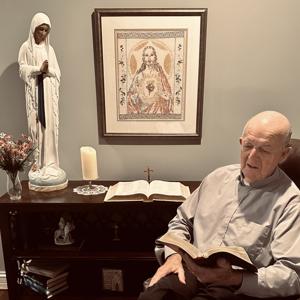


On Tuesday of the Twenty-First Week in Ordinary Time our Church invites us to first read and reflect on a passage from the beginning of the book of the prophet Jeremiah (1:) entitled "The call of the prophet Jeremiah". Our treasure, -which follows, is from a homily by Saint John Chrysostom.
Saint John Chrysostom was an important, fourth century, Early Church Father who served as Archbishop of Constantinople. He is known for his preaching and public speaking, and for his denunciation of abuse of authority of both ecclesiastical and political leaders. He was among the most prolific authors in the early Christian church. The word 'Chrysostom' means 'golden-mouth'. This name was given to him after he died because all his sermons were eloquent and lovely to hear.
The Book of Jeremiah combines history, biography, and prophecy. It portrays a nation in crisis and introduces the reader to an extraordinary person whom the Lord called to prophesy under the trying circumstances of the final days of the kingdom of Judah. Jeremiah was born, perhaps about 650 B.C., of a priestly family from the village of Anathoth, two and a half miles northeast of Jerusalem. He was called to his task in the thirteenth year of King Josiah. Josiah's reform, begun with enthusiasm and hope, ended with his death on the battlefield of Megiddo (609 B.C.) as he attempted to stop the northward march of the Egyptian Pharaoh Neco, who was going to provide assistance to the Assyrians who were in retreat before the Babylonians. Nineveh, the capital of Assyria, fell in 612 B.C., preparing the way for the new colossus, Babylon, which was soon to put an end to the independence of Judah.
On Saturday of the Twentieth Week in Ordinary Time our Church invites us to read and reflect on a passage from the book of the prophet Isaiah (37:21-35) entitled "Isaiah prophesies about the Assyrian king". Our treasure, which follows, is from the Explanations of the Psalms by Saint Ambrose, bishop.
Saint Ambrose was born of a Roman family at Trier about the year 340. He studied at Rome and served in the imperial government at Sirmium. In 374, while, living in Milan, he was elected bishop of the city by popular acclaim and ordained on December 7. He devotedly carried out his duties and especially distinguished himself by his service to the poor, and as an effective pastor and teacher of the faithful. He strenuously guarded the laws of the church and defended orthodox teaching by writings and actions against the Arians. He died on Holy Saturday, April 4, 397. Saint Ambrose is a Doctor of the Church.
Saint Ambrose explained the Psalms as a source of spiritual exercise, a celebration of faith, and a way to heal the human soul. He believed that the Psalms were a divine gift that could help people develop virtues, learn about God, and find peace. For Ambrose a psalm is a blessing for the people... our universal tongue; the voice of the Church, a sweet outpouring of faith; a devotion divinely ordained; the cry of heart's delight; a leaping and jumping for joy...it soothes the angry spirit, banishes care, lessens sorrow. It guards us by night, guides us by day.
The book of Isaiah is filled with sobering accounts of Israel's sin and rebellion and warnings of their coming judgement. But along with warnings, Isaiah also offers a message of hope—a suffering servant, a coming Messiah, who would come to establish God's Kingdom on Earth and create a new Jerusalem.
On Thursday of the Twentieth Week in Ordinary Time our Church invites us to read and reflect on a passage from the book of the prophet Isaiah (11:1-16) entitled "The root of Jesse and the return of the remnant of God's people". Our treasure, which follows, is from a treatise On the Hail Mary by Baldwin of Canterbury, bishop.
Baldwin of Forde was Archbishop of Canterbury between 1185 and 1190. The son of a clergyman, he studied canon law and theology at Bologna and was tutor to Pope Eugene III's nephew before returning to England to serve successive bishops of Exeter. After becoming a Cistercian monk he was named abbot of his monastery at Forde and subsequently elected to the episcopate at Worcester. Before becoming a bishop, he wrote theological works and sermons, some of which have survived.
A devotion to the Hail Mary prayer can be traced to the 1100s. Abbot Baldwin, the Archbishop of Canterbury in 1184 wrote about a devotion to the 'Hail Mary' prayer and said, "To this salutation of the Angel, by which we daily greet the most Blessed Virgin, with such devotion as we may, we are accustomed to add the words, "and blessed is the fruit of thy womb," by which clause Elizabeth at a later time, on hearing the Virgin's salutation to her, caught up and completed, as it were, the Angel's words, saying: "Blessed are thou amongst women and blessed is the fruit of thy womb."
The book of Isaiah is filled with sobering accounts of Israel's sin and rebellion and warnings of their coming judgement. But along with warnings, Isaiah also offers a message of hope—a suffering servant, a coming Messiah, who would come to establish God's Kingdom on Earth and create a new Jerusalem.
Today, August 16, as our church celebrates the Memorial of Stephen of Hungary, we are invited to read and reflect on passage taken from a letter of the apostle Paul to the Colossians (3:1–17), entitled "Your life is hidden with Christ in God". Our treasure, which follows, is from the admonitions to his son by Saint Stephen.
Saint Stephen was born in Pannonia around the year 969. After his baptism he was crowned a king of Hungary in the year 1000. In his relationships with his subjects he was just, peaceful and pius, exactly observing the laws of the Church, and ever seeking the welfare of his people. He founded many dioceses and spent great energy in fostering the work of the Church. He died at Szekesfehervar in 1038.
Saint Paul's letter is addressed to a congregation at Colossae in the Lycus Valley in Asia Minor, east of Ephesus. At the time of writing, Paul had not visited there, the letter says. The community had apparently been established by Epaphras of Colossae. Problems, however, had arisen, brought on by teachers who emphasized Christ's relation to the universe (cosmos). Their teachings stressed angels; "principalities and powers", which were connected with astral powers and cultic practices and rules about food and drink and ascetical disciplines. These teachings, Paul insists, detract from the person and work of Christ for salvation as set forth magnificently in a hymnic passage and reiterated throughout the letter. Such teachings are but "shadows"; Christ is "reality".
On Wednesday of the Nineteenth Week in Ordinary Time our Church invites us to first read and reflect on a scripture passage from the book of the prophet Micah (4:1-7) entitled "The nations go up to the mountain of the Lord". Our treasure, which follows, is from a discourse on the psalms by Saint Augustine, bishop.
Saint Augustine was born at Tagaste in Africa in 354. He was unsettled and restlessly searched for the truth until he was converted to the faith at Milan and baptized by Ambrose. Returning to his homeland, he embraced an ascetic life and subsequently was elected bishop of Hippo. For thirty-four years he guided his flock, instructing it with sermons and many writings. He fought bravely against the errors of his time and explained the faith carefully and cogently through his writings.
Augustine is perhaps the most significant Christian thinker after St. Paul. He adapted Classical teaching and created a powerful theological system of lasting influence. He also shaped the practice of biblical exegesis and helped lay the foundation for much of medieval and modern Christian thought.
Augustine is recognized as a saint in the Catholic Church, the Eastern Orthodox Church, the Lutheran churches, and the Anglican Communion. Saint Augustine is viewed as one of the most important Church Fathers of the Latin Church in the Patristic Period. He is also a preeminent Catholic Doctor of the Church and the patron of the Augustinians. He died in 430.
The book of the prophet Micah consists of a collection of speeches, proclamations of punishment and of salvation. The book has two major sections, each with two parts. The organization of the material is thematic, moving from judgment to salvation in both major sections. The first section consist almost entirely of prophecies of punishment, and prophecies of salvation. The second section also moves from prophecies of punishment to confidence in God's salvation.
Micah was a contemporary of the prophet Isaiah. The book's superscription places his prophetic activity during the reigns of three kings of Judah: Jotham, Ahaz, and Hezekiah. It identifies him as a resident of Moresheth, a village in the Judean foothills. The solitary reference to Micah outside the book places him in the reign of Hezekiah and reports that he went from his small town to proclaim the word of the Lord in the capital, and asserts that his announcements of judgment against Jerusalem moved the king and the people to repentance. Unlike Isaiah, who was a native of the holy city, Micah was an outsider from the countryside and must have been a controversial figure. He would have been unpopular with the leaders whom he condemned and the wealthy whom he criticized. He was quick to separate himself from priests and other prophets, whom he considered to be corrupt.
On Monday of the Nineteenth Week in Ordinary Time our Church invites us to first read and reflect on a scripture passage from the book of the prophet Hosea (14:2-10) entitled "The call to repentance and the promise of healing". Our treasure, which follows, is from a treatise On the Incarnation of the Lord by Theodoret of Cyr, bishop.
Theodoret of Cyr was fifth century influential theologian of the School of Antioch, biblical commentator, and Christian bishop of Cyrus. He played a pivotal role in several 5th-century Byzantine Church controversies that led to various ecumenical acts and schisms. He wrote extensively on the Incarnation of the Lord, exploring the dual nature of Jesus Christ as both fully divine and fully human. His work, particularly his dialogue Eranistes (also known as Beggar) and his letters, delves into the complexities of Christ's two natures, emphasizing the union of divinity and humanity in one person without confusion or separation. He highlights the significance of Christ's incarnation for human salvation and addresses the challenges posed by various heresies, particularly Monophysitism, which denied the full humanity of Christ.
Hosea, a prophet from the Northern Kingdom, preached in his homeland, which he addresses as Israel, Jacob or, frequently, Ephraim. Hosea began his mission in a period of prosperity, the last years of Jeroboam II (783–743 B.C.). This was followed by a period of internal instability, with intrigues at the royal court leading to the assassination of several kings. Hosea witnessed the revival of Assyria, the Syro-Ephraimite war, and the numerous treaties the Israelite kings made with Egypt and Assyria to survive. Hosea's long ministry (ca. 750–725) seems to have ended before the capture of Samaria in 722/721.
The only information the text provides us about the life of Hosea concerns his marriage. Even if we cannot reconstruct what happened exactly, the text as it now stands speaks of three moments in the relationship: first love, separation, reunion. This marriage is a symbol of the covenant between the Lord and Israel. Hosea speaks about the first love, the short period of Israel's loyalty in the desert, which was then followed by a long history of unfaithfulness lasting until his day. Hosea accuses Israel of three crimes in particular. Instead of putting their trust in the Lord alone, the people break the covenant: (1) by counting on their own military strength, (2) by making treaties with foreign powers (Assyria and Egypt), and (3) by running after the Baals, the gods of fertility. Israel thus forgets that the Lord is its strength, its covenant partner, and giver of fertility. This unfaithful behavior will lead to Israel's destruction by Assyria, but God's love will have the last word. The back and forth movement from doom to salvation is typical of the Book of Hosea.
On Saturday of the Eighteenth Week in Ordinary Time our Church invites us to first read and reflect on a scripture passage from the beginning of the book of the prophet Hosea (6:1---7:2) entitled "The emptiness of an insincere conversion". Our treasure, which follows, is from a treatise by Saint Irenaeus bishop.
Saint Irenaeus was a late second century Greek bishop noted for his role in guiding and expanding Christian communities in the southern regions of present-day France and, more widely, for the development of Christian theology.
On Jan. 21, 2022, Pope Francis named a Saint Irenaeus as a Doctor of the Church. Although he has just now been named a doctor of the Church, St. Irenaeus has always been known as a brilliant and orthodox teacher of the faith. The documents of the Second Vatican Council cite 14 references to his work, and the Catechism of the Catholic Church cites him 29 times.
Pope Francis assigned St. Irenaeus the title "doctor of unity" for his efforts to unite the Church, which was competing against the heresy of Gnosticism. Gnosticism taught that the world was created and ruled by a lesser divinity, the demiurge, and that Christ was an emissary of the remote supreme divine being, esoteric knowledge (gnosis) of whom enabled the redemption of the human spirit.
St. Irenaeus might also be the first doctor of the Church to die as a martyr. St. Irenaeus is known mainly for his clear and systematic teaching of the Christian faith because he considered the role of a bishop primarily as a teacher. He was particularly interested in apostolic succession, and he produced one of the earliest lists of the first bishops, going back to the time of the Apostles.
He is most known, though, for his treatises Against All Heresies, written about the year 180. Most of these heresies, as already mentioned, were from Gnosticism. He clearly understood the need to articulate the orthodox faith taught by the Apostles and against those who promoted other ideas that threatened the Apostles' teachings. All this was more than 100 years prior to the Council of Nicaea, which began to codify Christian dogma.
Saint Irenaeus was the last known living connection with the apostles. He is the earliest surviving witness to regard all four of the canonical gospels as essential.
Hosea, a prophet from the Northern Kingdom, preached in his homeland, which he addresses as Israel, Jacob or, frequently, Ephraim. Hosea began his mission in a period of prosperity, the last years of Jeroboam II (783–743 B.C.). This was followed by a period of internal instability, with intrigues at the royal court leading to the assassination of several kings. Hosea witnessed the revival of Assyria, the Syro-Ephraimite war, and the numerous treaties the Israelite kings made with Egypt and Assyria to survive. Hosea's long ministry (ca. 750–725) seems to have ended before the capture of Samaria in 722/721.
The only information the text provides us about the life of Hosea concerns his marriage. Even if we cannot reconstruct what happened exactly, the text as it now stands speaks of three moments in the relationship: first love, separation, reunion. This marriage is a symbol of the covenant between the Lord and Israel. Hosea speaks about the first love, the short period of Israel's loyalty in the desert, which was then followed by a long history of unfaithfulness lasting until his day. Hosea accuses Israel of three crimes in particular. Instead of putting their trust in the Lord alone, the people break the covenant: (1) by counting on their own military strength, (2) by making treaties with foreign powers (Assyria and Egypt), and (3) by running after the Baals, the gods of fertility. Israel thus forgets that the Lord is its strength, its covenant partner, and giver of fertility. This unfaithful behavior will lead to Israel's destruction by Assyria, but God's love will have the last word. The back and forth movement from doom to salvation is typical of the Book of Hosea.
On Thursday of the Eighteenth Week in Ordinary Time our Church invites us to first read and reflect on a scripture passage from the beginning of the book of the prophet Hosea (1:1-9; 3:1-5) entitled "The prophet, a sign of God's love for his people". Our treasure, which follows, is from a treatise by Baldwin, bishop Canterbury.
Baldwin of Forde was Archbishop of Canterbury between 1185 and 1190. The son of a clergyman, he studied canon law and theology at Bologna and was tutor to Pope Eugene III's nephew before returning to England to serve successive bishops of Exeter. After becoming a Cistercian monk he was named abbot of his monastery at Forde and subsequently elected to the episcopate at Worcester. Before becoming a bishop, he wrote theological works and sermons, some of which have survived.
Hosea, a prophet from the Northern Kingdom, preached in his homeland, which he addresses as Israel, Jacob or, frequently, Ephraim. Hosea began his mission in a period of prosperity, the last years of Jeroboam II (783–743 B.C.). This was followed by a period of internal instability, with intrigues at the royal court leading to the assassination of several kings. Hosea witnessed the revival of Assyria, the Syro-Ephraimite war, and the numerous treaties the Israelite kings made with Egypt and Assyria to survive. Hosea's long ministry (ca. 750–725) seems to have ended before the capture of Samaria in 722/721.
The only information the text provides us about the life of Hosea concerns his marriage. Even if we cannot reconstruct what happened exactly, the text as it now stands speaks of three moments in the relationship: first love, separation, reunion. This marriage is a symbol of the covenant between the Lord and Israel. Hosea speaks about the first love, the short period of Israel's loyalty in the desert, which was then followed by a long history of unfaithfulness lasting until his day. Hosea accuses Israel of three crimes in particular. Instead of putting their trust in the Lord alone, the people break the covenant: (1) by counting on their own military strength, (2) by making treaties with foreign powers (Assyria and Egypt), and (3) by running after the Baals, the gods of fertility. Israel thus forgets that the Lord is its strength, its covenant partner, and giver of fertility. This unfaithful behavior will lead to Israel's destruction by Assyria, but God's love will have the last word. The back and forth movement from doom to salvation is typical of the Book of Hosea.
On Saturday of the Seventeenth Week of Ordinary Time our Church invites us to first read and reflect on a scripture passage from the second letter of the apostle Paul to the Corinthians (12: 14*13: 13) entitled "Paul's forthcoming visit to the Corinthians". Our treasure, which follows, is from Saint Ignatius of Antioch's letter to Polycarp.
Saint Ignatius was a successor of Saint Peter as the bishop of Antioch. Condemned to death by being thrown to wild animals, he was brought to Rome for execution and was martyred there under the emperor Trajan in 107. On the journey to Rome he wrote seven letters to different churches. In these he discussed Christ, the structure of the Church, and the Christian life in a manner at once wise and learned.
The Epistle of Ignatius to Polycarp was written soon before the martyrdom of Ignatius, but it is uncertain when precisely this martyrdom occurred. The epistle contains various exhortations about morally correct behavior, and warnings against false doctrines. Ignatius also rejoices at the fact that his home church of Antioch is now "at peace".
The Second Letter to the Corinthians is the most personal of all of Paul's extant writings, and it reveals much about his character. In it he deals with one or more crises that have arisen in the Corinthian church. The confrontation with these problems caused him to reflect deeply on his relationship with the community and to speak about it frankly. One moment he is venting his feelings of frustration and uncertainty, the next he is pouring out his relief and affection. The importance of the issues at stake between them calls forth from him an enormous effort of personal persuasion, as well as doctrinal considerations that are of great value for us.
Today, July 26, as our Church celebrates the Memorial of Joachim and Anne, Parents of Mary, our Church invites us to first read and reflect on a passage from the letter of the apostle Paul to the Ephesians (5:21-32) entitled " The sanctity of Christian marriage". Our treasure, which follows, is from a sermon by Saint John Damascene, bishop
Mary's parents were named Anne and Joachim. They are recognized as the parents of the Virgin Mary and the grandparents of Jesus. While not mentioned in the canonical Gospels, they are prominent figures in Catholic tradition and apocryphal writings. According to these traditions, they were a devout couple who, despite initial childlessness, were blessed with the birth of Mary, whom they dedicated to God.
The tradition tells that Saints Anne and Joachim were a wealthy and pious couple who initially struggled with infertility. They prayed fervently for a child, with Joachim even spending time in the wilderness. An angel appeared to both Saints Anne and Joachim, promising them a daughter who would be blessed by God.
Saint Anne gave birth to Mary, who they named in accordance with God's will. When Mary was three years old, they presented her at the Temple in Jerusalem, dedicating her to God's service.
Saints Joachim and Anne are honored as the patron saints of grandparents, and they are also invoked for those seeking help with infertility.
Saint John Damascene, also known as John of Damascus, was a Syrian monk, priest, and theologian who lived from approximately 676 to 749 AD. He is recognized as a Doctor of the Church, a title given to individuals of exceptional sanctity and learning, particularly for their contributions to theology. He is also considered one of the last of the Eastern Church Fathers.
Ephesians is the great Pauline letter about the church. It deals, however, not so much with a congregation in the city of Ephesus in Asia Minor as with the worldwide church, the head of which is Christ, the purpose of which is to be the instrument for making God's plan of salvation known throughout the universe. Yet this ecclesiology is anchored in God's saving love, shown in Jesus Christ, and the whole of redemption is rooted in the plan and accomplishment of the triune God. The language is often that of doxology and prayer, indeed of liturgy and hymns.
The majestic chapters of Ephesians emphasize the unity in the church of Christ that has come about for both Jews and Gentiles within God's household, and indeed the "seven unities" of church, Spirit, hope; one Lord, faith, and baptism; and the one God. Yet the concern is not with the church for its own sake but rather as the means for mission in the world. The gifts Christ gives its members are to lead to growth and renewal. Ethical admonition is not lacking either; all aspects of human life and relationships are illumined by the light of Christ.
From the publisher's feed