
Sign up to save your podcasts
Or

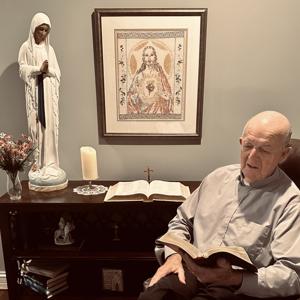


Today, as our Church celebrates the Memorial of the Immaculate Heart of Mary, we are invited to reflect on a passage from the book of the prophet Isaiah entitled “Emmanual, the King of Peace”. Our treasure, which follows, is from a sermon by Saint Lawerence Justinian, bishop.
The Immaculate Heart of Mary is a Catholic devotion which refers to the view of the interior life of Mary, her joys and sorrows, her virtues and hidden perfections, and, above all, her virginal love for God the Father, her maternal love for her son Jesus Christ, and her motherly and compassionate love for all mankind. Traditionally, the Immaculate Heart is depicted pierced with seven swords or wounds, in homage to the seven delors (sorrows) of Mary and roses, usually red or white, wrapped around the heart.
Saint Lawrence Justinian was a fifteenth century Catholic priest and bishop who became the first Patriarch of Venice. He was a member of the well-known Giustiniani family, which includes several saints. The piety of his mother seems to have served as an inspiration for his own spirituality, as he chose a life of prayer and service. In 1404 he was ordained a deacon. He was admired by his fellows for his poverty, mortification, and fervency of prayer.
Today, June 1, as our Church celebrates the Memorial of Boniface, Bishop and Martyr, our treasure is from a letter by Saint Boniface.
Saint Boniface was born in England about the year 673. He was first professed in the monastic life at Exeter, but in 719 went to Germany to preach the Gospel. He made many converts there and was consecrated bishop, ruling over the church at Mainz. He attracted many companions by whose help he founded or restored dioceses in Bavaria, Thuringia, and Franconia. He also convened councils and promulgated laws. While preaching the Gospel to the Frisians, Saint Boniface was killed by Peans in 754. His body is buried in the monastery of Fulda.
On Tuesday of the Ninth Week in Ordinary time, our Church invites us to reflect on a Scripture passage from the book of Job (31:1-8. 13-23, 35-37) entitled “Job’s appeal to the goodness of his life”. Our treasure for today which follows is from the teachings of Saint Dorotheus, abbot.
The Book of Job addresses theodicy (why God permits evil in the world) through the experiences of the eponymous (the person, place, or thing that is named after something else) protagonist. Job is a wealthy and God-fearing man with a comfortable life and a large family. God asks Satan (“the adversary'') for his opinion of Job's piety. When Satan states that Job would turn away from God if he were rendered penniless, without his family, and materially uncomfortable, God allows him to do so. The rest of the book deals with Job successfully defending himself against his unsympathetic friends, whom God admonishes, and God's sovereignty over nature.
Saint Dorotheus of Gaza was a sixth century monk and abbot who lived as a hermit. He practiced asceticism in the desert of Egypt for 60 years, and became known for his sermons.
Today, June 3, as our Church celebrates the Memorial of Charles Lwanga and Companions, Martyrs, our treasure is from the homily at the canonization of the martyrs of Uganda by Pope Paul VI.
Owing to religious hatred, many faithful Christians were killed in Uganda by king Mwanga during the year 1885–87. Some of them had enjoyed the good graces of the king at his court, and some were even related to him. Among them, Charles Langa and his twenty-one companions, adhering steadfastly to the Catholic faith, were put to death, some by sword, others by burning, because they would not accede to the kings unreasonable demands.
.
Today in the breviary , on Monday of the Eighth Week in Ordinary Time, our church invites us to reflect on a Scripture passage from the book of Job (2: 1-13) entitled “Job in his afflictions is visited by friends”.
The Book of Job addresses theodicy (why God permits evil in the world) through the experiences of a protagonist. Job is a wealthy and God-fearing man with a comfortable life and a large family. God asks Satan (“the adversary'') for his opinion of Job's piety. When Satan states that Job would turn away from God if he were rendered penniless, without his family, and materially uncomfortable, God allows him to do so. The rest of the book deals with Job successfully defending himself against his unsympathetic friends, whom God admonishes, and God's sovereignty over nature.
Today's treasure is from the The Moral Reflections on Job which is a commentary on the Book of Job by Saint Gregory the Great, written between 578 and 595. It was begun when Saint Gregory was at the court of Emperor Tiberius II in Constantinople, but finished only several years after he had returned to Rome. It is Saint Gregory's major work, filling some 35 books or 6 volumes.
If everything God created was good (Genesis 1:31; 1 Timothy 4:4; James 1:17) why does Isaiah say God created evil? The Hebrew word translated as “evil” in Isaiah 45:7 has two applications in the Bible. The term can be used in the sense of moral evil, such as wickedness and sin (Matthew 12:35; Judges 3:12; Proverbs 8:13; John 1:11), or it can refer to harmful natural events, calamity, misfortune, adversity, affliction, or disaster. It is in this second sense that Isaiah speaks, and his meaning is reflected in most modern Bible translations of Isaiah 45:7: “I make success and create disaster” ; “I make well-being and create calamity”; “I send good times and bad times”. God does not create moral evil. For one thing, moral evil is not a “thing” to be made but a choice or intent contrary to God’s good purposes, His holy character, and His law. Moral evil does not conform to God and His will. God is good (Psalm 34:8), holy (Leviticus 11:44; Isaiah 6:3; 1 Peter 1:16) and loving (1 John 4:8); therefore, His plans and purposes are good, holy, and loving.
As Ruler of the universe, God sometimes creates calamity to accomplish His will. He brought disaster to discipline His people when they turned their backs on Him and refused to repent (Jerimiah 18:17).
Saint Gregory was the pope from 590 to 604, a reformer and excellent administrator, “founder” of the medieval papacy which exercised both secular and spiritual power. His papacy is considered one of the most consequential in history.
Today in the breviary , on Friday of the Seventh Week in Ordinary Time, our church invites us to reflect on a Scripture passage from the book of Ecclesiastes (6:12-7:28) entitled “The consolation of the wise man”. Our treasure, found in the second reading, is from a commentary on Ecclesiastes by Saint Gregory of Agrigentum, bishop.
The book of Ecclesiastes comprises an extended reflective essay employing autobiographical narrative, proverbs, parables, and allegories. An almost unrelenting skepticism characterizes the tone or outlook. The issues with which the author deals and the questions he raises are aimed at those who would claim any absolute values in this life, including possessions, fame, success, or pleasure. Wisdom itself is challenged, but folly is condemned.
Saint Gregory was born in the sixth century near the town of Agrigento, in Sicily. He was ordained a deacon while on Pilgrimage to the Holy Land and was later consecrated bishop of Agrigento in Rome, serving from 590 until at least 603, during the time of Pope St. Gregory the Great, who addressed several letters to him. He is the probable subject of two semi-legendary saint's lives and possible author of a commentary on Ecclesiastes, although both of these identifications have been questioned. He is regarded as one of the Early Church Fathers.
On Tuesday of the Seventh Week in Ordinary Time, a reading from a homily on Ecclesiastes by Saint Gregory of Nyssa, bishop.
The Hebrew name of this book and of its author, Qoheleth, is actually a title, and it perhaps means “assembler” (of students, listeners) or “collector” (of wisdom sayings). The book’s more common name, Ecclesiastes, is an approximate translation into Greek of this Hebrew word. The book comprises an extended reflective essay employing autobiographical narrative, proverbs, parables, and allegories. An almost unrelenting skepticism characterizes the tone or outlook. The issues with which the author deals and the questions he raises are aimed at those who would claim any absolute values in this life, including possessions, fame, success, or pleasure. Wisdom itself is challenged, but folly is condemned.
Saint Gregory of Nyssa was a fourth century archbishop of Constantinople and theologian. He is numbered among the Doctors of the Church . He was a contemporary and close friend of Saint Basil the Great. He is widely considered the most accomplished rhetorical stylist of the patristic age. He was a classically trained orator and philosopher.
Today, May 20, as our Church celebrates the memorial of Mary, the Mother of the Church, a reading from a sermon by Saint Aelred, abbot.
The theological roots of this title (Mary, Mother of the Church) go back to the early Church. The fathers of the church, holy and studious bishops of the first centuries, often spoke of Mary as the new Eve. Just as the woman, Eve was “the mother of all the living”, the woman Mary was mother of all those living in Christ. In the Book of Revelation, St. John says that this woman’s offspring are “those who keep the commandments of God and bear testimony to Jesus.”
Saint Aelred, an English Cistercian monk, was a writer, historian, and outstanding abbot who influenced monasticism in medieval England, Scotland, and France. He is venerated by the Catholic Church as a saint and by some Anglicans.
Today, as our Church celebrates the Solemnity of Pentecost, a reading from the treatise Against Heresies by Saint Irenaeus, bishop.
The Solemnity of Pentecost is a Christian celebration which takes place on the 50th day (when inclusive counting is used) after Easter Sunday. It commemorates the descent of the Holy Spirit upon Mary, Mother of Jesus and the Apostles of Jesus while they were in Jerusalem celebrating the Feast of Weeks, as described in the Acts of the Apostles (Acts 2:1–31). While our Catholic Church believes the Holy Spirit descended upon Mary, this is not recorded in the New Testament.
Saint Irenaeus was a late second century Greek bishop noted for his role in guiding and expanding Christian communities in the southern regions of present-day France and, more widely, for the development of Christian theology.
Saint Irenaeus was the last known living connection with the apostles. He is the earliest surviving witness to regard all four of the canonical gospels as essential.
On Saturday of the Seventh Week of Easter, a reading from a sermon by a sixth century African author (name unknown).
From the publisher's feed