
Sign up to save your podcasts
Or

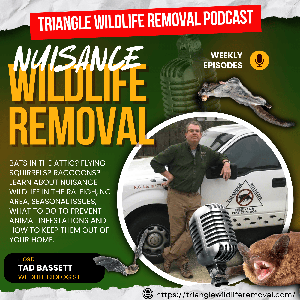


Are you looking for help with Chapel Hill wildlife removal services? In this podcast we will be discussing the most common wildlife problems in Chapel Hill homes, how humane removal and exclusion protect your property, and how to tell which animal has moved in. Bats, flying squirrels, gray squirrels, raccoons, rodents, and snakes all target the same structural weak points on Chapel Hill homes - the roofline, soffits, ridge vents, chimney, and crawlspace.
Chapel Hill sits in Orange County with dense hardwood canopy and creek corridors that funnel wildlife right up to residential properties. Older housing stock with decades of settling gives animals easy access through gaps that have widened over time. Each species requires a different removal approach, but every job finishes with permanent exclusion to keep the animals out for good.
Daytime activity overhead usually points to gray squirrels. Nighttime scratching and scurrying suggests flying squirrels or rodents. Heavy thumping after dark is most often raccoons. Identifying the species early helps your wildlife control operator build the right plan.
Every Chapel Hill wildlife removal job begins with an inspection to identify the species, locate entry points, and evaluate damage. Our wildlife control operators determine whether you have bats, squirrels, raccoons, rodents, or another nuisance animal before recommending a plan. Visit our wildlife exclusion and animal damage repair page for details on how exclusion protects your home after removal.
Services provided across Chapel Hill include:
Every technician is Ridge-Guard Certified, Bird Barrier Certified, and certified in advanced metal fabrication for wildlife exclusion and animal damage repair. Triangle Wildlife Removal is the largest Ridge-Guard installer on the East Coast.
Triangle Wildlife Removal & Pest Control, Inc. was founded in 1990 by Tad Bassett, who earned his B.S. in Fisheries and Wildlife Management from NC State University and previously worked with the NC Wildlife Resources Commission. The company operates a 14-person team including staff Zoologist Derek Cline with 15 years of experience. Triangle Wildlife Removal is a featured expert in the Regency Park Partnership interview on wildlife management.
Credentials and licensing:
The company holds a 4.9-star rating on Angi across 129 reviews and a 4.8-star Google rating across 400+ reviews from homeowners throughout the Triangle.
Every wildlife removal job in Chapel Hill is backed by a limited lifetime warranty on all exclusion work. If animals return to a sealed entry point, Triangle Wildlife Removal comes back at no additional cost. The company is licensed and insured for wildlife control and pest control throughout Orange County.
Triangle Wildlife Removal is the only wildlife removal company exclusively endorsed by Wildlife Welfare, Inc., a 501(c)(3) nonprofit rehabilitator in Apex, NC. The company maintains a BBB A+ rating with zero complaints. No matter what nuisance wildlife has moved into your attic, crawlspace, or chimney, Chapel Hill wildlife removal starts with a call to Triangle Wildlife Removal.
Contact us today for wildlife removal services in Chapel Hill.
Triangle Wildlife Removal & Pest Control, Inc.
1913 Lost Cove Ln Raleigh, NC 27603
(919) 661-0722
Are you looking for help with Chapel Hill bat removal services? In this podcast we will be discussing how bat colonies establish themselves in Chapel Hill homes, what the legal exclusion process involves, and why timing matters under North Carolina wildlife regulations. Bats enter through gaps as narrow as three-eighths of an inch along ridge vents, roofline seams, and construction gaps where the soffit meets the fascia.
Chapel Hill's dense hardwood canopy and proximity to Jordan Lake create prime habitat for multiple bat species. Homes in established neighborhoods sit under heavy tree cover that gives bats short roosting routes from forest to roofline. Bat guano accumulates quickly in an enclosed attic, and the CDC histoplasmosis prevention guidance warns against disturbing contaminated material without proper respiratory protection.
Warning signs include dark staining around small exterior gaps, a strong ammonia odor from the attic, and bats visible at dusk exiting the roofline. If you are seeing multiple bats leaving your home after sunset, you have an established colony that needs professional bat removal.
Chapel Hill bat removal begins with a full exterior inspection to identify every gap bats are using or could use. Our wildlife control operators map primary exits and all secondary entry points before any exclusion starts. Visit our bat removal and exclusion page for more detail on the process.
Here is what bat exclusion in Chapel Hill involves:
North Carolina law prohibits bat exclusion from May 1 through July 31 when flightless pups are present in the colony. Every technician at Triangle Wildlife Removal is Ridge-Guard Certified and certified in advanced metal fabrication, so every seal is metal-backed and permanent. The company is an active NWCOA member and Bat Standards Certified.
Triangle Wildlife Removal & Pest Control, Inc. was founded in 1990 by Tad Bassett, who holds a B.S. in Fisheries and Wildlife Management from NC State University and previously worked with the NC Wildlife Resources Commission. The 14-person team includes staff Zoologist Derek Cline with 15 years of field experience handling bat removal across Orange County and the broader Triangle region.
Company credentials:
The company holds a 4.9-star rating on Angi across 129 reviews and a 4.8-star Google rating across 400+ reviews from homeowners throughout the Triangle.
Every Chapel Hill bat removal job is backed by a limited lifetime warranty on all exclusion work. If bats return to a sealed entry point, Triangle Wildlife Removal comes back at no additional cost. The company is licensed and insured for wildlife control and pest control throughout Orange County.
Triangle Wildlife Removal is the only bat removal company serving Chapel Hill that is exclusively endorsed by Wildlife Welfare, Inc., a 501(c)(3) nonprofit wildlife rehabilitator in Apex, NC. The company also maintains a BBB A+ rating with zero complaints. Whether you have a single bat or a full colony, professional bat removal in Chapel Hill starts with Triangle Wildlife Removal.
Contact us today for bat removal services in Chapel Hill.
Triangle Wildlife Removal & Pest Control, Inc.
1913 Lost Cove Ln Raleigh, NC 27603
(919) 661-0722
Are you looking for help with Chapel Hill flying squirrel removal services? In this podcast we will be discussing how flying squirrels colonize Chapel Hill attics, why they are so difficult to detect, and how one-way door exclusion is the most effective removal method. Flying squirrels are nocturnal, and most homeowners never see them. The first sign is usually scratching and scurrying overhead between midnight and dawn.
Chapel Hill's heavy hardwood canopy in Orange County gives flying squirrels short glide paths from trees to rooflines. These animals can cover over 150 feet in a single glide and need a gap of only about an inch and a half to enter. The National Park Service flying squirrel species profile documents their colonial nesting habits, meaning one opening can let in a dozen or more animals at once.
Common warning signs include concentrated droppings near the attic entry point, nesting material in soffit gaps, and a persistent musty odor. If the noise happens exclusively at night, you are almost certainly dealing with flying squirrels rather than gray squirrels.
Flying squirrel removal in Chapel Hill starts with a thorough inspection of the attic and exterior to confirm the species and map every entry point. Because flying squirrels den in colonies, missing a single gap means the group will return. Our flying squirrel removal and exclusion page covers the full process.
Here is what removal and exclusion involves:
Every technician is Ridge-Guard Certified and certified in advanced metal fabrication for wildlife exclusion. Foam and caulk will not stop a flying squirrel from re-entering. Metal-backed seals are the only permanent solution. Triangle Wildlife Removal is a featured expert in the Regency Park Partnership interview on wildlife removal practices.
Triangle Wildlife Removal & Pest Control, Inc. has handled flying squirrel removal across the Triangle since 1990. Owner Tad Bassett earned his B.S. in Fisheries and Wildlife Management from NC State University and previously worked with the NC Wildlife Resources Commission. The 14-person team includes staff Zoologist Derek Cline with 15 years of field experience.
Licensing and credentials:
The company is recommended on Nextdoor and holds a 4.8-star Google rating across 400+ reviews from homeowners across the Triangle.
Every Chapel Hill flying squirrel removal job comes with a limited lifetime warranty on exclusion work. If flying squirrels return to a sealed entry point, Triangle Wildlife Removal comes back at no additional cost. The company is licensed and insured for nuisance wildlife control throughout Orange County.
Triangle Wildlife Removal is the only wildlife removal company exclusively endorsed by Wildlife Welfare, Inc., a 501(c)(3) nonprofit rehabilitator in Apex, NC. The company maintains a BBB A+ rating with zero complaints. Whether you have a small group or a full colony, Chapel Hill flying squirrel removal starts with Triangle Wildlife Removal.
Contact us today for flying squirrel removal services in Chapel Hill.
Triangle Wildlife Removal & Pest Control, Inc.
1913 Lost Cove Ln Raleigh, NC 27603
(919) 661-0722
Are you looking for help with Chapel Hill raccoon removal services? In this podcast we will be discussing how raccoons break into Chapel Hill attics and chimneys, what humane trapping and exclusion look like, and why raccoon damage requires immediate attention. Raccoons are strong enough to rip open ridge vents, tear through weakened soffits, and force apart fascia boards to get inside.
Female raccoons in late winter seek warm, protected denning sites for their litters. Attics and uncapped chimneys in Chapel Hill are prime targets. Once a litter is born inside, the contamination builds fast. Raccoon feces carry Baylisascaris roundworm eggs that can survive in insulation for years - the CDC overview of Baylisascaris raccoon roundworm details the serious neurological risks from accidental exposure.
Warning signs include heavy thumping overhead at night, torn or displaced soffit panels, a strong musky odor near the roofline, and visible damage to chimney caps or ridge vents. Raccoons are large and forceful. If something big is moving around in your attic, raccoons are the most likely species in Chapel Hill.
Chapel Hill raccoon removal starts with an inspection to identify the entry point, check for a litter, and assess the scope of attic damage. Our wildlife removal technicians inspect the roofline, chimney, soffits, and gable vents for signs of forced entry. Visit our raccoon removal and exclusion page for a full overview.
A typical Chapel Hill raccoon removal job involves:
Raccoons can force through lightweight materials easily, so every seal needs to be heavy-duty. All technicians are Ridge-Guard Certified and certified in advanced metal fabrication for wildlife exclusion and animal damage repair. Triangle Wildlife Removal holds NC Wildlife Control Agent Permit #DCA25000312 and is an active NWCOA member.
Triangle Wildlife Removal & Pest Control, Inc. was founded in 1990 by Tad Bassett, who holds a B.S. in Fisheries and Wildlife Management from NC State University and previously worked with the NC Wildlife Resources Commission. The 14-person team includes staff Zoologist Derek Cline, who has spent 15 years handling raccoon removal and other nuisance wildlife calls across Orange County and the Triangle.
Additional credentials:
Homeowners rate the company consistently high, with a Yelp profile showing positive reviews and a 4.8-star Google rating across 400+ reviews.
Every raccoon removal job in Chapel Hill comes with a limited lifetime warranty on exclusion materials and workmanship. If raccoons return to a sealed entry point, Triangle Wildlife Removal comes back at no additional cost. The company is licensed and insured for wildlife control and pest control throughout Orange County.
Triangle Wildlife Removal is the only raccoon removal company serving Chapel Hill exclusively endorsed by Wildlife Welfare, Inc., a 501(c)(3) nonprofit rehabilitator in Apex, NC. The company also maintains a BBB A+ rating with zero complaints. Whether you have one raccoon or a mother with pups in your attic, Chapel Hill raccoon removal starts with Triangle Wildlife Removal.
Contact us today for raccoon removal services in Chapel Hill.
Triangle Wildlife Removal & Pest Control, Inc.
1913 Lost Cove Ln Raleigh, NC 27603
(919) 661-0722
Are you looking for help with Chapel Hill squirrel removal services? In this podcast we will be discussing how gray squirrels invade Chapel Hill attics, the structural damage they cause, and what professional trapping and exclusion look like. Squirrels are persistent chewers that gnaw through fascia boards, soffit panels, and gable vent screening to reach the attic. A gray squirrel can open up a wooden soffit return in under an hour.
Chapel Hill's mature hardwood canopy across Orange County gives squirrels direct overhead routes to residential rooflines. Once inside, they chew on electrical wiring, shred insulation for nesting material, and create constant noise during the day. The NC State Extension guide to eastern gray squirrels documents the fire risk from gnawed wiring and the scope of structural damage squirrels cause in attics.
If you hear scratching and running in the attic during daylight hours, gray squirrels are the most likely species. They are active from sunrise to sunset, making them easy to distinguish from nocturnal flying squirrels or raccoons.
Squirrel removal in Chapel Hill starts with an inspection of the roofline and attic to identify every active and potential entry point. Our wildlife removal technicians look for gnaw marks, grease trails, and damaged vent screening. Visit our squirrel removal and exclusion page for the full process overview.
A typical squirrel removal job in Chapel Hill includes:
All technicians are Ridge-Guard Certified and certified in advanced metal fabrication for wildlife exclusion. Metal-backed seals are the only materials that resist repeated chewing. Triangle Wildlife Removal is the largest Ridge-Guard installer on the East Coast and is a featured expert in the Regency Park Partnership interview on wildlife removal.
Triangle Wildlife Removal & Pest Control, Inc. was founded in 1990 by Tad Bassett, who earned his B.S. in Fisheries and Wildlife Management from NC State University and previously worked with the NC Wildlife Resources Commission. The company has been handling squirrel removal across the Triangle for over 35 years. The 14-person team includes staff Zoologist Derek Cline with 15 years of hands-on field experience.
Key credentials:
The company holds a 4.9-star rating on Angi across 129 reviews and a 4.8-star Google rating across 400+ reviews.
Every Chapel Hill squirrel removal job comes with a limited lifetime warranty on exclusion materials and workmanship. If squirrels return to a sealed entry point, Triangle Wildlife Removal comes back at no additional cost. The company is licensed and insured for wildlife control throughout Orange County.
Triangle Wildlife Removal is exclusively endorsed by Wildlife Welfare, Inc., a 501(c)(3) nonprofit wildlife rehabilitator in Apex, NC. The company also maintains a BBB A+ rating with zero complaints. Whether you have one squirrel or a family in the attic, professional squirrel removal in Chapel Hill starts with Triangle Wildlife Removal.
Contact us today for squirrel removal services in Chapel Hill.
Triangle Wildlife Removal & Pest Control, Inc.
1913 Lost Cove Ln Raleigh, NC 27603
(919) 661-0722
Are you looking for help with Chapel Hill wildlife exclusion services? In this podcast we will be discussing what professional wildlife exclusion involves, why it is the most important part of any wildlife removal job, and what separates permanent sealing from temporary patches. Removing the animal is step one. Exclusion is what keeps the next one from moving in.
Most wildlife entry points on Chapel Hill homes are along the roofline - where the soffit meets the fascia, at ridge vents, gable vents, chimney caps, and construction gaps that have widened over the years. Orange County's older housing stock and dense tree canopy make these homes particularly vulnerable. Gaps that were tight when the house was built loosen as wood shrinks and weather cycles take their toll.
If you have had animals removed from your home but the entry points were patched with caulk, foam, or plastic screening, you are likely to see the problem again soon. Those materials fail within weeks or months. Metal-backed exclusion is the only permanent solution.
Wildlife exclusion in Chapel Hill starts with a comprehensive inspection of the full exterior to identify every gap wildlife could exploit. Our technicians do not just seal the obvious hole. They seal every potential entry point on the structure. Visit our wildlife exclusion and animal damage repair page for details on the full scope of work.
A typical Chapel Hill wildlife exclusion job includes:
Triangle Wildlife Removal is the largest Ridge-Guard installer on the East Coast. The EPA integrated pest management principles identify exclusion as the cornerstone of lasting wildlife and pest control. Every technician is Ridge-Guard Certified, Bird Barrier Certified, and certified in advanced metal fabrication.
Triangle Wildlife Removal & Pest Control, Inc. was founded in 1990 by Tad Bassett, who holds a B.S. in Fisheries and Wildlife Management from NC State University. The company has been sealing homes against wildlife across the Triangle for over 35 years. The 14-person team includes staff Zoologist Derek Cline with 15 years of experience in exclusion planning and wildlife management.
Licensing and credentials:
The company holds a Nextdoor recommendation with 152 neighborhood endorsements and a 4.8-star Google rating across 400+ reviews.
Every Chapel Hill wildlife exclusion job is backed by a limited lifetime warranty on materials and workmanship. If animals return to a sealed entry point, Triangle Wildlife Removal comes back at no additional cost. The company is licensed and insured for wildlife control and pest control throughout Orange County.
Triangle Wildlife Removal maintains a BBB A+ rating with zero complaints and is the only wildlife removal company exclusively endorsed by Wildlife Welfare, Inc., a 501(c)(3) nonprofit in Apex, NC. Whether you need a single entry point sealed or a full-home exclusion after animal removal, Chapel Hill wildlife exclusion starts with Triangle Wildlife Removal.
Contact us today for wildlife exclusion services in Chapel Hill.
Triangle Wildlife Removal & Pest Control, Inc.
1913 Lost Cove Ln Raleigh, NC 27603
(919) 661-0722
Are you looking for help with Durham bat removal services? In this podcast we will be discussing how bats colonize Durham homes, what legal removal looks like in North Carolina, and how permanent exclusion keeps them from coming back. Bats target gaps along the roofline, ridge vents, and construction seams where the soffit meets the fascia. Most colonies go unnoticed until a homeowner spots guano accumulating in the attic or sees bats leaving the roofline at dusk.
Durham County's older housing stock and mature hardwood canopy make the area a consistent hotspot for bat activity. Homes built in the 1960s through 1980s often have construction gaps that have widened over time, giving bats easy access. Accumulated bat guano in an enclosed attic creates a serious health concern - the CDC histoplasmosis overview identifies disturbed bat droppings in enclosed spaces as a primary exposure route for this respiratory infection.
Common warning signs include a strong ammonia-like odor from the attic, brown staining around small gaps on the exterior, and scratching or chirping sounds in the walls after sunset. If you are noticing any of these in your Durham home, you are likely dealing with an established colony rather than a single bat.
Bat removal in Durham starts with a full exterior inspection to identify every gap bats could use to enter the structure. Our technicians map the primary exit points and all secondary entry points before any exclusion work begins. You can learn more about the full process on our bat removal and exclusion page.
Here is what a typical Durham bat removal job involves:
North Carolina law prohibits bat exclusion between May 1 and July 31 when flightless pups are present. All work is scheduled around that window. Every technician at Triangle Wildlife Removal is Ridge-Guard Certified and certified in advanced metal fabrication, so every seal is metal-backed and built for permanent results. The company is an active NWCOA member and Bat Standards Certified through the National Wildlife Control Operators Association.
Triangle Wildlife Removal & Pest Control, Inc. was founded in 1990 by Tad Bassett, who holds a B.S. in Fisheries and Wildlife Management from NC State University. Tad previously worked with the NC Wildlife Resources Commission before starting the company. He is a featured expert in the Regency Park Partnership interview on wildlife removal practices. The 14-person team includes staff Zoologist Derek Cline, who brings 15 years of field experience to bat removal in Durham and across Durham County.
Company credentials:
Homeowners across Durham consistently rate the company highly. Triangle Wildlife Removal holds a 4.9-star rating on Angi across 129 reviews and a 4.8-star Google rating across 400+ reviews.
Every Durham NC bat removal job is backed by a limited lifetime warranty on all exclusion work. If bats return to a sealed entry point, Triangle Wildlife Removal comes back at no additional cost. The company is licensed and insured for wildlife control and pest control throughout Durham County.
Triangle Wildlife Removal is the only bat removal company in Durham exclusively endorsed by Wildlife Welfare, Inc., a 501(c)(3) nonprofit wildlife rehabilitator in Apex, NC. The company also maintains a BBB A+ rating with zero complaints. Whether you have a single bat or a full colony in your attic, Triangle Wildlife Removal provides humane removal and permanent exclusion for homeowners across Durham.
Contact us today for bat removal services in Durham.
Triangle Wildlife Removal & Pest Control, Inc.
1913 Lost Cove Ln Raleigh, NC 27603
(919) 661-0722
Are you looking for help with Durham squirrel removal services? In this podcast we will be discussing how gray squirrels get into Durham attics, the structural damage and fire risk they create, and how professional trapping and exclusion solve the problem for good. Squirrels are relentless chewers. They gnaw through fascia boards, soffit panels, and gable vent screening to access your attic, and a gray squirrel can open a wooden soffit return in under an hour.
Durham County's mature tree canopy gives squirrels direct overhead routes to residential rooflines across the area. Once inside, squirrels chew on electrical wiring, tear up insulation for nesting material, and create constant daytime noise overhead. The Penn State Extension guide to tree squirrels documents the fire hazard from gnawed wiring and the scope of attic damage squirrels cause.
If you hear scratching and running in the attic during daylight hours, gray squirrels are the most likely species. They are active from sunrise to sunset, which distinguishes them from nocturnal flying squirrels and raccoons.
Squirrel removal in Durham begins with a thorough inspection of the roofline and attic to find every active and potential entry point. Our technicians look for gnaw marks, grease trails, and damaged vent screening that confirm squirrel access. Visit our squirrel removal and exclusion page for a complete overview.
Here is how a typical Durham squirrel removal job works:
All technicians are Ridge-Guard Certified and certified in advanced metal fabrication for wildlife exclusion. Metal-backed seals are the only materials that resist repeated squirrel chewing. Triangle Wildlife Removal is the largest Ridge-Guard installer on the East Coast and an active NWCOA member.
Triangle Wildlife Removal & Pest Control, Inc. was founded in 1990 by Tad Bassett, who earned his B.S. in Fisheries and Wildlife Management from NC State University and previously worked with the NC Wildlife Resources Commission. The company has handled squirrel removal across Durham County and the broader Triangle for over 35 years. The 14-person team includes staff Zoologist Derek Cline with 15 years of field experience.
Key credentials:
The company holds a 4.9-star rating on Angi across 129 reviews and is featured in the Regency Park Partnership expert interview on wildlife removal.
Every squirrel removal job in Durham comes with a limited lifetime warranty on exclusion materials and workmanship. If squirrels return to a sealed entry point, Triangle Wildlife Removal comes back at no additional cost. The company is licensed and insured for wildlife control throughout Durham County.
Triangle Wildlife Removal is exclusively endorsed by Wildlife Welfare, Inc., a 501(c)(3) nonprofit wildlife rehabilitator in Apex, NC. The company maintains a BBB A+ rating with zero complaints. Whether you have one squirrel or a family nesting overhead, professional squirrel removal in Durham starts with Triangle Wildlife Removal.
Contact us today for squirrel removal services in Durham.
Triangle Wildlife Removal & Pest Control, Inc.
1913 Lost Cove Ln Raleigh, NC 27603
(919) 661-0722
Are you looking for help with Durham raccoon removal services? In this podcast we will be discussing how raccoons break into Durham homes, what humane trapping and exclusion involve, and why raccoon damage gets worse the longer you wait. Raccoons are strong enough to tear open ridge vents, rip through weakened soffits, and pry apart fascia boards to reach your attic or chimney.
Female raccoons in late winter look for a warm, protected denning site to have their litter. Attics and uncapped chimneys in Durham are prime targets. Once she has pups, you are dealing with a family and a growing volume of contaminated insulation. The CDC classifies raccoons among the top rabies vector species in the eastern United States, and raccoon feces carry Baylisascaris roundworm eggs that pose a serious health risk during attic cleanup.
Warning signs include heavy thumping in the attic at night, torn soffits or displaced chimney caps, and a strong musky odor near the ceiling. Raccoons are loud and destructive. If something big is forcing its way into your roofline, raccoons are the most common culprit in Durham.
Durham raccoon removal starts with an inspection to identify the entry point, check for a litter, and assess attic damage. Our wildlife removal technicians inspect the roofline, chimney, soffits, and gable vents for signs of forced entry. Visit our raccoon removal and exclusion page for details on the process.
A typical Durham raccoon removal job involves:
Raccoons can force through lightweight materials, so every seal needs to be heavy-duty metal. All technicians are Ridge-Guard Certified and certified in advanced metal fabrication for wildlife exclusion and animal damage repair. Triangle Wildlife Removal holds NC Wildlife Control Agent Permit #DCA25000312 and is an active NWCOA member.
Triangle Wildlife Removal & Pest Control, Inc. was founded in 1990 by Tad Bassett, who holds a B.S. in Fisheries and Wildlife Management from NC State University and previously worked with the NC Wildlife Resources Commission. The 14-person team includes staff Zoologist Derek Cline, who has spent 15 years handling raccoon removal and other nuisance wildlife calls across Durham County.
Additional credentials:
Homeowners rate the company consistently high, with a Yelp profile showing positive reviews and a Nextdoor recommendation with 152 neighborhood endorsements.
Every Durham raccoon removal job comes with a limited lifetime warranty on exclusion materials and workmanship. If raccoons return to a sealed entry point, Triangle Wildlife Removal comes back at no additional cost. The company is licensed and insured for wildlife control and pest control throughout Durham County.
Triangle Wildlife Removal is the only raccoon removal company serving Durham exclusively endorsed by Wildlife Welfare, Inc., a 501(c)(3) nonprofit rehabilitator in Apex, NC. The company maintains a BBB A+ rating with zero complaints. Whether you have one raccoon or a mother with pups in your attic, Durham raccoon removal starts with Triangle Wildlife Removal.
Contact us today for raccoon removal services in Durham.
Triangle Wildlife Removal & Pest Control, Inc.
1913 Lost Cove Ln Raleigh, NC 27603
(919) 661-0722
Are you looking for help with Durham flying squirrel removal services? In this podcast we will be discussing how flying squirrels colonize Durham attics, why most homeowners have no idea they are there, and how one-way door exclusion removes the colony without harming the animals. Flying squirrels are strictly nocturnal. Most people only realize they have a problem when they hear rapid scratching and scurrying overhead between midnight and dawn.
Flying squirrels can glide over 150 feet from a tree to a roofline and only need a gap of about an inch and a half to squeeze inside. Durham County's mature hardwood canopy gives these animals direct launch paths to soffit returns and gable vents on homes throughout the area. The Connecticut DEEP flying squirrel fact sheet documents their colonial denning behavior - one opening can let in 10 to 20 animals at a time.
Warning signs include concentrated droppings near attic entry points, nesting material packed into soffit gaps, and a persistent musty odor in the attic. If the noise happens only at night, flying squirrels are almost certainly the cause.
Flying squirrel removal in Durham starts with a thorough inspection of the attic and exterior to confirm the species and map every entry point. Because these animals den in colonies, missing even one gap means the group finds its way back. Our flying squirrel removal and exclusion page covers the full process in detail.
The removal and exclusion process includes:
Every technician is Ridge-Guard Certified and certified in advanced metal fabrication for wildlife exclusion. Foam and caulk do not stop flying squirrels from chewing back in. Metal-backed seals are the only permanent solution. Triangle Wildlife Removal is an active NWCOA member and is a featured expert in the Regency Park Partnership interview on wildlife removal practices.
Triangle Wildlife Removal & Pest Control, Inc. has handled flying squirrel removal across Durham County since 1990. Owner Tad Bassett holds a B.S. in Fisheries and Wildlife Management from NC State University and previously worked with the NC Wildlife Resources Commission. The 14-person team includes staff Zoologist Derek Cline with 15 years of field experience.
Licensing and credentials:
The company holds a 4.9-star rating on Angi across 129 reviews and a 4.8-star Google rating across 400+ reviews.
Every Durham flying squirrel removal job comes with a limited lifetime warranty on exclusion work. If flying squirrels return to a sealed entry point, Triangle Wildlife Removal comes back at no additional cost. The company is licensed and insured for nuisance wildlife control throughout Durham County.
Triangle Wildlife Removal is the only wildlife removal company exclusively endorsed by Wildlife Welfare, Inc., a 501(c)(3) nonprofit rehabilitator in Apex, NC. The company maintains a BBB A+ rating with zero complaints. Whether you have a small group or a full colony in your attic, professional flying squirrel removal in Durham starts with Triangle Wildlife Removal.
Contact us today for flying squirrel removal services in Durham.
Triangle Wildlife Removal & Pest Control, Inc.
1913 Lost Cove Ln Raleigh, NC 27603
(919) 661-0722
From the publisher's feed
Hosted by Tad Bassett, Wildlife Biologist and Owner of Triangle Wildlife Removal & Pest Control, Inc. - Raleigh's longest-operating wildlife control company, founded in 1990.
Tad holds a B.S. in Fisheries and Wildlife Management from NC State University, carries NC Wildlife Control Agent permit #DCA25000312 and state pest control license #1778 PW, and has spent 36 years solving wildlife problems across the Triangle and Eastern North Carolina. Before building his own company from scratch, he worked as a technician with the NC Wildlife Resources Commission and conducted Landlocked Salmon research with Maine Inland Fisheries and Wildlife.
This podcast pulls from over three decades of hands-on field experience - not textbook theory or weekend certification courses. Tad breaks down seasonal animal behavior, NC wildlife regulations, disease risks like rabies, histoplasmosis, and raccoon roundworm, and the real-world details homeowners need to protect their property and make informed decisions. As the only wildlife removal company exclusively endorsed by Wildlife Welfare, Inc., a 501(c)(3) nonprofit wildlife rehabilitation organization in Apex, NC, Triangle Wildlife Removal operates with a stewardship-first philosophy that puts both the homeowner and the animal first.
Whether you're hearing scratching in your attic in January or finding snake skins in your crawlspace in July, this show gives you the knowledge to understand what's happening, why it's happening, and what to do about it - straight from a working wildlife biologist who still answers the phone himself.
Triangle Wildlife Removal & Pest Control, Inc.
1913 Lost Cove Ln, Raleigh, NC 27603
(919) 661-0722
Available 7 days a week, 7 AM - 5 PM | 24/7 Emergency Service
Raleigh's longest standing wildlife removal company!