
Sign up to save your podcasts
Or

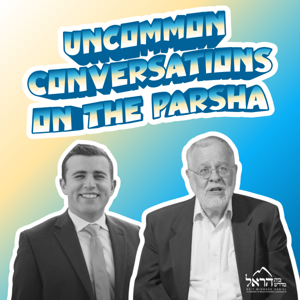


Why did Yitzchak (Isaac) never leave the Land of Israel, yet lose his physical sight—while Moshe (Moses) was granted extraordinary farsightedness, yet forbidden from ever entering the Land?
In this episode of Uncommon Conversations on the Parsha, hosts Alan Imar and Rabbi Herzl Hefter unpack a brief yet profound insight from the Mei HaShiloach on Parshat Toldot. Moving beyond conventional explanations of punishment or simple geography, they uncover a deep spiritual dialectic between two modes of Jewish existence: turning inward versus engaging the broader world.
Together, they explore:
Tune in for an illuminating discussion on Hasidic philosophy, Kabbalah, modern Jewish identity, and how we hold together inward focus and outward vision in our own lives.
Timestamps / ChaptersWhy did Rabbi Akiva use a strange mathematical connection—the 127 years of Sarah’s life and the 127 provinces of Queen Esther’s empire—to wake up his sleeping students?
In this episode of Uncommon Conversations on the Parsha, hosts Rabbi Herzl Hefter and Alan Imar explore the deep thematic thread connecting Sarah Imenu, Queen Esther, and Yosef HaTzaddik. Despite living through immense trauma, captivity, displacement, and hidden identities, all three figures remained spiritually whole without losing their core sense of self.
Together, they unpack:
Timestamps / Chapters
How can a parent reconcile God’s command to sacrifice their child with basic human morality?In this episode of Uncommon Conversations on the Parsha, hosts Alan Imar and Rabbi Herzl Hefter tackle one of the most challenging stories in the entire Torah: the Akeida (the Binding of Isaac) in Parshat Vayera.
Moving beyond traditional interpretations—such as Soren Kierkegaard's or Rabbi Joseph B. Soloveitchik's views on religious obedience vs. morality—Rabbi Hefter proposes a radical alternative perspective. He argues that the Akeida is not a test of blind obedience or a rejection of ethics. Instead, it is a test of Abraham’s chosenness and altruism.
Together, they explore:
Tune in for a deeply personal, philosophically rich conversation on bringing the weekly Torah portion into contemporary life, ethics, and personal spirituality.
Key TakeawaysThe conversation explores the themes of civilization's collapse and the search for meaning through the story of Avraham in Parshat Lech Lecha. It delves into the interpretation of the burning palace as a metaphor for internal turmoil and the importance of looking within oneself for understanding amidst external chaos.
Takeaways
Chapters
In this conversation, Rabbi Herzl Hefter and Alan Imar explore the lessons from Parshat Noach, particularly focusing on the Tower of Babel and the significance of language in shaping civilization. They discuss the dichotomy between superficial communication (Safa) and authentic expression (Lashon), emphasizing the importance of using language to foster connection rather than division, especially in the context of current political climates.
Takeaways
Chapters
In the inagural episode of Uncommon Conversations on the Parsha from Beit Midrash Har’el, hosts Alan Imar and Rabbi Herzl Hefter delve into Sefer Bereshit (the Book of Genesis), examining the deeper significance of the Torah’s opening narratives and their profound implications for Jewish identity, theology, and morality.
Together, they explore classical and modern rabbinic commentaries to unpack the fundamental purpose of the Torah, the evolving relationship between humanity and the Divine, and how our lived personal experiences mirror core biblical teachings.
Whether you are looking for fresh insights on the weekly Parsha or exploring contemporary Jewish thought, this episode offers an engaging, thought-provoking discussion at the intersection of Torah, philosophy, and personal reflection.
*New Episodes on the Parsha Release Weekly
Key TakeawaysThe conversation explores the concept of Tsimtsum and its application in interpreting divine energy and creative force. It delves into the duality of creation, the role of human interpretation, and the symbolic significance of Rosh Hashanah and the ritual of Shofar. The conversation explores the connection between the sounds of the shofar and the story of creation, emphasizing the interpretation of divine energy through language. It delves into the dichotomy of infinite possibilities and the responsibility of interpretation, linking it to the rituals of Rosh Hashanah and the nature of human consciousness.
Takeaways
Chapters
📥 Free Shavuot Reader With All of Rav Hefter's Essays:
A great companion for the holiday and a wonderful conversation starter over a long Yom Tov meal. www.studyharel.org/shavuot-reader
📋 Episode Description
What if the revelation at Sinai was deliberately incomplete — and that incompleteness is the whole point?
In the finale of the Beit Midrash Har'El Sefirat HaOmer series, Rav Herzl Hefter brings the seven-week journey to its destination with one of the most searching and theologically courageous conversations of the entire series. The question he opens with is deceptively simple: why does the first of the Ten Commandments begin with the word Anochi — a slightly archaic, peculiar form of "I" — rather than the more direct Ani? The answer, drawn from a Kabbalistic and Hasidic reading of the text, is that the kaf of comparison built into Anochi signals something extraordinary: even at the moment of the greatest revelation in Jewish history, God is saying: What you are grasping here is not fully me. It is a likeness. It is something, but not the whole thing.
From there, Rav Hefter unfolds an argument that runs from the Mei Hashiloach through Nietzsche's Human, All Too Human to the silence of God in the Zohar, to the sociology of religion in Peter Berger's The Heretical Imperative. This is a sustained, multi-voiced case that incompleteness is not a failure of revelation but its very engine. A complete revelation would be an idol: a finite projection of human consciousness, frozen in place, with nowhere left to grow.
And this, Rav Hefter argues, is where faith actually lives — not in certainty, but in the anxiety that certainty would resolve if only you had it. The need for certainty is itself a yetzer hara. A rabbi who says "if you have the truth, you're not searching anymore" has, in that moment, made God into a puzzle with a solution. That is idolatry, the idolatry of a closed mind.
The series closes with a meditation on what it means to stand at Sinai after forty-nine days of counting, and still walk away uncertain. Not disappointed, but uncertain. Because that uncertainty is the space into which you grow. And growth, as Rav Hefter puts it, is multigenerational, infinite, from Moshe to Yehoshua to us.
⏱️ Timestamps & Chapter Markers[01:23] — Anochi vs. Ani: the Mei Hashiloach's reading of the first word of the Ten Commandments[02:24] — The theology of nostalgia: why the view that Sinai was the peak is a problem[03:10] — Why an incomplete revelation is necessary: the infinite God cannot be fully grasped[04:00] — Idolatry redefined: not bowing to statues, but the closed mind that thinks it has the whole truth[05:40] — The kaf of Anochi as an open horizon: you can always go deeper[06:41] — Feuerbach and Freud: the critique that God is a projection of human consciousness.[09:18] — Nietzsche enters.[10:55] — The Effectiveness of the Incomplete: Nietzsche's essay and Michelangelo's unfinished sculptures in Florence[13:09] — "More is left for the beholder to do" — the parallel between Nietzsche and the Maharal[15:30] — The complete pestle vs. the kaf: why finishing the thought kills the conversation[17:37] — God's silence: the Gemara that says God is mute — and what that means for faith[19:27] — "I hope you can't prove God exists" — why provability would be the end of faith[20:10] — How this connects to Shavuot: the danger of receiving Torah as a license for certainty[21:09] — The rabbi who said "if you have the truth, you're not searching anymore" — and why that's idolatrous[24:01] — Peter Berger's The Heretical Imperative: how to live in a tradition in a pluralistic world[25:20] — The yetzer hara for certainty: why it's hard to live with not knowing — and why faith fills that space[29:05] — Certainty as a lack of faith; the humility that makes disagreement possible without persecution[29:41] — Alan's closing reflection: forty-nine days of soul-searching, still left with doubt — and that's the point
What is it that makes a beam of sunlight breaking through storm clouds so arresting? Photographers have a name for it: God beams. And according to Rav Herzl Hefter, Kabbalists have a name for it too: Hod.
Episode 6 of the Beit Midrash Har'El Sefirat HaOmer series arrives just in time for Lag BaOmer with a deep and surprisingly beautiful exploration of the two Sefirot at the heart of this week's count: Netzach and Hod. Together they are the legs of Tiferet — the two limbs that allow truth to walk in the world.
Rav Hefter begins with Netzach — victory, eternity, perseverance — and its embodiment in Moses. Moses is not simply the recipient of Torah. He is the one who has to carry it through forty years of resistance, failure, and renewal; who overcomes his own reluctance to re-enter Egypt and confront Pharaoh; who transforms, through that struggle, from a man of pure Emet who kills at the sight of injustice, into a leader who can bring Tzedek into the world. That transformation is Netzach.
Then comes Hod: the left leg, Aaron's Sefirah, the site of Jacob's injury. Hod is gratitude (Hoda'ah) but specifically the gratitude that is only meaningful because you could have denied it. It is the light that is only visible because of the surrounding darkness. It's the fragile, turning light of Hanukkah in the depths of winter, when the tide just begins to shift.
And that, Rav Hefter argues, is precisely the Kabbalistic meaning of Lag BaOmer. Rabbi Shimon Bar Yochai's story mirrors Moses's: the man who cannot survive in the world because his truth burns everything it touches. The cave. The emergence. The burning. The return. And finally, the second emergence — transformed, softened, capable of seeing light where before he could only see what needed to be destroyed. The day his students stopped dying is the day the darkness began to yield. That is Hod. That is Lag BaOmer.
An episode that brings the abstract map of the Sefirot into vivid, embodied life just in time for the bonfire.
⏱️ Timestamps & Chapter Markers
[00:00] — Recap: the body map of the Sefirot — arms, torso, and now the legs[00:27] — Tiferet as Emet: truth as the most accurate way of encountering reality[02:03] — "Lies have no legs" — how Netzach and Hod are the legs of Emet[03:00] — Netzach defined: victory, eternity, perseverance, and orchestration[03:56] — Moses as Netzach: forty years of perseverance, broken tablets, and the second set[05:40] — Moses in Midian: why he doesn't want to go back to Egypt — and what it takes to overcome that[07:25] — Emet becomes Tzedek: how truth gets transformed when it enters the world[08:30] — The Emet man who kills the Egyptian: pure truth without Hod is dangerous[10:10] — Hod defined: Hoda'ah, acknowledgment, gratitude — and why denial makes it meaningful[11:12] — Hod as darkness and the light that breaks through it[12:20] — Tiferet as symmetry (Da Vinci's Last Supper); Hod as the beauty of contrast[13:23] — "God beams" — the photographer's name for light breaking through storm clouds[13:38] — Hanukkah as Hod: the light at the turning of the dark[14:31] — Hod and Jacob's left thigh — why it's the limb that gets injured at the Jabbok[15:33] — Rabbi Shimon Bar Yochai as a mirror of Moses: the cave, the burning, the return[16:51] — Why his students were dying — and why they stopped on Lag BaOmer[17:09] — Lag BaOmer as Hod: the moment the light begins to break through[18:16] — Netzach and Hod together; and what integrates them — Yesod (next time)
🏫 About Beit Midrash Har'El
Beit Midrash Har'El is the only Orthodox institution that grants Smicha (rabbinic ordination) to both men and women studying together. This series on Sefirat HaOmer is hosted by Alan Imar and led by Rav Herzl Hefter, Rosh Beit Midrash.
Want to learn at Har'El or know someone who would be a good fit? Visit studyharel.org for more information on applying to next year's cohort.
What if the Exodus wasn't just a historical event — but a birth?
In Episode 5 of the Beit Midrash Har'El Sefirat HaOmer series, Rav Herzl Hefter unfolds one of the most vivid and unexpected readings of the Omer period you'll ever encounter. The seven weeks between Pesach and Shavuot, he argues, are not simply a countdown to the giving of the Torah. They are a period of tum'ah and taharah — of gestation, emergence, and new life.
The journey begins with the Zohar's well-known parallel between the Omer and the seven "clean days" a zavah must count before immersing in the mikveh. Rav Hefter takes that image further — all the way back to Parshat Tazria. After giving birth, a woman counts seven days of tum'ah, followed by thirty-three days of tohar, totaling forty days before she can enter the Mikdash. Forty weeks of pregnancy. Forty years in the desert. The number forty, Rav Hefter shows, is the Torah's language for gestation — and once you see it, you can't unsee it.
The imagery compounds: the blood on the doorposts at Pesach. The splitting of the sea. The narrow, contracting passage of Mitzrayim — a name that literally means "the narrow place." This is not metaphor laid over history. It is the Torah's own symbolic vocabulary, drawn from the most primal human experience there is: being born.
Rav Hefter then opens the lens even wider, tracing how the same birth narrative structures the entire Torah arguing that the Five Books of Moses are not a timeline but a symphony: the same essential story told again and again at different scales, in different voices, on different stages. Bereishit is birth. Shemot is birth again. Vayikra is birth again. And Sinai, far from being the destination, is itself just another stage in the gestation of B'nai Yisrael on their way to something larger still.
This episode is a masterclass in Torah symbolism, ancient Near Eastern mythology, and the living meaning of the Omer.
⏱️ Timestamps & Chapter Markers
[00:00] — The Zohar's parallel: the Omer as the seven clean days of a zavah[01:30] — Why tum'ah and taharah are not automatic — becoming pure is a process[04:35] — A new reading: the Omer as parallel to tum'at leidah — the impurity after childbirth[05:30] — Parshat Tazria and the math: seven days + thirty-three days = forty; forty years in the desert[06:44] — Shavuot as birth: the giving of the Torah as emergence from the womb[07:15] — Blood on the doorpost, the splitting of the sea, and the birth canal[08:10] — Mitzrayim as the evil mother: Tiamat, Mesopotamian creation myth, and the God who tears Egypt asunder[11:30] — Forty as the Torah's birth number: pregnancy, the desert, the mikveh[12:59] — The Exodus as reenactment of creation: dry land emerging from water[14:38] — Why does creation begin with water? Because it begins with birth[15:00] — The five or of Bereishit: five lights, five books — the Torah as a single unfolding[18:41] — The Torah is not a timeline but a symphony: the same story told at different scales[19:32] — Shemot as Bereishit again: Noah/Moshe, the flood/the Nile, Bavel/Egypt[20:54] — Vayikra as the story again: the Mishkan as creation, Tazria as birth[22:59] — The Omer as spiritual gestation; Sinai as one more stage, not the destination[23:19] — The forty years in the desert as the gestation that leads to Israel
🏫 About Beit Midrash Har'El
Beit Midrash Har'El is the only Orthodox institution that grants Smicha (rabbinic ordination) to both men and women studying together. This series on Sefirat HaOmer is hosted by Alan Imar and led by Rav Herzl Hefter, Rosh Beit Midrash.
Want to learn at Har'El or know someone who would be a good fit? Visit studyharel.org for more information on applying to next year's cohort.
If this episode opened the Torah in a new way for you, please rate us on Spotify or Apple Podcasts — it helps others find the show. Subscribe wherever you listen so you never miss an episode.
From the publisher's feed
Relevant, timely Torah from Beit Midrash Har'el, the only Orthodox institution granting rabbinic ordination to both men and women studying together.