
Sign up to save your podcasts
Or



What This Season Built: The Season 3 Finale
A walk. A corner. A dog forty feet ahead. A quick, deliberate glance — not a lunge, not a bark, not the beginning of something hard. Just a check-in. And then they kept walking.
It took years to get there. Every decompression walk, every morning ritual with Jenn’s husband in the kitchen, every afternoon her daughter went to Rosco first, every time her son sat on the couch and Rosco decided to stay. The whole household, accumulated, expressed in one glance and one decision to keep going.
That is where Season 3 ends — and it is also where Season 4 begins.
In this finale, Jennyfer takes stock of what the season built, names the thread that runs through all of it, reflects honestly on what she is still learning, and looks ahead to what Season 4 will explore: dog welfare, what these dogs are actually carrying inside complicated households, and what a genuinely good life looks like for a dog like Rosco.
This episode covers:
If you have been here since Season 1, this episode is for you. If you found the show somewhere in the middle, this episode is a map of what you can go back and find. And if you are in the difficult middle of your own household right now, still in the gap between understanding and Tuesday — this episode is also for you. The gap is the territory. The work done inside it is real.
Season 4 is coming. There is more to say.
To work through what your household’s system is asking of your dog — and what your dog might be asking of you — you can book a consultation at R+R Canine Consulting: https://rplusrcanineconsulting.com/services
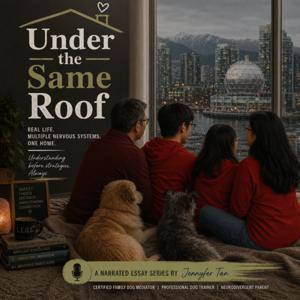
Under the Same Roof is a narrated essay podcast hosted by Jennyfer Tan, Certified Family Dog Mediator, grounded in the L.E.G.S. Applied Ethology model — Learning, Environment, Genetics, Self — developed by Kim Brophey, author of Meet Your Dog and founder of Family Dog Mediation. The series explores the intersection of reactive dog guardianship and neurodivergent family life, in the real world, without shortcuts.
Understanding before strategies. Always.
My book Loving the Difficult Dog: What My Reactive Rescues Taught Me About Unconditional Love is out now!
What Rosco Knows When I’m Running on Empty
There are two versions of Jennyfer who walk Rosco. One is present, unhurried, following his nose. The other is somewhere else — behind on something, carrying a conversation she hasn’t finished processing, going through the motions while her nervous system is elsewhere. Rosco knows the difference. He always does.
In this penultimate episode of Season 3, Jennyfer turns the lens on herself — on what the caregiver brings to the leash, what the dog reads in it, and what that exchange costs both of them on the days when the primary caregiver is depleted. It is, she argues, one of the most underappreciated dynamics in any household with a reactive dog: the dog is not a closed system. What you carry is part of what he has to process.
Topics covered in this episode:
This episode is for anyone who has ever wondered whether their dog can tell when they’re struggling. He can. And understanding what that means — for both of you — is where a different kind of care begins.
To explore how your own state as a caregiver is affecting your dog’s behavior and wellbeing, you can book a consultation at R+R Canine Consulting: https://rplusrcanineconsulting.com/services
Under the Same Roof is a narrated essay podcast hosted by Jennyfer Tan, Certified Family Dog Mediator, grounded in the L.E.G.S. Applied Ethology model — Learning, Environment, Genetics, Self — developed by Kim Brophey, author of Meet Your Dog and founder of Family Dog Mediation. The series explores the intersection of reactive dog guardianship and neurodivergent family life, in the real world, without shortcuts.
Season 3 has moved through the stages of life, the people in this household, the city, another family’s story, and now this: what happens when the person at the centre of it all runs out of road, and what the dog knows about it that nobody else does.
Understanding before strategies. Always.
My book Loving the Difficult Dog: What My Reactive Rescues Taught Me About Unconditional Love is out now!
Another Household: What the L.E.G.S. Lens Revealed When I Stopped Looking at the Dog
A family with a large working breed mix. Eight incidents. Trainers, obedience programs, more structure, firmer handling. The dog was lovely at home — gentle, devoted, described by everyone who lived with him as one of the most loving animals they had ever known. In public, he was explosive and frightening. The gap between the two made no sense to them.
Then Jennyfer walked in — and started asking about the household.
In this episode of Under the Same Roof — the first to step entirely outside Jennyfer's own household — she walks through a real case (details changed for privacy) that shows exactly what the L.E.G.S. framework reveals when it's applied to a dog who has been read as a character problem for years. The answer was not in the dog. It was in three things nobody had yet looked at: the household's invisible schedule, the working genetics nobody had channeled, and a socialization history that had taught this dog, systematically and without anyone intending it, that the outside world required defensive decision-making rather than confident engagement.
Topics covered in this episode:
If you have been through training programs and still can't explain your dog's good days and hard days, this episode is for you. The behaviour is legible. You just need the right framework to read it.
To get a full Behavioral and Wellness Assessment for your dog and household using the L.E.G.S. framework, you can book at R+R Canine Consulting: https://rplusrcanineconsulting.com/services
Under the Same Roof is a narrated essay podcast hosted by Jennyfer Tan, Certified Family Dog Mediator, grounded in the L.E.G.S. Applied Ethology model — Learning, Environment, Genetics, Self — developed by Kim Brophey, author of Meet Your Dog and founder of Family Dog Mediation. The series explores the intersection of reactive dog guardianship and neurodivergent family life, in the real world, without shortcuts.
Season 3 opens the lens wider — beyond the inside of one household, into the city, into other families, and into the patterns that show up wherever reactive dogs and complicated lives share a roof.
Understanding before strategies. Always.
My book Loving the Difficult Dog: What My Reactive Rescues Taught Me About Unconditional Love is out now!
The City at the End of the Leash: What Urban Life Actually Costs a Reactive Dog
Vancouver is a beautiful city to walk a dog in. It is also dense, loud, and relentless — a sensory environment that never stops generating input. For a reactive dog, the city does not justproduce occasional hard moments. It raises the baseline cost of existing. But not every dog pays that cost the same way.
In this episode of Under the Same Roof, Jennyfer Tan gives an honest accounting of what urban life actually costs both of her dogs — Rosco, whose nervous system runs hot and whosevigilance is continuous, and Rei, the Korean Village Dog who came from the streets of Korea and whose challenge in Vancouver is not fear but the sustained frustration of wanting to engage with everything the leash won't let him reach.
Two dogs. One city. Two very different ledgers.
Topics covered in this episode:
This episode is for anyone managing one or more complex dogs in an urban environment. For anyone in a flat or condo who wonders whether they have made an unfair choice. For anyone standing at the front door knowing the world starts immediately on the other side.
The honest accounting is not comfortable. But it is where the real work begins.
To assess what your dog's urban environment is costing them — or to untangle how two dogs with different profiles are navigating the same household and the same city — you can book a consultation at R+R Canine Consulting: https://rplusrcanineconsulting.com/services
Under the Same Roof is a narrated essay podcast created by Jennyfer Tan, Certified Family Dog Mediator, grounded in the L.E.G.S. Applied Ethology model — Learning, Environment,Genetics, Self — developed by Kim Brophey, author of Meet Your Dog and founder of Family Dog Mediation. The series explores the intersection of reactive dog guardianship and neurodivergent family life, in the real world, without shortcuts.
Season 3 opens the lens wider — beyond the inside of one household, into the city that surrounds it and the broader patterns that show up wherever reactive dogs and complicated families share a life.
Understanding before strategies. Always.
My book, Loving the Difficult Dog: What My Reactive Rescues Taught Me About Unconditional Love is out now!
The Anchor: What the Quiet Person in Your Household Gives Your Reactive Dog
Every morning, before the rest of the household wakes up, Jennyfer's husband gets up, makes coffee, and sits quietly in the kitchen. And Rosco, without being asked, gets up and goes to be near him. This happens every day. Without variation. Without anyone deciding it should.
This episode is about that. About what it means to be the emotional bond — the person whose presence lowers a reactive dog's dial rather than raising it, whose nervous system registers as safe before a single word is spoken. About what the steady one gives, and what, quietly, it asks of them.
Topics covered in this episode:
If there is someone in your household who moves through it differently — quietly, without drama, without anyone much noticing — this episode is about what that person may be giving your dog that no amount of training or technique can replicate.
To understand the relational dynamics in your own household and what your dog is drawing from each person in it, you can book a consultation at R+R Canine Consulting: https://rplusrcanineconsulting.com/services
Under the Same Roof is a narrated essay podcast created by Jennyfer Tan, Certified Family Dog Mediator, grounded in the L.E.G.S. Applied Ethology model — Learning, Environment, Genetics, Self — developed by Kim Brophey, author of Meet Your Dog and founder of Family Dog Mediation. The series explores the intersection of reactive dog guardianship and neurodivergent family life, in the real world, without shortcuts.
Season 3 moves through the stages of life and the people inside them — what each person in a household gives a reactive dog, what it costs, and what it builds.
Understanding before strategies. Always.
My book, Loving the Difficult Dog: What My Reactive Rescues Taught Me About Unconditional Love is out now!
When Your Neurodivergent Young Adult Starts Taking Care of the Dog
One afternoon, Jennyfer and her husband and daughter were out longer than expected — past the window when the dogs needed to be checked on. Her son was home. So Jennyfer called him. Not with a general ask, but with a specific list: fill the water bowl, check the food, make sure Rosco's bed hadn't moved, text when done. He did it. He texted. Everything was fine.
It was not the moment Jennyfer had been waiting for. The moment she had been waiting for — her son noticing on his own, acting independently, taking initiative without being asked — hadn't arrived. What arrived instead was something she had to learn to see clearly: her son, executing reliably inside a clear structure that someone else had built. And the question this episode asks is whether that counts.
It does. This episode is about why.
Topics covered in this episode:
If you have a neurodivergent young adult in your household and you're navigating the gap between the independence you hoped for and what is actually there — this episode is for you. The gap is not failure. It is the territory. And within it, there is more than you might be seeing.
To explore what meaningful contribution to dog care can look like for a neurodivergent young adult in your household, you can book a consultation at R+R Canine Consulting: https://rplusrcanineconsulting.com/services
Under the Same Roof is a narrated essay podcast created by Jennyfer Tan, Certified Family Dog Mediator, grounded in the L.E.G.S. Applied Ethology model — Learning, Environment, Genetics, Self — developed by Kim Brophey, author of Meet Your Dog and founder of Family Dog Mediation. The series explores the intersection of reactive dog guardianship and neurodivergent family life, in the real world, without shortcuts.
Season 3 moves through the stages of life — the school years, the teenage years, the young adult transition — tracing what changes as time moves through a household like this one.
Understanding before strategies. Always.
My book, Loving the Difficult Dog: What My Reactive Rescues Taught Me About Unconditional Love is out now!
The Teenage Years: What Changes When Your Neurodivergent Child and Your Dog Are Both Growing Up
Most of the conversations about dogs and neurodivergent children imagine a young child — small, still forming, growing up alongside the dog in those early years when everything is still plastic. But what about families who come to it differently? Who get a dog when their child is a teenager, and discover that the developmental stakes look completely different from anything they expected?
In this episode of Under the Same Roof, Jennyfer Tan reflects on what it meant to bring an eighteen-week-old puppy into a household anchored by a nearly-eighteen-year-old neurodivergent young man — and what that particular collision of developmental stages cost both of them, and what it slowly built.
Topics covered in this episode:
- Why the puppy socialization window and the teenage developmental stage are both real constraints — and what happens when they collide
- What the teenage brain is actually doing, and why a neurodivergent teenager's regulatory limits are not choices
- The mirror recognition: why Rosco and her son share a frequency, and how that recognition slowly changed their relationship
- What the early months cost Rosco's nervous system — an account of what the socialization window absorbed, and the particular grief of understanding that after the fact
- What shifted as her son moved from seventeen into young adulthood, and what 'more access to himself' actually looked like in practice
If you have a neurodivergent teenager and a dog — or if you're considering getting one — this episode is about the timing, the stakes, and the particular shape of a bond that has to be built through friction rather than ease.
If you're navigating the teenage years with a reactive dog and want support assessing what your household's specific dynamic is costing both of them, you can book a consultation at R+R Canine Consulting: https://rplusrcanineconsulting.com/services
Under the Same Roof is a narrated essay podcast hosted by Jennyfer Tan, Certified Family Dog Mediator, grounded in the L.E.G.S. Applied Ethology model — Learning, Environment, Genetics, Self — developed by Kim Brophey, author of Meet Your Dog and founder of Family Dog Mediation. The series explores the intersection of reactive dog guardianship and neurodivergent family life, in the real world, without shortcuts.
Season 3 moves through the stages of life — the school years, the teenage years, the young adult transition — tracing what changes as time moves through a household like this one.
Understanding before strategies. Always.
My book, Loving the Difficult Dog: What My Reactive Rescues Taught Me About Unconditional Love is out now!
The 3 to 6 Problem: Dogs, Neurodivergent Kids, and the Hardest Hours of the School Day
There's a window in the school day that nobody warns you about. It starts at three o'clock and ends somewhere around six — and for households with a neurodivergent child and a reactive dog, it is consistently the hardest part of the day. Not because of logistics. Because of nervous systems.
In this episode of Under the Same Roof, Jennyfer Tan explores what she calls the 3 to 6 problem: the dynamic that unfolds when a neurodivergent child who has been masking and managing all day comes home and finally releases everything they were holding — directly into the environment of a dog who has his own threshold, his own bucket, and his own complicated history with unpredictability.
Topics covered in this episode:
If the afternoon hours in your household feel like a collision you can't quite prevent, this episode is for you. Understanding what's driving that collision — from both directions — is where the change actually starts.
To work through your household's specific afternoon dynamics or assess your dog's threshold patterns across the day, you can book a consultation at R+R Canine Consulting:https://rplusrcanineconsulting.com/services
Under the Same Roof is a narrated essay podcast created by Jennyfer Tan, Certified Family Dog Mediator, grounded in the L.E.G.S. Applied Ethology model — Learning, Environment,Genetics, Self — developed by Kim Brophey, author of Meet Your Dog and founder of Family Dog Mediation. The series explores the intersection of reactive dog guardianship and neurodivergent family life, in the real world, without shortcuts.
Season 3 opens the lens beyond Jennyfer's household and into the patterns that show up across stages of life — the school years, the teenage years, the young adult transition, and everything that shifts when time moves through a family that lives like this one.
Understanding before strategies. Always.
My book, Loving the Difficult Dog: What My Reactive Rescues Taught Me About Unconditional Love is out now!
What Happens When It's Not Working - and How to Know the Difference
Two rehoming stories. One question that every guardian asks eventually, including this one. This is the episode nobody wants to make — about what genuine incompatibility looks like, what it isn't, and what it means to hold that question honestly rather than avoiding it.
Topics covered: rehoming a dog, dog welfare, incompatibility vs hard stretch, reactive dogs, neurodivergent family and dogs, urban dog ownership, family dog mediation, caregiver load, dog mental health, honest assessment, when to rehome, responsible rehoming
📍 If you're in a situation that doesn't feel sustainable and you're not sure what you're looking at: A Behavioral and Wellness Assessment at R+R Canine Consulting helps you see clearly what's actually happening — and what your options are. Book here.
There was a goldendoodle who spent eight hours a day alone in a small condo apartment with nowhere to put his energy. His guardian loved him. She just couldn't give him what he needed, and he couldn't stop needing it. She reached out to Jennyfer Tan for help not because she had failed, but because she was honest enough to see what was happening and do something about it. He ended up with a family with a backyard, time, and people home. He is exactly where he needs to be.
That story has a clean ending. Not all of them do.
In this Season 2 finale of Under the Same Roof, Jennyfer tells two rehoming stories — one straightforward, one harder — and draws from both of them a framework for understanding the difference between a hard stretch and a genuine incompatibility. What a dog's stress signals look like when the situation is chronic rather than situational. What a cycle of mutual depletion looks like from the outside. And what it means to make a decision about rehoming not as failure, but as an act of genuine care for two lives.
She also talks about the question she has asked herself — not on the worst day, but from a more settled place — about whether her own urban condo household, with two reactive dogs and a neurodivergent family member and no backyard, is actually sufficient. And what the honest answer is, and where it comes from.
This episode is for families who are in it and wondering. Who are having a hard stretch and aren't sure if that's all it is. Who love their dog and are not sure if love is enough. Who need someone to say, plainly and without judgment: sometimes it isn't enough, and knowing that is not the same as giving up.
The families who ask this question — who are willing to sit with an uncomfortable answer and act on it if they need to — are the same families who end up with the relationships that are real.
Under the Same Roof is a narrated essay series about what nobody tells you when you share a home with a reactive dog and a neurodivergent family. Rooted in the L.E.G.S.® Applied Ethology model developed by Kim Brophey, author of Meet Your Dog and founder of Family Dog Mediation. Grounded in the kind of lived experience that no certification can replace.
Understanding before strategies. Always.
My book, Loving the Difficult Dog: What My Reactive Rescues Taught Me About Unconditional Love is out now!
Sensory Profles Your Child's and Your Dog's
Her husband wakes up early. Rosco is already on the couch, waiting. This episode maps the sensory profiles of every member of Jennyfer's household — and finds, in the overlaps and the alignments nobody planned, an explanation for why some relationships in a neurodivergent home with reactive dogs work the way they do.
Topics covered: sensory profiles, neurodivergent children and dogs, autism sensory processing, reactive dogs, dog sensory sensitivity, family dog mediation, nervous system regulation, two-dog household, urban neurodivergent family
📍 If you're trying to understand why your household feels harder than it should: A Behavioral and Wellness Assessment at R+R Canine Consulting helps you see the sensory and nervous system dynamics that are driving the friction. Book here.
Every morning, before the household wakes up, before the city outside the windows has found its rhythm, Jennyfer Tan's husband sits on the couch to pray. Rosco is already there. Or arrives within moments — not urgently, just present. The two of them sit in the stillness of the early morning, and Rosco stays.
This is not a trained behavior. It is a sensory relationship. Jennyfer's husband is physically still in a way that communicates safety to a nervous system that is always, on some level, braced for what comes next. Rosco found him not through effort but through fit.
In this episode of Under the Same Roof, Jennyfer maps the sensory profiles of every member of her household — her son, her two dogs, and, briefly, herself — and puts them side by side to look at what they reveal. Where do they clash? Where do they align in ways nobody planned? And what do those alignments explain about the relationships that have formed in this household, organically, without design?
Her son is sensitive to sudden, unpredictable sound but unbothered by the constant traffic noise of a busy Vancouver street — the sounds he cannot control are the ones that cost him, not the ones that are constant and expected. He regulates through touch, through soft textures, through music that covers rather than competes. Rosco is sensitive to sudden movement and unexpected sound, habituated to the household's rhythms but always reading the room. Rei, the Korean Village Dog, is almost the sensory opposite inside the home — unbothered by most of what keeps Rosco alert, but fully activated outside by motorcycles and bikes and birds and the smaller, faster things his street-dog genetics were built to track.
And then there are the roles. She is the manager, the infrastructure of Rosco's days. Her daughter is the playmate. Her husband is the emotional bond. And her son is the mirror.
Her son is the human Rosco. Rosco is the dog version of her son. Both of them smart in specific channels. Both needing routine and predictability to function well. Both navigating the nuances of the social world consciously, explicitly, with effort that most beings don't have to spend. It took years to name. It assembled itself from a hundred small observations until it was simply undeniable.
This episode is about what happens when you put the sensory profiles side by side and actually look. Not to solve anything. Just to see it clearly — and to understand that sometimes the relationships that form in a complicated household form because of exactly who the people and the animals in it actually are.
Under the Same Roof is a narrated essay series about what nobody tells you when you share a home with a reactive dog and a neurodivergent family. Rooted in the L.E.G.S.® Applied Ethology model developed by Kim Brophey, author of Meet Your Dog and founder of Family Dog Mediation. Grounded in the kind of lived experience that no certification can replace.
Understanding before strategies. Always.
My book, Loving the Difficult Dog: What My Reactive Rescues Taught Me About Unconditional Love is out now!
From the publisher's feed