
Sign up to save your podcasts
Or



A temple which would be known by the Greek term Pantheion was first dedicated in the Field of Mars by Agrippa, perhaps to exalt all of the gods. It was rebuilt over a century later and completed during the reign of Hadrian almost exactly nineteen centuries ago. This reconstruction is perhaps the best preserved building of any ancient civilization, and arguably the most influential building ever constructed. It is, quite simply, exquisite beyond belief. I have taken more photographs of the dome than I can possibly count. Here are some recent ones.
A year after Hadrian’s accession to the throne, after his return to Rome, he embarked on the building of a villa complex at Tibur (now called Tivoli) in the limestone mountains to the east of the city. The area was one long favoured for villas: the abundant natural springs, cooler breezes, and local limestone were all convenient for building summer retreats. Plus the River Aniene, then navigable, provided an alternative route to the unforgiving via Tiburtina for travel from Rome.
The villa complex would be informed by Hadrian’s travels and was interpreted by the late Imperial Historia Augusta (a biography of second and third century emperors of disputed authorship, which describes the villa with great admiration) as a version of the Empire in miniature:
His villa at Tibur was marvellously constructed, and he actually gave to parts of it the names of provinces and places of the greatest renown, calling them, for instance, Lyceum, Academia, Prytaneum, Canopus, Poecile and Tempe.
The ancient port of Rome at Ostia had, in legend, been founded by Ancus Martius, the fourth of Rome’s seven semi-legendary kings. However winds magnified by its position and the exposed nature of the mouth of the river proved particularly treacherous, and in the mid first century Claudius established a new and complementary port at Portus, four kilometres (two and a half miles or so) to the north.
Some six decades after Claudius’ port had been begun, a vast hexagonal basin was created slightly inland. This extension was intended to deal both with increased volume in the traffic of goods, and with the significant deposits from the accumulation of sand and mud from the mouth of the Tiber. Trajan’s harbour at Portus is quite simply one of the most extraordinary engineering feats of the Roman world.
Useful sites of places mentioned:
Portus Project
Museum of the Ships at Fiumicino
Harbours of Claudius and Trajan: opening hours and visiting information
A stone’s throw from the Forum of Nerva, about which I spoke last time, is one of the finest, most innovative, and indeed largest examples of Roman art. Trajan’s Column is also a spectacularly sophisticated piece of public messaging. It commemorates Trajan’s victory in Dacia (modern-day Romania) over the fearsome king Decebalus and his allies, but also alludes to engineering triumph and the earthworks which led to its construction. Carved in exquisite relief from marble quarried in the Apuan Alps to advertise the reign of arguably the most successful of all of Rome’s emperors, Trajan’s Column quite literally moved mountains.
An excellent resource is this page from the Italian Ministry of Culture, clicking on the “Story” tab gives a narration of the scenes as they unfurl.
Last time I spoke of Domitian who came to a Sticky End. After Domitian’s death his successor, Nerva, inaugurated the Forum Transitorium built largely during Domitian’s reign and bearing traces of his fondness for Minerva. More than a “forum” as such, it is a sort of monumentalisation of the Forum end of the Argiletum, a street running between the grubby, noisy alleys of the Subura and the civic heart of the city. Today remnants survive by my petrol pump of choice. All photos taken this week.
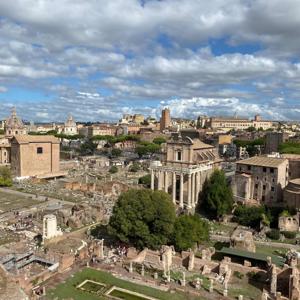
In September this year the structures long referred to as the Domus Tiberiana reopened to the public for the first time since 1970. They once formed a spectacular facade overlooking the Roman Forum, straddling an existing Roman road, and in fact dating not to the reign of Tiberius (as was believed when it was given the name, which stuck) but instead to the reigns of Nero, Domitian, and Hadrian. It’s a fabulously intriguing space, and offers a coherent and exciting connexion between the Palatine Hill and the Forum. It’s also great in my line of work offering another route through the Parco Archeologico del Colosseo; after all rule number one in tour guide school is never retrace your steps.
When visiting the ruins of the imperial palaces on the bucolic and ever-glorious Palatine Hill—possibly my favourite place in the world—today much of what we see is the complex as it was rebuilt by Domitian. He was terrified of being murdered by a conspiracy, and that was exactly what happened, amid the halls and fountain courtyards once gleaming with materials quarried and mined across the Empire.
In this episode I quote both Suetonius and Statius. The translations I’ve used are respectively Rolfe, Loeb, 1914, and Slater, Clarendon Press, 1908.
Last time I spoke of the Flavian Amphitheatre, subsequently and more commonly known as the Colosseum in this free episode. The Flavian Amphitheatre was begun by the Emperor Vespasian and sponsored by the treasures looted during the Sack of Jerusalem by his son Titus. Soon after he oversaw the inauguration of the Amphitheatre as emperor of Rome, Titus died. Eleven years had passed since he had sacked Jerusalem, destroying its Temple, as general. After his death and deification a posthumous triumphal arch was erected in his honour, a monument which still has a profound resonance in Jewish culture.
The Flavian Amphitheatre is undoubtedly one of the most famous buildings in the world, and an extraordinary manifestation of the control exercised by the Roman Empire over the citizenry. As Juvenal spat with disdain:
“…for the [Roman] People who once upon a time handed out military command, high civil office, legions, everything, now restrains itself and anxiously hopes for just two things: bread and circuses” (Satires, Satire X)
If grain imported from Egypt and Sicily kept Roman bellies from rumbling, then public entertainments gave Roman souls a state of jingoistic superiority whilst reminding them at every turn of the power of the Empire. The Flavian Amphitheatre, better known as the Colosseum, was a wildly cynical machine for maintaining a docile population through horrific violence. It was also an incredibly efficient structure for getting people in and out quickly and without the brawls that could see revolution lurking at every turn. As a building for managing large numbers of people it worked so well that it remains the prototype of every sports stadium you’ve ever been to.
This is more an illustrated podcast (or a narrated selection of photographs) because there were just too many good images to choose from.
In his life of Nero Suetonius tells us:
“There was nothing however in which [Nero] was more ruinously prodigal than in building. He made a palace extending all the way from the Palatine to the Esquiline, which at first he called the House of Passage [Domus Transitoria], but when it was burned shortly after its completion and rebuilt, the Golden House [Domus Aurea].”
The vast palace complex of the Domus Aurea was the work, according to Pliny, of the architects Severus and Celer and made use of land cleared by the great fire of 64 CE (the one in which Nero is said to have fiddled while Rome burned). It occupied all or part of three of the seven hills of Rome.
Trajan subsequently obliterated all memory of Nero, and used the pavilion on the Colle Oppio as ready-made foundations for his new public bath complex.
In the late fifteenth century artists began to explore the “grottoes” below the Baths of Trajan, and emulate the decorations they found. The results can be found all over Italy, but also from Mexico to London and most places in between.
To visit the Domus Aurea one joins an internally organised tour. Presently open Fri-Sun, information and booking here.
From the publisher's feed

43,868 Listeners

43,324 Listeners