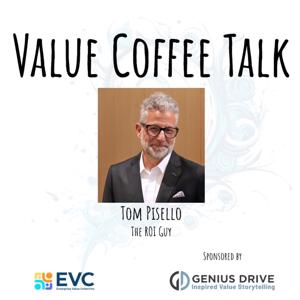
Value Coffee Talk

Value Coffee Talk

Download on the App Store

All Value Coffee Talk episodes

  • Navigating the AI ROI Paradox

    In this episode of the Value Coffee Talk podcast, host Thomas Pisello and sales strategy / value leader Steve Thibodeau discuss the complexities of ROI in AI implementations.

    The pair explore the paradox of AI investments, the challenges of scalability, and the importance of governance and data readiness.

    The conversation delves into Gartner's framework for evaluating AI projects, emphasizing the need for change management and effective communication of value propositions. They also highlight the benefits of leveraging external expertise and the significance of measurement in achieving successful outcomes.

    Takeaways

    • AI implementation often faces a paradox of ROI.
    • Scalability is a critical challenge for AI projects.
    • Governance and data readiness are essential for success.
    • 95% of AI projects fail to deliver expected value.
    • Gartner's framework categorizes AI projects into defend, extend, and upend.
    • Change management is crucial for AI adoption.
    • Consistent messaging across teams enhances value communication.
    • Collaborative business cases foster shared ownership of outcomes.
    • External expertise can significantly improve AI project success.
    • Measurement is key to managing and improving AI initiatives.

    29 min
  • Is Your GTM Ready for the Outcome Economy?

    In this episode of the Value Coffee Talk Podcast, host Thomas Pisello and Scott Shaul, veteran GTM leader, discuss the concept of the Outcome Economy, which emphasizes aligning vendor and customer incentives around measurable value delivery. 

    The pair explore how this new economy is changing go-to-market strategies, the role of AI in measuring outcomes, and the transformation needed in customer success teams to focus on value realization. 

    The conversation also highlights the importance of creating a shared value plan that evolves beyond the sale, ensuring ongoing collaboration between vendors and customers to achieve desired outcomes.

    Takeaways
    • The outcome economy focuses on charging for value delivered.
    • Aligning vendor and customer incentives is crucial for success.
    • Customers are more educated and demanding proof before purchasing.
    • AI enhances the measurement of outcomes and scalability.
    • Customer success teams must shift to a revenue-focused mindset.
    • A shared value plan should be a living document managed collaboratively.
    • Value realization is essential for customer retention and expansion.
    • Pricing models need to adapt to reflect measurable outcomes.
    • Understanding unique value propositions is the first step to success.
    • Companies should not rush into the outcome economy without preparation.
    • titles

    Chapters

    00:00   Introduction to the Outcome Economy

    03:07   Understanding the Outcome Economy

    05:52   Shifts in Go-to-Market Strategies

    08:46   The Role of AI in Value Measurement

    11:59   Transforming Customer Success

    14:53   Creating a Shared Value Plan

    17:49   Final Thoughts and Advice

    24 min
  • The Future of Sales Engineering: From Demo Driver to Value Consultant

    In this episode of Value Coffee Talk, host Thomas Pisello and Jack Cochran, GM of the PreSales Collective, discuss the evolving landscape of sales engineering, particularly in the context of AI and value consulting. 

    The pair explore the shifting responsibilities of sales engineers, the importance of training and enablement, and the critical role of storytelling in sales conversations. 

    The conversation also highlights the transition from traditional proof of concept to proof of value, emphasizing the need for sales engineers to embrace change and focus on delivering business value outcomes to customers.

    Takeaways
    • AI is driving significant changes in sales engineering.
    • Sales engineers are evolving into value consultants.
    • Training should focus on why solutions matter to customers.
    • Soft skills are essential for effective sales conversations.
    • The transition to proof of value is crucial for success.
    • Sales engineers need to ask the right questions to uncover customer needs.
    • Leadership alignment is necessary for implementing changes.
    • Storytelling is a powerful tool in sales.
    • Different types of business value require different approaches.
    • Embracing change can lead to more fulfilling roles for sales engineers.

    Chapters

    00:00   Introduction to Value Coffee Talk

    02:47    The Evolution of Sales Engineering

    05:47    The Role of Value Consultants

    08:36    Training and Enablement for Sales Engineers

    11:15    The Importance of Storytelling in Sales

    14:08    Transitioning to Proof of Value

    17:16    Embracing Change in Sales Engineering


    24 min
  • AI and the Future of Value Engineering and Automation

    In this episode of Value Coffee Talk, Thomas Pisello and Max Elster (CEO / Founder of value automation platform firm Minoa.io) discuss the evolving landscape of value engineering in the age of AI. 

    The pair explore how AI is reshaping the role of value engineers, emphasizing the importance of differentiation, customer accountability, and the orchestration of value across organizations. 

    The conversation highlights the need for value engineers to leverage AI effectively, the significance of value realization, and the human element in maintaining meaningful customer relationships. Max encourages the value community to evangelize their roles and share insights to foster growth and collaboration.

    Takeaways
    • AI has fundamentally changed how software is sold and built.
    • Differentiation in products is becoming increasingly challenging.
    • Value engineers are evolving into orchestrators of value across organizations.
    • Customer success roles are becoming more tied to revenue generation.
    • Value realization is crucial for maintaining customer accountability.
    • AI can automate specific tasks, enhancing efficiency in value engineering.
    • The future of AI in business is about connecting systems and extracting insights.
    • Human connections and live interactions remain vital in an AI-driven world.
    • Evangelizing the role of value engineering is essential for community growth.
    • The value engineering community needs to attract new talent and interest.

    30 min
  • Driving Revenue Growth: From The Challenger to The Activator Advantage

    In this episode of the Value Coffee Talk Podcast, Thomas Pisello interviews Matt Dixon, a renowned sales performance author (The Challenger Sale, The Jolt Effect and Activator Advantage), analyst and consultant. The pair discuss the evolution of sales challenges over the past decade, particularly in the context of AI and virtual selling. 

    Matt introduces his latest work, the Activator Advantage, which focuses on adapting sales strategies for professional services. He outlines the characteristics of successful sales profiles, particularly the Activator, who builds strong client relationships through proactive engagement and idea sharing.

    The conversation also touches on the importance of understanding client needs beyond just business transactions, emphasizing the role of personal value in maintaining client loyalty.

    Takeaways

    • Sales challenges have worsened with the rise of AI.
    • Buyers are more informed and further along in their journey.
    • The size of buying committees has increased significantly.
    • No decision losses are a major issue for salespeople.
    • AI can enhance productivity but also lead to spam.
    • The Activator Advantage focuses on service organizations.
    • Activators build networks and proactively engage clients.
    • Debaters can exhaust clients with constant challenges.
    • Personal value is crucial for client loyalty.
    • Sales strategies must adapt to changing client expectations.

    Sound bites

    • "Activators are super connectors."
    • "They are always bringing new ideas to clients."
    • "Personal value creates lasting stickiness."

    37 min
  • Success Starts with Better Value Qualification and Discovery

    In this episode of the Value Coffee Talk podcast, host Thomas Pisello and guest Mike Muhlfelder, veteran CRO and sales performance coach, discuss the current challenges in B2B sales, particularly in light of economic uncertainty and the rise of AI. The pair unfold two fundamentals -  proper value-centric qualification and discovery processes can lead to an incredible increase in success.

    Takeaways

    • Quota miss is expected to be higher this year.
    • AI is a game changer for sales and business.
    • Qualification is crucial for closing deals.
    • Understanding the urgency of change is key.
    • Budget discussions should focus on urgency, not just numbers.
    • Discovery processes need to be improved for better outcomes.
    • Sales professionals must balance discovery and demo expectations.
    • Sales should be treated as a lifelong profession.
    • Understanding the economics of your product is essential.
    • Effective sales require continuous learning and adaptation.

    Sound bites

    • "Quota miss is going to be higher."
    • "You need a trigger for customer change."
    • "It's always about the money."

    33 min
  • AI Killed the Value Superstar?

    In this episode of the Value Coffee Talk podcast, hosts Thomas Pisello and veteran value leader Shane Finlay dive into the evolving landscape of value engineering and consulting. They discuss the shift from large value teams and the “business case factory” approach to a more streamlined, software-enabled capability, and the role of AI in transforming value consultants into not just orchestrators and enablers, but composers. 

    Tune in to explore how AI is rapidly reshaping value-based growth programs, and the evolving role of AI-powered value consultants, sellers, success reps and sales engineers.

    Takeaways
    • Value teams are shifting from the “business case factory” (Player) to software-enabled Composers and lifecycle Orchestrators, with AI multiplying impact across GTM.
    • Smaller teams + smarter tools: Equip sellers, SEs, and CS with guided discovery, ROI, and value storytelling — not just pre-sale business cases.
    • AI as a force multiplier: Private LLMs + value playbooks + past cases = faster, tailored briefs, cleaner CRM hygiene, and real-time discovery prompts.
    • Human-in-the-loop stays essential: AI drafts; value pros validate KPIs, benchmarks, and executive narratives to maintain trust and accuracy.
    • Adoption is a program, not a launch: Drive usage via simple, monthly “one new use case” enablement (lunch-and-learns), track usage, and reinforce wins.

    Sound Bites
    • “We’re moving from factory to symphony — AI doesn’t replace value pros; it amplifies them.”
    • “Enable the field, not just the deal: value must show up in every touch — discovery, demo, onboarding, renewal.”
    • “AI is the co-pilot; the value consultant is the pilot — keep the human in the loop to make the case credible.”

    27 min
  • Navigating the Value of AI in Healthcare: Challenges and Opportunities

    In this episode of Value Coffee Talk, Thomas Pisello and Andy De discuss the current state of AI in healthcare and life sciences, exploring the challenges organizations face in implementing AI solutions, the evolution of AI technologies, and the importance of a strategic portfolio approach to AI investments. 

    They emphasize the need for effective communication of AI's value, the significance of governance, and the necessity of building trust in AI systems to ensure successful adoption and positive patient outcomes.

    Takeaways
    • AI investments in healthcare are significant but often yield low ROI.
    • Understanding AI's true potential is crucial for successful implementation.
    • The evolution of AI includes stages from augmentation to automation.
    • Governance and ethics in AI are critical, especially in healthcare.
    • A portfolio approach to AI investments can mitigate risks and enhance outcomes.
    • Trust in AI systems is essential for adoption by healthcare professionals.
    • Effective communication of AI's value is necessary for stakeholder buy-in.
    • AI can alleviate burnout and increase capacity in healthcare settings.
    • The integration of AI should focus on enhancing patient care and outcomes.
    • AI should not be adopted for its own sake but for tangible benefits.

    Sound Bites
    • "Barely 10 to 11% of CXOs see ROI."
    • "Fear of missing out is prevalent."
    • "AI augmentation is the first stage."
    • "The holy grail is autonomous AI."
    • "AI for the sake of AI is not enough."

    Chapters

    00:00     Introduction to AI in Healthcare

    01:05     Challenges in AI Implementation

    07:30     The Evolution of AI: From Augmentation to Automation

    13:07     AI as a Portfolio: Strategies for Success

    21:38     Communicating AI Value in Healthcare

    24:53     Pragmatic Approaches to AI Adoption

    28 min
  • The Vital Role of Sales Engineers in the Future of Value Selling

    In this episode of the Value Coffee Talk podcast, hosts Thomas Pisello and April Morley engage with Stephen Morse, CEO of the SE Leadership Institute, to discuss the evolving role of sales engineers in today's market. 

    The trio explore the importance of emotional intelligence, the shift towards value-led growth, and the challenges faced by sales teams amidst cost pressures. Stephen emphasizes the need for sales engineers to enhance their communication skills, embrace AI technologies, and focus on delivering value to customers. 

    The conversation highlights the significance of building trust and emotional connections in sales, as well as the necessity of adapting to changing market dynamics.

    Takeaways
    • Sales engineers play a crucial role in bridging technology and value.
    • Emotional connection is key to why people buy.
    • AI is transforming the sales landscape, but human touch remains essential.
    • Sales engineers must adapt to evolving roles and responsibilities.
    • Value-led growth is becoming increasingly important in sales strategies.
    • Effective communication and storytelling are vital for sales engineers.
    • Understanding business KPIs is essential for sales success.
    • Proof of value should accompany proof of concept in sales processes.
    • Sales engineers need to embrace a growth mindset in challenging times.
    • Collaboration across teams enhances the overall sales strategy.

    Sound Bites
    • "Sales engineers are vital to success."
    • "AI has massive promise in sales."
    • "We need to lean into value-led growth."
    • "Communication is key for sales engineers."
    • "Value is a team sport."

    Chapters

    00:00   Introduction to the Value Coffee Talk Podcast

    02:51   The Evolution of Sales Engineering

    10:36   Navigating Cost Pressures in Sales

    11:15   The Shift to Value-Led Growth

    19:20   Communicating and Quantifying Value

    24:09   Final Thoughts and Advice

    25 min
  • Growth Stage: Navigating The Top Three GTM Challenges

    In this episode of Value Coffee Talk, hosts Thomas Pisello and April Morley engage with Ron Ariana, a seasoned expert in go-to-market strategies. 

    The group discussed the common challenges faced by early and growth-stage companies, emphasizing the importance of a clear strategy, effective messaging, and the need for alignment across various organizational functions. 

    Ron shares insights on how to identify target markets, the significance of understanding customer personas, and the necessity of enabling teams to communicate a consistent value proposition. The conversation culminates in advice on the importance of strategic planning and execution for long-term success.

    Takeaways
    • Many early-stage companies face execution problems that stem from unclear strategies.
    • Identifying the problem your product solves is crucial for success.
    • Understanding your target market is essential for effective sales.
    • Positioning your product against competitors is key to standing out.
    • All departments must align on the go-to-market strategy for success.
    • Effective messaging should be tailored to different stakeholders.
    • Sales enablement is critical for consistent communication.
    • Companies should focus on helping buyers make informed decisions.
    • Evidence of value is necessary for gaining customer trust.
    • Investing time in strategy will pay off during execution.

    Sound Bites
    • "What problem are you solving?"
    • "You can't sell to everyone."
    • "You have to be sure everybody is on the same page."

    Chapters

    00:00   Introduction to Value Coffee Talk

    01:15   Identifying Go-To-Market Challenges

    08:07   Strategizing for Success

    14:47   Building and Activating the Strategy

    20:02   Execution and Evidence in Go-To-Market

    22:00   Final Insights and Advice

    22 min