
Sign up to save your podcasts
Or



Few Yogas for Wealth:-
Indu Lagna: A point calculated from the 9th lords' units of brilliance that indicates multi-millionaire status.
Wealth Quartet: Mutual relationships between lords of the 2nd, 5th, 9th, and 11th houses.
Sunapha Yoga: A planet (except Sun) in the 2nd from the Moon, giving wealth through self-exertion.
Anapha Yoga: A planet in the 12th from the Moon, granting enormous wealth and worldly comforts.
Durudhura Yoga: Planets in both the 2nd and 12th from the Moon, conferring luxuries and leadership.
Adhi Yoga: Benefics in the 6th, 7th, and 8th from the Moon or Lagna, making one immensely affluent.
Vasumat Yoga: All natural benefics in Upachaya houses (3, 6, 10, 11), ensuring command over plenty of money.
Amala Yoga: A natural benefic in the 10th from the Lagna or Moon, resulting in lasting prosperity.
Pushkala Yoga: Moon sign lord and Lagna lord conjunct in a Kendra in a friend's sign.
Lakshmi Yoga: The 9th lord and Venus in mutual trines or Kendras in own or exaltation signs.
Gaja Kesari Yoga: Jupiter in a Kendra from the Moon, granting perennial wealth, fame, and success.
Malavya Yoga: Venus in a Kendra in its own or exaltation sign, providing wealth and conveyances.
Hamsa Yoga: Jupiter in a Kendra in its own or exaltation sign, resulting in a generous and wealthy ruler.
Bhadra Yoga: Mercury in a Kendra in its own or exaltation sign, making one exceedingly rich and scholarly.
Sasa Yoga: Saturn in a Kendra in its own or exaltation sign, leading to headship and material strength.
Ruchaka Yoga: Mars in a Kendra in its own or exaltation sign, providing wealth through valorous deeds.
Vaisheshikamsa: Dignities like Parijata or Simhasana indicating high status and prosperity through divisional strength.
Yoga Pinda: Using Ashtakavarga's Sodhya Pinda to predict the specific timing and scale of financial influx.
Ashtakavarga Formula: 11th house having more dots than 10th and 12th fewer than 11th for luxuries.
Al Nine Planets:-
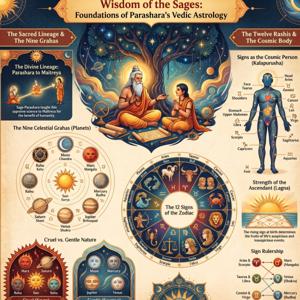
1. The Sun is the Atmakaraka (significator of the soul), representing the father, authority, and royalty with a majestic, firm voice.
Physically, he has a square body, honey-colored eyes, and a bilious (Pitta) temperament, traditionally wearing saffron or coarse thick clothes.
Associated with Lord Ramachandra and the fire deity Agni, he is a masculine Sattvic planet that reaches its exaltation in Aries.
2.The Moon signifies the mind (Manas), mother, and royal favor, characterized by an auspicious, youthful appearance and sweet speech.
She has a round body, a fair complexion, and a windy/phlegmatic (Vata/Kapha) constitution, ruling over white products like pearls, salt, and milk.
Linked to Lord Krishna and the deity Varuna, this feminine Sattvic planet is the fastest-moving and reaches exaltation in the sign of Taurus.
3. Mars is the Army Chief representing strength, courage, and younger brothers, known for his intense heat and quick-to-anger temperament.
He has a muscular, short physique with blood-red eyes and a Pitta constitution, signifying weapons, fire, and landed property.
Associated with Lord Narasimha and Kartikeya, this masculine Tamasic planet is exalted in Capricorn and rules over Aries and Scorpio.
4. Mercury is the Prince signifying speech, education, and logic, appearing as a youthful 16-year-old with an olive complexion and a witty nature.
He possesses a lean, attractive build susceptible to all three humours (Tridosha) and rules business, mathematics, and communication.
Representing Lord Buddha and the deity Vishnu, he is a neuter Rajasic planet who is both exalted and reaches Moolatrikona in Virgo.
5. Jupiter is the Minister of Knowledge, representing wisdom, wealth, and dharma with a big, stout body and a lion-like voice.
He has a yellowish complexion, a Kapha temperament, and signifies gurus, advisors, and fruit-bearing trees.
Associated with the Vamana avatar and Lord Indra, he is an auspicious Sattvic planet exalted in Cancer and ruling Sagittarius and Pisces.
6. Venus is a Minister signifying luxury (Bhog), marriage, and arts, characterized by a charming, splundrous physique and curly hair.
She has a windy/phlegmatic (Vata/Kapha) temperament and rules over beauty, perfumes, and the female reproductive organs.
Linked to Lord Parashurama and the goddess Lakshmi, this feminine Rajasic planet is exalted in Pisces and rules Taurus and Libra.
7. Saturn is the Servant and indicator of misery (Dukh Karaka), representing longevity, karma, and the hardships of the lower strata of society.
Physically, he is tall, emaciated, and dark-complexioned with a Vata temperament, often described as slow-moving or lame.
Associated with Lord Kurma and the deity Brahma, this neuter Tamasic planet is exalted in Libra and rules Capricorn and Aquarius.
8. Rahu is a shadowy planet of illusion and foreign elements, possessing a smoky blue appearance and a terrifying, cunning disposition.
He represents mental confusion, outcasts, and sudden wealth, following a windy (Vata) temperament similar to Saturn.
Linked to the Varaha avatar and Goddess Durga, he is a malefic node traditionally exalted in Taurus and associated with 8 months of influence.
8. Ketu is the Mokshakaraka (significator of liberation) and detachment, described as having a terrifying, smoky form with a red, fierce look.
He creates detachment and follows traditions, signifying surgeons, micro-elements, and a windy temperament similar to Mars and Saturn.
Associated with the Meena (Fish) avatar and Chitragupta, he is a malefic neuter planet exalted in Scorpio or Sagittarius
Nakshatra 19 to 27:-
Mula: Investigative and core-oriented; seeks to get to the absolute root and innermost core of all matters.
Purvashadha: Invincible and ambitious; characterized by an intense conviction to succeed and uncover hidden talents.
Uttarashadha: Determined and victorious; focuses on total responsibility and achieving permanent victory through righteous action.
Shravana: Receptive and preserving; centered on the power of listening and tuning into universal knowledge.
Dhanishta: Prosperous and rhythmic; represents mastery over the material plane through perfect timing and universal harmony.
Shatabhisha: Mysterious and healing; an all-pervasive energy focused on secrecy and discovering hidden universal truths.
Purvabhadrapada: Transformative and intense; involves severe penance and internal purification to raise one's evolutionary level.
Uttarabhadrapada: Wise and enlightened; represents a calculative path that synthesizes experience into supreme spiritual clarity.
Revati: Transcendent and benevolent; represents the final summation of all life experiences and the transition into complete enlightenment
Nakshatra from 10 to 18:-
Magha: Authoritative and achieving; represents status, ancestral heritage, and reaping the rewards of past actions.
Purva Phalguni: Creative and relaxing; focuses on rest, pleasure, and the renewal of life-giving energies.
Uttara Phalguni: Social and reliable; a helpful, philanthropic energy that values long-term friendship and civilized graces.
Hasta: Skilful and industrious; characterized by dexterity, quick wit, and a clever, hardworking "handyman" nature.
Chitra: Artistic and illusory; focuses on beauty, proportion, and the "magic" of creating and fashioning physical forms.
Swati: Diplomatic and independent; represents a flexible, balanced approach to individual growth and learning.
Vishakha: Goal-oriented and fixated; defined by intense single-mindedness and the single-minded pursuit of one's ambitions.
Anuradha: Harmonious and loyal; seeks universal friendship and spiritual flowering through inner gentleness.
Jyeshta: Powerful and protective; associated with maturity, senior authority, and maintaining a respected public image.
First 9 Nkshatras explained
Ashvini: Spontaneous and pioneering; represents the quick instinctual start of all activities.
Bharani: Extreme and transformative; involves the intense processes of birth and life-death transitions.
Krittika: Critical and piercing; acts as a "celestial training ground" for purification through knowledge.
Rohini: Productive and alluring; the harbinger of growth, fertility, and civilized living.
Mrigashira: Searching and curious; a poetic soul constantly wandering to find its true life path.
Ardra: Intellectual and cleansing; involves stormy events that churn emotions to create hard-won clarity.
Punarvasu: Harmonious and renewing; signifies "the return of the light" and success on a second attempt.
Pushya: Nourishing and ethical; represents safe, maternal care and total benevolence.
Ashlesha: Secretive and intense; maps the complex struggle between instinctual "reptilian" drives and the mind
All about Navgrahas Related to Vedic Astrology which will help you in predictions. Interesting Podcast not to be missed
12 Houses explained in entertaining and Gripping way to remember easily
All about Sun the Radiant King of Navgrahas and Its Leadership Qualities Explained in an Interesting Story
From the publisher's feed