
Sign up to save your podcasts
Or

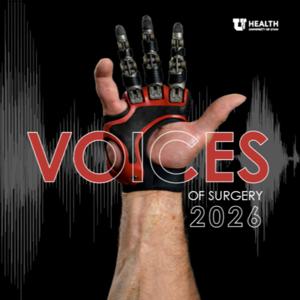


Niki Tonks and Keslie Ta'afua turn the microphones on each other to talk about what it’s really like behind the scenes, creating an annual report, podcast, and website as a team of two in just four months. They stand feet from the operating table, sit across from the people willing to share their stories, laughing, and even shedding a few tears.
Find out how a trip to the bookstore turned into a podcast and annual report, and why they’re still in awe of the team they get to tell stories about.
Burnout feels inevitable in health care, say two colleagues who live it: a medical assistant and a physician assistant in vascular surgery. What started as an informal after-work mountain biking habit grew into the "Saphenous Senders," a group where MDs, PAs, MAs, and colleagues ride as equals: no white coats, no hierarchy.
Find out how John Daines and Sam Sainju say getting on a bike together changed the way they show up for each other, and for their patients.
For years, many vascular surgeons didn’t consider median arcuate ligament syndrome (a vascular compression condition) a real disease. In the last two to three years, that changed enough that it became the leadoff topic at the field’s national meeting.
Find out how Dr. Libby Weaver diagnoses patients whose pain has been written off, sometimes for years, and what it means to be finally believed and relieved.
Every wire and catheter a vascular surgeon steers through the vascular system is guided by continuous x-ray, and that exposure adds up over an entire career, with real links to cancer and genetic change. Dr. Nathan Droz is one of a handful of surgeons in the country using a new fiber-optic navigation system that lets him steer by light instead.
Find out what it’s like to learn a brand-new tool in real time, built purely to protect the surgeon.
Families in Dr. Deborah Jacobson’s pediatric urology practice don’t just see one surgeon; they get a team. Complex cases are reviewed by seven partners every other week, and families see the surgeon most convenient for them.
Join Dr. Jacobson to learn how a program spanning Utah, Idaho, and Montana is rethinking what continuity of urologic care over a lifetime means for children and their families.
Utah doesn’t have enough urologists to begin with, and for patients living hours from the nearest one, that shortage becomes something more serious: cancer that goes undiagnosed for years simply because no one was close enough to catch it.
Learn how Dr. Stephen Summers and the urology team is closing the gap with telehealth, a first-of-its-kind FDA-approved device, and a developing partnership with the Navajo Nation.
Only a handful of surgeons in the country can perform the reconstructive surgery Dr. Tara Woodle has just completed a fellowship in, training she’s now bringing back to military medicine.
Follow her journey to learn how a single lecture sent her career, and her future patients’ care, in a completely new direction.
From 25 to 35% of deceased donor kidneys are discarded every year, while more than 100,000 people remain on the transplant list, and some die waiting.
Hear what Dr. Motaz Selim and Dr. Dinesh Bhattarai are doing in research to help save more organs so people don’t die waiting.
Idaho, Montana, and Wyoming make up the largest transplant desert in the continental United States.
Learn how Dr. Austin Forbes and a new generation of organ-preservation technology are helping fill that gap.
A young mother arrived with a rare vascular condition, a five to six-centimeter aneurysm, heart failure, and a pregnancy to protect, all at once. Getting her through it eventually pulled in vascular surgery, cardiology, interventional radiology, OB, hepatology, thoracic surgery, and a liver transplant, with no single specialist able to carry it alone.
Join Dr. Thomas Varghese and Dr. Mike Zimmerman as they describe a culture where no one’s ego gets in the way of a patient’s care, no matter how complex.
From the publisher's feed