
Sign up to save your podcasts
Or

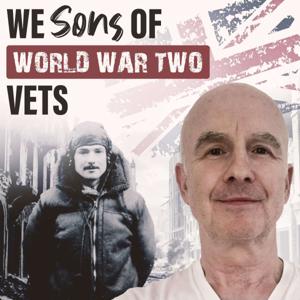


Rick continues the story of Peter's war. We hear about a military VIP whom he took up the Italian coast and about his time in Malta - as commander of the most fragrant ship in the harbour.
We follow him to India, hear about the commandos he took down the coast of Burma, and learn about Rita - Peter's onboard pet monkey.
We also hear about Peter's complicated postwar life and about the restaurant Rick's mother ran whose customers included Prince Charles (as he was then); Jacob Bronowski; Delia Smith; and Prince Faisal of Saudi Arabia.
Cricket and music are also much discussed.
Send us Fan Mail
Support the show
Retired teacher, Rick Shepperson, talks about his father, Peter, who served on a minesweeper with the Royal Navy Volunteer Reserve and (after travelling to New York to collect his vessel) commanded a landing craft during Operation Husky - the Allied Invasion of Sicily.
The story of Peter Shepperson's war continues in Episode 16 - Rick and Peter, Part 2.
Send us Fan Mail
Support the show
The second of a two-part interview with John Rouse from Sydney whose father, Norman, and uncle John were POWs held by the Japanese.
In this episode, John tells the story of their captivity - of their inspiring commanding officer, Weary Dunlop; of their forced labour on the Thai/Burma railway; of the horrific brutality in the prison camps; of their time working underground in a Japanese copper mine when the first atomic bomb was dropped; and of their return to Australia.
John also explores the lifelong effects of their captivity on the brothers. His father developed a 'carapace' to survive but which, after the war, left him emotionally cold. But his dad had a successful career and family life - while his uncle suffered debilitating postwar challenges.
Send us Fan Mail
Support the show
We Sons' first interview with the son of a non-British veteran!
This episode is the first of a two part interview with John Rouse from Sydney, Australia whose father, Norman, spent most of his war as a POW held by the Japanese.
Norman was taken prisoner with his brother. So, they looked after each other during their captivity - which took them from The Bicycle Camp, a former Dutch military base (that Norman described as "almost luxurious" compared to the horrors that followed), to camps along the route of the Thai/Burma railway that they were forced to labour on.
Norman Rouse spent his early pre-war years on the family's New South Wales stud farm, Gunterwang. But after the family left the estate, he took a job as a teenage jackaroo.
After the war Norman became a pastoral property manager. So, John grew up on isolated sheep stations.
In this first part of John's interview, he tells Matthew about his uniquely Aussie childhood - and about his father's early life up to his military service in the Far East when he and he has brother became POWs.
The next episode, John and Norman - Part 2, tells the story of their brutal imprisonment and explores its lifelong effects on the brothers.
Send us Fan Mail
Support the show
Classical music conductor, Robin Page, talks about his father, Ron, who was a prisoner-of-war held by the Japanese - in Changi Jail and in the railway death camps.
Ron hated the film The Bridge on the River Kwai because, he said, "The reality was far worse than that..."
Ron witnessed savagery during his four years as a prisoner. When he got home to Ipswich in 1946 his body and his faith in humanity were damaged.
But he built a happy postwar life - as an Ipswich postman (delivering letters to Alf Ramsey); as a loving husband and father; and as an Ipswich football fan.
Robin, who became a classical music conductor, was always an immense source of pride to him. And in Ron's later life, Robin gave him four grand-children whom he completely doted on.
Send us Fan Mail
Support the show
Comedian Arthur Smith talks about his dad Syd who was a prisoner-of-war in Colditz.
Syd was captured at the Battle of Alamein. He was taken to Sicily, paraded in Palermo as a trophy of war, and then sent to do forced labour in a copper mine.
But he finally ended up in Colditz, the Saxony castle that became a prisoner-of-war camp for Allied officers who'd escaped from other camps - or who were deemed a security risk.
But Syd wasn't a committed escapee. So, Arthur explains why his dad was sent to Colditz.
Syd hand-wrote his memoirs when he was 70. Arthur says they're his most-prized possession. And reads the odd extract from them during the interview.
This podcast is a tribute to a much-loved father but it does contain the odd profanity and occasional reference to “getting his leg over”.
Send us Fan Mail
Support the show
Before WW2, Nick Wells was an engineer who specialised in commercial vehicles. At the outbreak of war, he joined the Royal Navy and became an engine room 'artificer'. He was at sea for four years.
Ray arrived in 1946 - an early baby boomer.
Nick didn't talk much about his war but one horrific tale stuck in his son's mind: Nick saw a colleague get vaporised by steam from a damaged turbine when their ship was hit by a torpedo.
Other stories included accounts of going ashore in Crete with commandos in small dinghies to sabotage enemy supply lines. Then hurtling perilously back to the UK across the Mediterranean. "Blood, sweat and tears," was how he described the voyage.
There were also mentions of freezing Murmansk and motorcycling in the desert on a Moto Guzzi with a dangerously rogue flywheel. (It shot off into the sand at 60mph.)
The overall effect of his father's war on Ray was a lifelong wariness of moving parts in engines. He's never serviced his cars.
Send us Fan Mail
Support the show
Richard Foster tells Matthew about his father, Jack, an ace night fighter pilot who shot down nine enemy aircraft - three of them within 50 minutes!
Richard brings his father's log books to the interview and reads out reports of combats - as well as a crash in Libya.
After the war, Jack became a test pilot at Farnborough, exploring the possibilities of supersonic flight. He flew over 50 aircraft, including British, American, and captured German and Italian planes. His outstanding flying talents - and his modesty - shine out of the discussion.
Send us Fan Mail
Support the show
Matthew met Edward and David Toms in the picture framing shop they ran.
When they framed a booklet of Matthew's father's quotes (which included a few lines about WW2) he got to know a little about Edward's war.
But it was only when Edward died and obituaries appeared in national newspapers, that Matthew found out quite how extraordinary Edward Toms' war had been.
Send us Fan Mail
Support the show
Eric Grant talks about his father George who took 11 bullets after parachuting into Arnhem.
He also talks about his mother, Pearl; about wartime romance; and about a desire to erase wartime history.
Send us Fan Mail
Support the show
From the publisher's feed
A podcast about men who fought in World War Two, whose stories are told by their sons.
In each episode, Matthew Collins interviews a son who tells the story of his father's war and explores…
But his father rarely talked about the war. And when he did, he usually told light-hearted stories about it - rather than discuss fully what he'd seen and done.
He was, however, serious when discussing other family members - a brother who was shot at Dunkirk; a cousin whose ship was torpedoed; and his own father who'd survived battles in the First World War (as well as uncles who had not).
War experiences seeped into Matthew's consciousness. From a young age, he appreciated that he was part of a lucky generation that was unlikely to be called upon to fight.
But what if he had been called up? And if war had broken out, how might he have responded?
After his father died, he started to compare notes with other veterans' sons.
He then interviewed men who told the stories of their fathers' war. And reflected on its effects. On their fathers and on themselves.
But the interviews also became explorations of the contrast between two very different generations - wartime dads and their baby boomer sons. And touching explorations of father/son relationships.
To coincide with the 80th anniversary of the end of World War Two, nine episodes have, so far, been published. (The most recent - Episode 9, Richard and Jack, about ace night-fighter pilot Jack Foster - came out in August.) More will follow soon.
Matthew Collins started his career presenting on TV. (He's best remembered as 'Special Assignments Man' for BBC2's The Travel Show.)
He then raised two sons alone and became a prison teacher.
For ten years, he ran 'Speaking Shakespeare' workshops in men's and women's prisons.
Today he runs public 'Speaking Shakespeare' workshops for businesses; social organisations; and members of the public. To find out more about Matthew, please go to:
https://www.matthewcollins.com/about
MEANWHILE, HERE'S A BRIEF POSTSCRIPT:
There are many more World War Two Vets' sons out there - with personal-historical reflections to share.
Matthew wants to document as many as possible.
He's already travelled around the UK recording interviews. And will continue to do so, funding this project out of his own pocket.
But ideally, he could do with assistance.
If you would like to support this podcast, please see "Support the Show" under each episode’s info.
Or go to:
https://www.patreon.com/wesonsofww2vets
Thank you.