Wealth Actually

Wealth Actually

Download on the App Store

All Wealth Actually episodes

  • Personal Finance Author, Jonathan Clements
    This is a special "Wealth Actually" podcast.  I spoke with an author and educator that has had a major impact on financial literacy and wealth management.  He is also a terrific guy to boot!  Over the course of our discussion, While I felt like I was nodding my head in agreement a lot (that's the whoosh near the microphone), My guest's nuanced views on wealth and his consistent and deep writing taught me a lot about the importance of great advice, clear thinking and long-term planning.

    Jonathan Clements is the founder and editor of HUMBLEDOLLAR.COM. He’s also the author of eight personal finance books, including his latest, “From Here to Financial Happiness.”  Born in England and educated at Cambridge University, Jonathan spent almost two decades at The Wall Street Journal in New York, where he was the newspaper’s personal finance columnist. He also worked for six years at Citigroup as Director of Financial Education for the U.S. wealth management business.  You can find him on on Twitter (@ClementsMoney) and Facebook (https://www.facebook.com/ClementsMoney)

    FROM HERE TO FINANCIAL HAPPINESS
    Background:

    * Tell us a little bit about your background
    * How did your career evolve?
    * How did writing become a part of it?

    "From Here to Financial Happiness . . . in 77 Days"

    * Where did the need for this book come from?
    * "Just because it's not complicated doesn't mean it's easy!"
    * The Power of Compounding- why it's vital.
    * I'm impressed with the structure of the book and breaking down self-improvement steps in a series of days.  How did you decide on that?
    * Enjoyed the saving for retirement section.  It has to happen first even though it's a liability that is farthest away.
    * What works and what doesn't when trying to teach financial discipline to people whose
    * After tax, After fee, After Inflation (spending); why is it so hard for wealth managers to frame things in these terms?
    * Estate planning - necessary for everyone
    * Friendly debate . . . whole life insurance as a way to save for LTC (instead of LTC insurance);  The emergence of HSA's . . .
    * Where should you expect an advisor to add value?  Robo-advice, tax advice, sounding board, investment performance
    * State of the wealth management industry . . . fee compression, business models, the role of the advisor, consolidation, service standards
    * Humble Dollar- terrific blog on investing and general financial literacy- what can we do as a country to help make people make better decisions?

    Contact

    * How can we get a hold of "From Here to Financial Happiness."
    * How do we find out more about your other writings?
    * How do we keep track of your whereabouts?

    To find my book, "Wealth, Actually", click below!

    https://www.amazon.com/Wealth-Actually-Intelligent-Decision-Making-1/dp/1619618605/ref=sr_1_2?s=books&ie=UTF8&qid=1539574775&sr=1-2&keywords=wealth+actually

     
    30 min
  • Personal Finance Author, Jonathan Clements
    This is a special "Wealth Actually" podcast.  I spoke with an author and educator that has had a major impact on financial literacy and wealth management.  He is also a terrific guy to boot!  Over the course of our discussion, While I felt like I was nodding my head in agreement a lot (that's the whoosh near the microphone), My guest's nuanced views on wealth and his consistent and deep writing taught me a lot about the importance of great advice, clear thinking and long-term planning.
    Jonathan Clements is the founder and editor of HUMBLEDOLLAR.COM. He’s also the author of eight personal finance books, including his latest, “From Here to Financial Happiness.”  Born in England and educated at Cambridge University, Jonathan spent almost two decades at The Wall Street Journal in New York, where he was the newspaper’s personal finance columnist. He also worked for six years at Citigroup as Director of Financial Education for the U.S. wealth management business.  You can find him on on Twitter (@ClementsMoney) and Facebook (https://www.facebook.com/ClementsMoney)
    FROM HERE TO FINANCIAL HAPPINESS
    Background:
    Tell us a little bit about your background
    How did your career evolve?
    How did writing become a part of it?
    "From Here to Financial Happiness . . . in 77 Days"
    Where did the need for this book come from?
    "Just because it's not complicated doesn't mean it's easy!"
    The Power of Compounding- why it's vital.
    I'm impressed with the structure of the book and breaking down self-improvement steps in a series of days.  How did you decide on that?
    Enjoyed the saving for retirement section.  It has to happen first even though it's a liability that is farthest away.
    What works and what doesn't when trying to teach financial discipline to people whose
    After tax, After fee, After Inflation (spending); why is it so hard for wealth managers to frame things in these terms?
    Estate planning - necessary for everyone
    Friendly debate . . . whole life insurance as a way to save for LTC (instead of LTC insurance);  The emergence of HSA's . . .
    Where should you expect an advisor to add value?  Robo-advice, tax advice, sounding board, investment performance
    State of the wealth management industry . . . fee compression, business models, the role of the advisor, consolidation, service standards
    Humble Dollar- terrific blog on investing and general financial literacy- what can we do as a country to help make people make better decisions?
    Contact
    How can we get a hold of "From Here to Financial Happiness."
    How do we find out more about your other writings?
    How do we keep track of your whereabouts?
    To find my book, "Wealth, Actually", click below!
    https://www.amazon.com/Wealth-Actually-Intelligent-Decision-Making-1/dp/1619618605/ref=sr_1_2?s=books&ie=UTF8&qid=1539574775&sr=1-2&keywords=wealth+actually
    30 min
  • The Impact Coalition’s Matt Posner: “Municipal Bonds: The Original Impact Investment?”
    "MUNICIPAL BONDS: THE ORIGINAL IMPACT INVESTMENT?"
    For this first WA episode, I spoke with Matt Posner the Director of the Impact Coalition.  We attack a bunch of topics centered around the emergence of the municipal bond markets' increased relevance in the impact investing world.  Matt is helping to coordinate through the efforts of the Impact Coalition.

    THE IMPACT COALITION (www.theimpactcoalition.com) is working with the largest underwriters, investors, and state and local governments to build a new language to analyze public infrastructure projects. The Coalition allows market practitioners to have a universally recognized Social Rate of Return on projects that improve the daily lives of our communities, and as a result, lower the costs for those that are raising funds for the public good.

    Matt has spent the last 15 years analyzing the intersection of public policy, financial markets and state and local governments. Prior to the Impact Coalition, Matt was Head of Market Strategy for a venture-backed start-up aiming to modernize public finance through technological advances, called Neighborly. During his tenure there, the firm successfully raised a Series A round and started an asset-management firm with a focus on socially responsible investing. It was during this time that Matt dove into the impact space and realized its true potential to help make positive community changes around the world.

    Prior to Neighborly, Matt started a consulting and research firm, Court Street Group, which provides weekly analysis of public finance along with several municipal bond market veterans. He is an Advisor to that company and writes for them. He began his career writing about Nuclear Energy and was a Managing Director at a boutique public finance research firm, Municipal Market Advisors.

    Matt has testified before the U.S. Senate Committee on Finance on infrastructure finance problems facing the country and spent years educating staff in the U.S. House of Representatives, the U.S. Senate, the U.S. Treasury Department and the Securities and Exchange Commission, among others, on public policy and market implications. Matt has been quoted on his views and published in the Wall Street Journal, the New York Times, Bloomberg News, The Bond Buyer, the Municipal Finance Journal, and the Government Finance Officers Association’s Government Finance Review, among others.

    Matt doesn't lack for international experience!  He spent most of his childhood abroad in Senegal, The Gambia, Bolivia and Peru. He is a graduate of Georgetown University with degrees in Government and History.

    The format of our discussion is below.
    Questions
    Background:

    * Tell us a little bit about your background
    * How did your career evolve?

    The Impact Coalition:

    * What problem was it formed to solve?  Why do we need a new language for public infrastructure?
    * What does it do?
    * Who is a part of it?

    Various issues in the Municipal Space

    * Vast number of public issues
    * Some universal language, some language particular to state law
    * Problems with indexing
    * Intensive manual reading and credit analysis
    * Predicting interest rates
    * Different levels of information
    * Emerging technology AI, ML
    * Active v. Passive Management

    How would the IC's work help the RIA community?

    * What is there problem in dealing with clients fixed income needs?
    * Fixed income ignored?
    * Difficult to tell the fixed income story?
    * Difficult to tell the ESG story?  Municipals:  The Original Impact Investment?
    34 min
  • The Impact Coalition’s Matt Posner: “Municipal Bonds: The Original Impact Investment?”
    "MUNICIPAL BONDS: THE ORIGINAL IMPACT INVESTMENT?"
    For this first WA episode, I spoke with Matt Posner the Director of the Impact Coalition.  We attack a bunch of topics centered around the emergence of the municipal bond markets' increased relevance in the impact investing world.  Matt is helping to coordinate through the efforts of the Impact Coalition.
    THE IMPACT COALITION (www.theimpactcoalition.com) is working with the largest underwriters, investors, and state and local governments to build a new language to analyze public infrastructure projects. The Coalition allows market practitioners to have a universally recognized Social Rate of Return on projects that improve the daily lives of our communities, and as a result, lower the costs for those that are raising funds for the public good.
    Matt has spent the last 15 years analyzing the intersection of public policy, financial markets and state and local governments. Prior to the Impact Coalition, Matt was Head of Market Strategy for a venture-backed start-up aiming to modernize public finance through technological advances, called Neighborly. During his tenure there, the firm successfully raised a Series A round and started an asset-management firm with a focus on socially responsible investing. It was during this time that Matt dove into the impact space and realized its true potential to help make positive community changes around the world.
    Prior to Neighborly, Matt started a consulting and research firm, Court Street Group, which provides weekly analysis of public finance along with several municipal bond market veterans. He is an Advisor to that company and writes for them. He began his career writing about Nuclear Energy and was a Managing Director at a boutique public finance research firm, Municipal Market Advisors.
    Matt has testified before the U.S. Senate Committee on Finance on infrastructure finance problems facing the country and spent years educating staff in the U.S. House of Representatives, the U.S. Senate, the U.S. Treasury Department and the Securities and Exchange Commission, among others, on public policy and market implications. Matt has been quoted on his views and published in the Wall Street Journal, the New York Times, Bloomberg News, The Bond Buyer, the Municipal Finance Journal, and the Government Finance Officers Association's Government Finance Review, among others.
    Matt doesn't lack for international experience!  He spent most of his childhood abroad in Senegal, The Gambia, Bolivia and Peru. He is a graduate of Georgetown University with degrees in Government and History.
    The format of our discussion is below.
    Questions
    Background:
    Tell us a little bit about your background
    How did your career evolve?
    The Impact Coalition:
    What problem was it formed to solve?  Why do we need a new language for public infrastructure?
    What does it do?
    Who is a part of it?
    Various issues in the Municipal Space
    Vast number of public issues
    Some universal language, some language particular to state law
    Problems with indexing
    Intensive manual reading and credit analysis
    Predicting interest rates
    Different levels of information
    Emerging technology AI, ML
    Active v. Passive Management
    How would the IC's work help the RIA community?
    What is there problem in dealing with clients fixed income needs?
    Fixed income ignored?
    Difficult to tell the fixed income story?
    Difficult to tell the ESG story?  Municipals:  The Original Impact Investment?
    Munis simply a tax free income play or something more?
    Tech issues
    International Investing community
    Confused by lack of universal vernacular around public infrastructure
    Interest in infrastructure- unsure about "impact"
    Little experience in munis- Americans have long retail history- don't understand the disconnect
    Grappling with increasing interest rates?
    Better to go with high dividend equity infrastructure on after tax basis?
    Contact
    How do we keep track of the Impact Coalition's progress?  (www.theimpactcoalition.com)
    How do we keep track of your whereabouts?
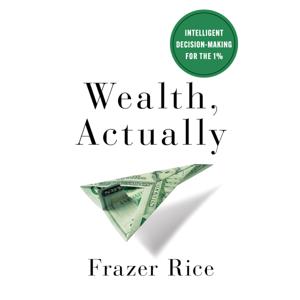
    Some quick news which you all probably guessed: the Frazer Rice podcast has been rebranded "Wealth, Actually" to align with my new book on the issues around wealth management.  And don't forget about "Wealth, Actually" the book:
    https://www.amazon.com/Wealth-Actually-Intelligent-Decision-Making-1-ebook/dp/B07FPQJJQT

    34 min
  • Frazer Rice discussing “Wealth, Actually” on Bookstr’s Facebook Live Channel
    https://frazerrice.com/wp-content/uploads/2018/08/Frazer-Rice-FB-Live.mp4

    Thanks to David Grasso, Scott Richmond and the team at Bookstr for having me on their Facebook Live channel.  It's always a pleasure to discuss "Wealth, Actually."

    A link to the book is here and don't forget to leave comments on the Amazon site.

    https://www.amazon.com/Wealth-Actually-Intelligent-Decision-Making-1-ebook/dp/B07FPQJJQT
    23 min
  • Frazer Rice discussing “Wealth, Actually” on Bookstr’s Facebook Live Channel
    https://frazerrice.com/wp-content/uploads/2018/08/Frazer-Rice-FB-Live.mp4
    Thanks to David Grasso, Scott Richmond and the team at Bookstr for having me on their Facebook Live channel.  It's always a pleasure to discuss "Wealth, Actually."
    A link to the book is here and don't forget to leave comments on the Amazon site.
    https://www.amazon.com/Wealth-Actually-Intelligent-Decision-Making-1-ebook/dp/B07FPQJJQT
    23 min
  • Frazer Rice, Author of “Wealth, Actually”, on the Josh Jalinski Financial Quarterback show.
    Here is something that is a little bit new!  I was interviewed on my new book "Wealth, Actually by Josh Jalinksi on his Financial Quarterback show on 710 WOR ad on #iheartradio.  We discussed estate planning, family dynamics, investing and a host of tools that could helpful in making good decisions about wealth.  Thanks again, Josh!


    To buy "WEALTH, ACTUALLY" on AMAZON, click BELOW . . . Feel free to leave Amazon Reviews (hopefully good ones!).  They help the algorithm.

    https://www.amazon.com/Wealth-Actually-Intelligent-Decision-Making-1-ebook/dp/B07FPQJJQT


    56 min
  • Frazer Rice, Author of “Wealth, Actually”, on the Josh Jalinski Financial Quarterback show.
    Here is something that is a little bit new!  I was interviewed on my new book "Wealth, Actually by Josh Jalinksi on his Financial Quarterback show on 710 WOR ad on #iheartradio.  We discussed estate planning, family dynamics, investing and a host of tools that could helpful in making good decisions about wealth.  Thanks again, Josh!
    To buy "WEALTH, ACTUALLY" on AMAZON, click BELOW . . . Feel free to leave Amazon Reviews (hopefully good ones!).  They help the algorithm.
    https://www.amazon.com/Wealth-Actually-Intelligent-Decision-Making-1-ebook/dp/B07FPQJJQT
    56 min
  • Ben Phillips, Chief Investment Officer of Eventshares
    With the 2018 midterm elections around the corner, I spoke with Ben Phillips about the impact of policy on the investment world.

    Ben Phillips serves as the CIO of EventShares, overseeing research and portfolio management for the U.S. Policy Alpha ETF (PLCY). Mr. Phillips previously worked for Goldman Sachs Asset Management, where he had portfolio management responsibilities across several multi-sector total return funds. Prior to GSAM, he held senior investing roles at Providence Equity Partners and Lord Abbett. Mr. Phillips is a CFA charterholder and received an MBA and BSBA in Finance from the University of Missouri. Mr. Phillips works in the firm's New York office.

    Background:

    * How do you think about investing at Eventshares? (What is the effect of Policy on the markets)
    * Government affects everything.  How do you break this down and organize your thinking?
    * Once your themes are established how do you implement your findings into good investment ideas?

    Onto the 2018-2019 political environment:

    First, what do we make of the general political environment and the effect of Trump?

    Second, what is the current thinking on the midterms?

    Onto the specific policy themes that affect investments:

    Policy themes outlined by Ben:

    * Trade: "Trade continues to be the biggest potential headwind to the market. We expect headline volatility to linger, as markets attempt to decipher if Trump is bluffing on tariffs. While negotiations play out, we prefer to hold U.S. focused companies with minimal foreign currency exposure."
    * Immigration: "Border arrests trended down in 2017 after Trump assumed office pledging an immigration crackdown. However, 2018 border arrests are increasing as the administration doubles down on its agenda and strengthens border enforcement. We expect this to impact U.S.-Mexico relations and be a defining issue in the midterm elections."
    * Trucking: "Electronic logging devices (ELDs) continue to be implemented, which we believe will slow trucker productivity. In our view, ELDs are compounding a driver shortage, which will force trucking companies to increase compensation and turn down freight. We prefer to own asset-light companies with exposure to the spot freight market, as well as companies involved in the intermodal and rail markets."
    * Defense: "The FY 2019 appropriations process is underway in Washington D.C. We continue to expect companies involved in the defense industry to grow their revenues over the upcoming years due to the long lead time of defense contracts and the added tailwind from foreign demand. In our view, aircraft manufacturers and shipbuilders are best positioned to benefit from increased spending."
    * Refining Spreads: "The U.S. energy boom continues to redefine the energy market. Drilling companies in the Permian Basin are extracting record amounts of oil, but pipeline capacity issues mean not all of it is moving out of the area. Trucking shortages (see above) are exacerbating the issue, causing some drillers to sell at the local Midland spot price to refining companies. The refining companies may then be able to capture the spread by selling the oil at WTI or Brent benchmark prices."
    * Financial Deregulation: "The Trump administration continues to focus efforts on dismantling the Consumer Financial Protection Bureau (CFPB), which is responsible for consumer protection in the financial sector. In our view, this will continue to benefit specialty finance companies, non-traditional lenders, and select regional banks."
    * Healthcare:

    * "The Affordable Care Act (ACA) continues to be a long-tail policy. After years of fighting the ACA,
    28 min
  • Ben Phillips, Chief Investment Officer of Eventshares
    With the 2018 midterm elections around the corner, I spoke with Ben Phillips about the impact of policy on the investment world.
    Ben Phillips serves as the CIO of EventShares, overseeing research and portfolio management for the U.S. Policy Alpha ETF (PLCY). Mr. Phillips previously worked for Goldman Sachs Asset Management, where he had portfolio management responsibilities across several multi-sector total return funds. Prior to GSAM, he held senior investing roles at Providence Equity Partners and Lord Abbett. Mr. Phillips is a CFA charterholder and received an MBA and BSBA in Finance from the University of Missouri. Mr. Phillips works in the firm's New York office.
    Background:
    How do you think about investing at Eventshares? (What is the effect of Policy on the markets)
    Government affects everything.  How do you break this down and organize your thinking?
    Once your themes are established how do you implement your findings into good investment ideas?
    Onto the 2018-2019 political environment:
    First, what do we make of the general political environment and the effect of Trump?
    Second, what is the current thinking on the midterms?
    Onto the specific policy themes that affect investments:
    Policy themes outlined by Ben:
    Trade: "Trade continues to be the biggest potential headwind to the market. We expect headline volatility to linger, as markets attempt to decipher if Trump is bluffing on tariffs. While negotiations play out, we prefer to hold U.S. focused companies with minimal foreign currency exposure."
    Immigration: "Border arrests trended down in 2017 after Trump assumed office pledging an immigration crackdown. However, 2018 border arrests are increasing as the administration doubles down on its agenda and strengthens border enforcement. We expect this to impact U.S.-Mexico relations and be a defining issue in the midterm elections."
    Trucking: "Electronic logging devices (ELDs) continue to be implemented, which we believe will slow trucker productivity. In our view, ELDs are compounding a driver shortage, which will force trucking companies to increase compensation and turn down freight. We prefer to own asset-light companies with exposure to the spot freight market, as well as companies involved in the intermodal and rail markets."
    Defense: "The FY 2019 appropriations process is underway in Washington D.C. We continue to expect companies involved in the defense industry to grow their revenues over the upcoming years due to the long lead time of defense contracts and the added tailwind from foreign demand. In our view, aircraft manufacturers and shipbuilders are best positioned to benefit from increased spending."
    Refining Spreads: "The U.S. energy boom continues to redefine the energy market. Drilling companies in the Permian Basin are extracting record amounts of oil, but pipeline capacity issues mean not all of it is moving out of the area. Trucking shortages (see above) are exacerbating the issue, causing some drillers to sell at the local Midland spot price to refining companies. The refining companies may then be able to capture the spread by selling the oil at WTI or Brent benchmark prices."
    Financial Deregulation: "The Trump administration continues to focus efforts on dismantling the Consumer Financial Protection Bureau (CFPB), which is responsible for consumer protection in the financial sector. In our view, this will continue to benefit specialty finance companies, non-traditional lenders, and select regional banks."
    Healthcare:
    "The Affordable Care Act (ACA) continues to be a long-tail policy. After years of fighting the ACA, Republicans appear slightly more willing to expand Medicaid and Medicare, but only under their terms. While risk reduction payments were recently in the headlines after a New Mexico court ruling, we don’t believe they will be stopped under the ACA. In our view, these two items will help stabilize the insurance exchanges and insurer business models."
    "The Trump administration also released its drug pricing plan during Q2 2018. In our view, the plan does little to impact drug prices or pharmaceutical company business models."
    Midterm Volatility: "Campaign season will kick into high gear during Q3 2018. We expect the political environment to be highly charged. In our view, it’s too early to call midterms as control over the recent Supreme Court vacancy and immigration will be contentious items. Plus, Donald Trump is a master campaigner who gets his base."
    Following up with Ben:
    How can we keep track of your policy thoughts and their impact on the markets:
    WWW.EVENTSHARES.COM
    How do we find out more about Eventshares?
    How do we keep track of your writings?
    ***This podcast is a educational discussion about the impacts of governmental policy on investments.  It is neither an advertisement, nor an endorsement for Eventshares.***
    28 min