
Sign up to save your podcasts
Or



Hotels, Haunts, and Hanging On until the 15th
What’s scarier: a haunted hotel, a room full of TikTok tax advice, or a client asking what you need to get started four days before the deadline?
Josh and Shannon are hanging on until October 15 with hotel grievances, ghost stories, and a haunted house designed specifically to terrify tax professionals. Think last-minute W-2s, questionable S corporation advice, and BOI tombstones.
Shannon shares how she negotiated a peaceful night with a hotel ghost—and why haunted houses now qualify as relaxation. Josh questions hotel Wi-Fi, bathroom design, and whether every tax topic he teaches is destined to disappear.
They also discuss morning pages, AI’s unintentionally hilarious approach to literature, and preparing for the U.S. Tax Court nonattorney exam: why structured preparation and study partners mattered to them, where AI helped, and why it cannot do the learning for you.
Plus: upcoming classes, plans for Saratoga Springs, and the reminder that you can’t care more than the client does.
CLASSES AND EVENTS
• Tax Court Exam Preparation Class — USTC Practitioner’s Services
The program Josh and Shannon attended:
https://taxcourtexam.com/
• Ethics in the Real World — Brass Tax
Josh’s ethics class. Available on demand, with live replays October 20 and 27:
https://brasstax.com/products/ethics-in-the-real-world/
• The IRS’s First AI Rules: Circular 230 Exposure After OPR Alert 2026-19 — myLawCLE
Sharyn Fisk and Josh Youngblood | October 14, 2026 | 2:30–4:40 p.m. Eastern:
https://mylawcle.com/products/the-irss-first-ai-rules-circular-230-exposure-after-opr-alert-2026-19/
• NYSSEA 39th Annual Conference
October 25–27, 2026 | Saratoga Springs, New York:
https://nyssea.starchapter.com/meetinginfo.php?id=54&ts=1783363088
More episodes and full show notes:
https://wellactually.tax/
Tom, Taxes, & (good) Trouble
Tom Gorczynski, EA, USTCP, joins Josh and Shannon for a candid conversation about building a career in tax and speaking up when the profession can do better.
They discuss professional organizations, why Tom left NAEA, sponsored education, conflicts of interest, and choosing instructors who know their material. They also get into AI, preparing for the U.S. Tax Court practitioner exam, and Tom’s advice for new enrolled agents.
Plus: the value of meeting people in person, airport lounges, and one unforgettable dinner in Las Vegas.
Guest: Tom Gorczynski, EA, USTCP
Hosts: Josh Youngblood, EA, USTCP · Shannon Hall, EA, USTCP
Full show notes and links: https://wellactually.tax
Tom’s work: https://www.tomg.tax
Tax Court exam preparation: https://taxcourtexam.com
Josh and Shannon are officially admitted to practice before the United States Tax Court.
In this special edition of Well, Actually…, they look back at the long road to becoming U.S. Tax Court Practitioners: deciding to take the exam, months of preparation, surviving test day, waiting for results, completing the character and fitness process, and finally getting the news they had been waiting for.
They talk about which parts of the four-part exam were the hardest, why the USTCP exam is nothing like the EA exam, the chaos and excitement of finding out they passed, and what the credential actually means now that they have it.
Plus: remote-testing anxiety, tornado sirens, spam folders, study-group trauma, character-and-fitness nerves, and why passing the exam is really just the beginning.
For tax professionals considering the USTCP path, Josh and Shannon also share what helped them prepare and their advice for approaching the process.
Learn more about the exam and sign up for the preparation class:
https://taxcourtexam.com
Connect with us:
Josh Youngblood — josh.tax
Shannon Hall — shannon.tax
Josh and Shannon dig into The AI-Driven Leader, how AI should actually be used, and why faster and more automated does not always mean better.
They talk about AI as a tool for strategy and research, the risk of outsourcing too much thinking, and why responsibility still belongs to the people building, deploying, and relying on the technology.
Then the conversation turns to accountability in the tax profession: jealousy, scarcity thinking, gatekeeping, toxic behavior, discrimination, sexual harassment, and the importance of speaking up when professional conduct crosses the line.
Also in this episode: Josh’s SpaceX AI meetup in Austin, Cal Newport’s take on AI and agents, work-life balance, and why technology should support professional judgment rather than replace it.
Plus, Josh previews the IRS Tax Forums in San Diego and AskTomG.ai demos, while Shannon shares what’s coming up with Brass Tax.
Explicit: Strong language sometimes and adult topics.
EAs, Emmys, and… Enlargements
Josh and Shannon get into what actually separates a business deduction from a personal one.
Shannon reports back from the Brass Tax EA Bootcamp and the first year of at-home EA exam proctoring (the metal detector stories are real). Then: why an unlicensed preparer cannot represent you before the IRS no matter what the Facebook group says, how to tell whether a CE speaker actually knows the material, and §162 versus §262 by way of an influencer who deducted the Grammys, a dancer who depreciated her chest, and two business partners who were very sure the Rolexes were ordinary and necessary.
Plus: why the adversarial posture toward the IRS is mostly bad strategy.
CASES
An IT manager/social media influencer deducted roughly $97,000 in celebrity meet-and-greets, Grammys and Emmys tickets, and signed Kobe Bryant shoes. The celebrity expenses went down, but the result wasn't a complete wipeout: the court allowed portions of several business expenses under Cohan and credit-card processing fees in full.
Hess v. Commissioner, T.C. Summary Opinion 1994-79 — Yes, that case. Cynthia Hess, stage name “Chesty Love,” successfully treated her surgical implants as depreciable business property. And much of what tax professionals repeat about this opinion is wrong.
WELL, ACTUALLY…
• Hess is not T.C. Memo. 1994-79. It's a nonprecedential small-tax-case summary opinion.
• “Not precedent” does not mean “not citable.”
• She was 56FF in the tax year before the court; the later 56N implants came afterward.
• The next case was a mixed result, not a complete denial.
• Calling it “the first influencer case” may be premature.
• The Dinah Shore gown deduction appears to be tax folklore, not a reported case.
Code: IRC §§162, 262, 7463(b), 67(h)
MENTIONED
Brass Tax Presentations — brasstax.com
AskTomG — asktomg.ai (Disclosure: Josh has a financial interest.)
Tom Talks Taxes — tomtalkstaxes.com
U.S. Tax Court — ustaxcourt.gov
Full show notes, citations, source documents, links, and corrections: wellactually.tax
This podcast is general commentary on federal tax law and procedure, not tax, legal, or accounting advice. Tax outcomes depend on facts. Views expressed are the hosts’ own.
Two enrolled agents who just survived the Tax Court exam sit down to compare notes on a summer of conferences, a vendor hall full of AI products, and the disclosure rule nobody wants to talk about.
Josh and Shannon open the first episode of Well, Actually with the small talk (105 degrees in Texas, an angelic glow in Long Beach) and get to the substance quickly: what they'd change about every tax practice in the country if they had one wish, why "our lawyer says 7216 doesn't apply" is a red flag, how to actually vet an AI vendor, and what OPR's guidance on artificial intelligence does and doesn't say about billing.
Then a detour through ghost tours, continuation school, GEDs, acting degrees, and whether you need a master's in taxation to sit for the USTCP exam. (You don't.)
The episode ends on the first official well, actually of the series, courtesy of a five-hour research spiral in a rented house in the desert: an IRS publication is not primary authority. It has never been primary authority. It can also, it turns out, simply be wrong.
Interested in the USTCP Exam? Check out www.taxcourtexam.com
From the publisher's feed
Josh Youngblood and Shannon Hall are enrolled…
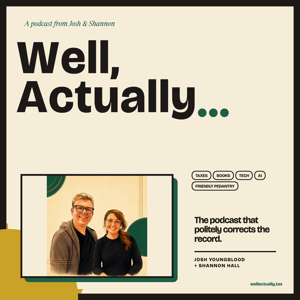
Well, Actually… is a conversation between two tax professionals about the things they can't stop reading about: tax (obviously), books, technology, and AI. Some weeks that means a Tax Court opinion nobody covered properly. Some weeks it means the Section 7216 question every AI vendor would rather not answer. Some weeks it means a novel one of them finished at a hotel bar and got yelled at for reading.
The premise is friendly pedantry. Getting the detail right matters; the difference between a primary source and a persuasive one matters, and "I don't know" is a perfectly good answer as long as it's followed by "let's find out."
No hot takes. Occasional ghost tours. At least one well-sourced "actually" per episode.
Neither of them is giving you tax advice on a podcast.