
Sign up to save your podcasts
Or



We invite you to join us in this continued, engaging discussion with author, advocate, and the National Wildlife Federation's Executive Director, Beth Pratt, as we further explore the profound connection between conservation science and the essence of human existence. In this conversation, we will delve into the depths of what it truly means to be human, fostering a harmonious coexistence with wildlife, and contemplating the future trajectory of human life on our beloved planet Earth.
" P22, the majestic mountain lion who captured the hearts of many, passed away recently. He was an iconic symbol of urban wildlife and a beloved resident of the Santa Monica Mountains. P22's story touched people around the world, highlighting the challenges faced by wildlife in fragmented habitats.
Despite his struggles, P22 became a beacon of hope, proving that wild animals can coexist with humans in urban landscapes. His journey, from the remote wilderness to the heart of Los Angeles, inspired conservation efforts and raised awareness about the importance of preserving natural corridors for wildlife.
P22 faced numerous obstacles during his time in the city, including navigating busy freeways and adapting to an urban diet. Despite these challenges, he managed to survive and thrive, becoming a symbol of resilience and adaptability.
His story sparked conversations about the need to protect and connect open spaces, enabling animals like P22 to roam freely and maintain healthy populations. He reminded us that our actions have consequences for the natural world and that it is our responsibility to ensure a future where wildlife can flourish.
P22's passing is a reminder of the urgent need to prioritize conservation efforts and create sustainable solutions for wildlife. His legacy will continue to inspire generations to come, as we strive to protect and preserve the precious biodiversity of our planet.
In memory of P22, let us work together to build a future where wild creatures can roam without boundaries and where the beauty and wonder of nature can be cherished by all. " - Excerpt from Beth Pratt's stirring obituary to the Mountain Lion P22
Visit Beth Pratt's website for her blog, books and more.
We extend a massive thank you to the spoken word content: Cores, Corridors, Carnivores by Natasha Deganello Giraudie, music by: Alexander Nacarada and to you our listeners.
We have the deep honor of opening this show with our nature practice guide natasha deganello giraudie, who poetically expresses the theme of this series | Cores, Corridors, Carnivores. Calm your body, clear your mind, open your heart & uplift your soul by deepening your relationship with the Earth.
We invite you to explore a nature practice with natasha, too. Nature Practice Guide
Our featured guest on this episode is Beth Pratt, a lifelong advocate for wildlife, Beth has worked in environmental leadership roles for over twenty-five years, and in two of the country’s largest national parks: Yosemite and Yellowstone. As the California Regional Executive Director for the National Wildlife Federation, she says, “I have the best job in the world—advocating for the state’s remarkable wildlife.” We couldn't agree more!
Beth also leads the #SaveLACougars campaign to buildThe Wallis Annenberg Wildlife Crossing, the largest wildlife crossing in the world. This wildlife crossing will help save a population of mountain lions from extinction. Beth's innovative conservation work has been featured by The New Yorker, The Wall Street Journal, Washington Post, BBC World Service, CBS This Morning, the Los Angeles Times, Men’s Journal, NPR and more.
Her upcoming book, "Yosemite Wildlife," will be released by the Yosemite Conservancy in 2023. She has given a TEDx talk about coexisting with wildlife called, “How a Lonely Cougar in Los Angeles Inspired the World,” and is featured in the new documentary, “The Cat that Changed America.”
Join us for this enlightening two part conversation with Beth Pratt, where we travel down some familiars trails and some not so familiar ones ... exploring connectivity, our place in the web of Life, caring for wildlife, our planet and ourselves.
Want to have a live peek at the progress of the wildlife crossing ? visit Save LA Cougars
Music |
Ablation Suite by Hayden Folker
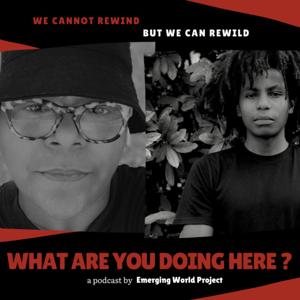
What Are You Doing Here ?
Produced by |
Emerging World Project
We are rebroadcasting one of our most listened to and enjoyed episodes... A conversation with Nick Brandt | photographer
The themes in Nick Brandt’s photographic series always relate to the destructive impact that humankind is having on both the natural world and now humans themselves too.
Nearly twenty years ago Nick Brandt started photographing the wild animals of Africa as an elegy to a dis-appearing world. After some years, seeing the escalating environmental destruction, he felt an urgent need to move away from that kind of work and address the destruction in a much more direct way. This led to the series, Inherit the Dust (2016) and This Empty World (2019). These were mainly about habitat loss and biodiversity loss, significantly as a result of human ex-pansion and development.
Nick established a style of portrait photography of animals in the wild similar to that of the photography of humans in studio setting, shot on medium format film, attempting to portray animals as sentient creatures not so different from us.
Nick’s "The Day May Break" (2021) series is the first part of a global series portraying people & animals impacted by environmental destruction. Photographed in Zimbabwe and Kenya, the people in the photos have all been badly affected by climate change - displaced by cyclones that destroyed their homes, displaced & impoverished after years-long severe droughts.
The photos were taken at 5 sanctuaries/ conservancies. The animals are almost all long-term rescues, due to everything from poaching of their parents to habitat destruction & poisoning. These animals can never be released back into the wild. Now habituated, it was therefore safe for strangers to be photographed close to the animals in the same frame. Nick has had solo gallery and museum shows around the world, including New York, London, Berlin, Stockholm, Paris and Los Angeles. All of the series are published in book form. In descending order, Nick says the images are best viewed in a gallery, in the book or online full screen on your computer at the very least on your phone. You can discovery his work on his website www.nickbrandt.com
Nick is also the co-founder of Big Life Foundation, a non-profit in Kenya/ Tanzania, established 2010. They employ more than 300 local rangers protecting 1.6 million acres of the Amboseli / Kilimanjaro ecosystem.
We caught up with Nick at his home in California and if you want to know what word he would add to the dictionary... it rhymes with "schmuck" followed by wit.
The music on this episode are natural original sounds of Earth herself and the beautiful music of apoxode and Daniel Birch
Excerpt from "Love Letter to the Earth " Parallax Press (2013) by Thich Nhat Hanh was read by Greta
Enjoy. We will catch on the flip side.
We are rebroadcasting this popular episode with apiarist, Madison Newman. Enjoy!
Have you ever day dreamed about being a beekeeper ? or do you really want to understand the role bees play in our world?
Well, here is your chance even if you don't think it's for you, to learn the ins and outs of beekeeping. Our guest on this episode is Madison Newman. She is a 22 year old beekeeper born and raised in Southern California's, San Fernando Valley. She holds a Bachelor's degree in English Literature from California State University Northridge. Madison started her beekeeping profession working as a honey salesperson right out out of high school, and has worked her way up to beekeeper. When she isn't beekeeping you can likely find her hiking, brewing beer, or practicing martial arts.
Madison reminds us of the integral part that all of the pollinators play in our ecosystem. Her English literature studies have taught her how to take an analytical approach to the way she handles the many different bee scenarios that she might be up against as a beekeeper, this approach is very beneficial when it comes to managing bee colonies, keeping bees alive and safe for the public. You can check out Maddog's adventures and truly learn a lot by dropping into her IG @maddog586
And if you want to learn more about beekeeping, join a community, or get yourself some local honey be sure to visit www.thevalleyhive.com ... from tasting honey to viewing bees in a fully functional glass hive, it is the only place of its kind in Southern California.
This week we are rebroadcasting our conversation with Jennifer Brent, Executive Director of the California Wildlife Center.
Our nature practice guide Natasha Deganello Giraudie sets the tone for us with a beautiful Land Blessing. Together we can deepen our relationship to the more -than-human world at this critical time. We encourage you to take it slow ... find a tree to sit under and relax into this important conversation.
California Wildlife Center takes responsibility for the protection of native wildlife through rehabilitation, education, and conservation. It is dedicated to the rescue and rehabilitation of native California species, who otherwise would be left to suffer from the effects of human encroachment, habitat destruction and environmental damage.
Jennifer Brent has been working with animals for over 13 years most recently as the Executive Director of California Wildlife Center. She has a passion for the preservation of native species and the environment and has been at the helm to help over 82,000 wild California animals.
She was previously at the Jason Debus Heigl Foundation, the Found Animals Foundation and served on the Los Angeles Department of Animal Services' Commission.
California Wildlife Center offers all of their programs at zero cost to the finder. They help over 4,300 animals each year and answer over 30,000 phone calls. This work is funded by individual donations as they receive no sustaining government money. Your kind offerings are greatly appreciated.
Learn more by visiting www.cawildlife.org
This show is produced by I Emerging World Project, whose studios are located on Tongva Land .
The music is by | axletree and the surrounding wildlife near the EWP studios.
“To restore stability to our planet, we must restore its biodiversity, the very thing that we’ve removed. It’s the only way out of this crisis we’ve created – we must rewild the world.’ – David Attenborough
The broad C’s of rewilding – Cores, Corridors and Carnivores – largely encapsulate the conservation rationale behind most large scale rewilding endeavours whose grander aim is to increase biodiversity, reverse extinction trends in several species, and revive ecological machinery to mitigate climate change. This includes identifying and demarcating a large core (inviolate of humans) region in need of ecological restoration and allowing regeneration of degraded and imbalanced ecosystems. For smooth movement of animals such as wide ranging large carnivores and genetic flow between animal populations, ensuring healthy connectivity between such core areas and other wilderness areas is crucial. Wildlife corridors connecting two or more cores need to be restored with the help of local communities, preserved, and protected. Carnivores represent the apex predators within ecosystems whose presence and reintroduction within a landscape enables ecosystem revival.
Natural ecosystems by nature are self-regulating and self-sustaining. But, impact of human actions have rendered large swathes of natural habitats dilapidated, destroyed and wounded. Wildlife populations the world over have witnessed a staggering 60% or more decline in just the last 40-50 years. We have essentially fractured the carbon absorbing sinks such as oceans and forests, and are now reeling under the impact of man-made climate change further compounded by continued and relentless carbon emissions. Only restoration of such ecosystems on the land and in the seas will keep all dominoes from falling, and ecosystem functions from collapsing.(Wildlife Conservation Trust)
For this series " Cores, Corridors, Carnivores" we will start with exploring the impact that the famous mountain lion P22 had in Los Angeles, California (and the world!) and the construction of the worlds largest wildlife crossing in the world to date, The Wallis Annenberg Wildlife Crossing.
In an effort to get You involved we invite you to become a citizen scientist! yes, You. We invite you to download the community powered App " iNaturalists " and become deeply familiar with the natural world around you and join us in an ecosystem revival!
Music : Truth in Stones by Kevin McCloud
In the spirit of collaboration and community science we invite you to have a listen to this episode we are sharing from the “Nature Talks” podcast by Erfan Firouzi. Erfan chats it up with Kelsey Prediger about the most trafficked mammal, the elusive beauty known as the Pangolin.
Growing up on a lake immersed in nature, Kelsey developed a fiery passion for adventure and wildlife with the dream of one day working in conservation. In 2016 she moved to Namibia to work with carnivores but soon after she learned about the plight of the pangolin. She dedicated her research to learning more about this gentle creature and found her calling and with that she founded the Pangolin Conservation & Research Foundation
The Pangolin Conservation & Research Foundation (PCRF) was founded on the belief that without combined outreach, collaboration, scientific research and policy, conservation efforts would continue to fall short.
Kelsey is also the Secretariat of the Namibian Pangolin Working Group. Additionally, she leads the Pangolin Conservation and Research Project, a collaboration between PCRF and the Biodiversity Research Centre- Namibian University of Science and Technology.
Her work to expand field research and develop strong policies is ground breaking.
Please visit and support their work here | www.pangolincrf.org | on IG @pangolincrf
The music for this episode is by Kevin McCloud &natural sounds around the EWP studios.
" It is not enough to rescue these animals from illegal trafficking. They must be given the opportunity to recover properly. They must be given a real chance at survival, not just at a rescue station, but back in the wild, where they can contribute to genetic diversity and the continuation of their species in these areas. Jungle Rescue Reform is committed to aiding in this cause and making a difference for these animals and the species to which they belong."
Joey, founder - Jungle Rescue Reform
Our guest is Joey Solimine, she is a veterinary nurse, wildlife conservationist, conservation student, and the founder of Jungle Rescue Reform. Joey studied Animal Science and Pre-Veterinary Medicine at Rutgers University and is currently studying Wildlife Conservation Biology through Unity College of Maine. She travels to wildlife rehabilitation centers across Central and South America, predominantly in the Amazon region, where she helps rehabilitate, medically care for, research and eventually release wildlife victims of illegal pet trade.
She has been traveling to and working in the jungle for almost 7 years now, doing research on ethical wildlife rehabilitation practices, controversies, and successful rehabilitation, with a focus on primate behavior and how primate cognitive complexities may complicate the rehabilitation process and what we think we know about it. Her goal is to help build on what we know about rehabilitating wildlife that were once held as pets or used as tourist attractions, especially primates.
Her organization Jungle Rescue Reform also aims to help bring funding and support to wildlife rescue centers operating in remote parts of the world, with a focus on the Amazon rainforest, they also aim to advocate for locals who run these sanctuaries, and to bridge the gaps that exist between the experts and the professionals; the science and the first hand experience of those native to those jungle areas.
Visit Jungle Rescue Reform at www.junglerescuereform.org and find Joey Solimine on IG @joey.of.the.jungle
Music :
Joystick | shiny new kicks
John Bartmann | african moon
“Our task must be to free ourselves from this prison, by widening our circle of compassion to embrace all living creatures and the whole of nature in its beauty.”
~ Albert Einstein
Wildlife Veterinarian, Sharon Mulindi joins us from her mobile vet unit position in Northern Kenya.
The mobile Vet units tackles some pretty import conservation concerns to assist the regional KWS vet in interventions which include treatments, rescues, disease surveillance and collaring. The mobile vet unit is sponsored by Save The Elephants, Ewaso Lions and Grey's Zebra Trust in collaboration with the Kenya Wildlife Service.
Enjoy our episode with Sharon and hear about some of the wildlife she comes face to face with, how Africa's first community owned and run elephant sanctuary works, and a peek into the important research work being done in conservation. The journey to a being a wildlife vet is quite a journey, and discovering Sharon's passion and commitment is an inspiration to us all as we tackle the challenges we face in our current reality.
For a bit of levity Marley steps in with his rapid fire questions for his segment of "Off the Top."
Be sure to see what Ms. Mulindi is up to on her IG @sha.ron_mulindi and the mobile vet teams @savetheelephants, @ewasolions @kenyawildlifeservice
Visit | Reteti Elephant Sanctuary, Africa’s first community owned elephant sanctuary situated in Northern Kenya. We rescue, to release. www.reteti.org
Opening "Love Letter to the Earth" by Thich Nhat Hanh, read by Natasha Deganello Giraudie
Reflections by Erika Tengu and Greta Mae
Music by John Bartman & the EWP natural environment.
“ A problem well stated is a problem half-solved.” - Charles Kettering
Our culture depends on single use plastic… look around you, right now. what do you see? maybe a plastic bottle, food containers, the infamous six pack rings… the problem is that most plastic waste does not make it to the recycling center or even the landfill. This plastic is carried by rivers, wind and animals and can find its way to the sea.
It’s time for us to break up with single - plastic! so go ahead turn on your favorite dance party song and start your break-up !
we encourage to you visit PlasticTides.Org see what you can do for a ton of inspiration and opportunities.
Our featured guest today is Christian Shaw, he is the Founder and Executive Director of Plastic Tides, an organization whose mission is to inspire and catalyze action toward a plastic- free future through adventure, education and youth empowerment.
Christian has undertaken a great deal of challenges in his desire to see a plastic-free future, he has lead paddle board expeditions to some of the worlds most polluted bodies of water to aid in the collection of marine plastic pollution research.
Now rolling into a decade of experience in the non-profit sector of conservation, he recently completed an expedition up the Mississippi river researching the prevalence of nurdles (the parent material of plastic products. This expedition leads to engaged activism through an online petition supporting opposition to the proposed Formosa Plastics facility in St. James Parish, La.
Since 2014, inspiring youth to take action has always been core to Plastic Tides.
The Global Youth Mentor Program (GYM) gives motivated Youth Leaders the tools and support to create lasting systemic change in their communities. Youth Leaders are paired with Mentors from all over the world and directed through change-based projects. Now more than ever, youth leadership is vital to the success of the environmental movement.
We are grateful that You are here with us for our talk with Christian.
Find out more about and get involved the Global Youth Mentor program PlasticTides.Org & follow @plastictides on IG.
Thank you to Maryam Faresh and Erfan Firouzi for opening and closing the show with their beautiful readings from “Love Letter to the Earth”
by Thich Nhat Hanh, Parallax Press (2013)
Further show details can be found over at EmergingWorldProject.Org
From the publisher's feed