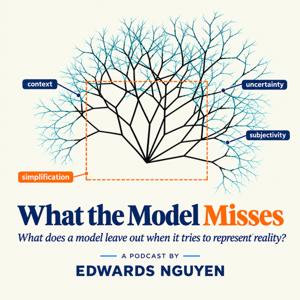
Dr. Michael Batty has built computer models of cities since the 1970s. He is Bartlett Professor of Planning at University College London and Chair of the Centre for Advanced Spatial Analysis (CASA), and he is a recipient of the Vautrin Lud Prize, widely regarded as the Nobel Prize of geography. I opened the interview by asking him where the principal constraint on urban modeling lies today: in computing power, in data quality, or elsewhere. His answer reframed nearly everything that followed.
The fundamental limit, he argued, has never been computational. It has always been theoretical: the field still lacks a sufficiently robust account of how cities actually function. Architects, planners, economists, and geographers each bring competing theories to the problem, and no quantity of computation can substitute for a sound underlying understanding. In his view, this remains the defining challenge of the discipline.
This theme recurred as he described how urban modeling has evolved over the course of his career. Earlier aggregative models treated entire populations as uniform blocks, each roughly the size of a census tract. Contemporary agent based models, by contrast, simulate individual people and the interactions among them. Although this transition appears to represent straightforward progress toward greater detail and realism, Dr. Batty cautioned against that assumption. Greater detail does not necessarily produce a better model; frequently it produces only a more complicated one.
The portion of the conversation I found most instructive concerned prediction. Dr. Batty invoked the statistician George Box's dictum that "all models are wrong, but some are useful." He described models that generate accurate aggregate figures while misrepresenting the actual relationships among individuals, and models that perform almost flawlessly under laboratory conditions yet fail once they are exposed to the noise and disorder of the real world. Climate models, he noted, confront precisely the same difficulty. For this reason, disciplines ranging from climate science to central banking now run multiple models in parallel and pool their results, rather than relying on any single model to be "correct."
We also discussed how the physical form of cities has changed over time, from monocentric cities organized around a single downtown core to the dispersed, polycentric metropolitan regions in which most people now live. Dr. Batty acknowledged that this transformation remains difficult to model. Most models capture a city at a single moment rather than representing its evolution over time, a limitation he regards as one of the most significant unsolved problems in the field.
Toward the end of the interview, I asked what advice he would offer a high school student who wished to build a city model. His answer concerned neither programming nor software. The first task, he explained, is to determine precisely what one is trying to explain, because many of the most effective models begin as simple, back of the envelope ideas rather than elaborate systems. He urged me to read substantive work in urban geography rather than rely on summaries. The conversation concluded on a personal note: when he asked where I was from, we briefly discussed Atlanta, itself an example of the complex, polycentric city we had been examining throughout the interview.
By the end of the conversation, I understood the point Dr. Batty had been making from his first answer: the model itself was never the central achievement. The thinking behind it was.