
Sign up to save your podcasts
Or

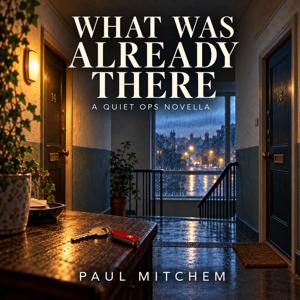


Danny has climbed two flights of stairs without remembering the first. His keys are gone, his gym bag is spread across the landing, and twelve minutes into a run an hour ago, a phone call ended the life he thought he was living.
A neighbour he barely knows is holding something that belongs to him.
Chapter One of What Was Already There, a Quiet Ops novella. Season 2 of Quiet Ops, written and read by Paul Mitchem. It's fiction, and it follows The Noise.
New chapters follow. Quiet Ops: remove noise so humans and systems can function properly.
For most of my life I believed my value came from fixing things.
If something wasn’t working, I worked harder.
If I could just get far enough upstream, there would always be a lever to pull.
Sometimes there was.
Sometimes there wasn’t.
This is the last chapter of Quiet Ops.
It isn’t about a method. It’s about what changed in the man who used it.
I stopped confusing responsibility with control.
I stopped measuring a good life by performance.
I started noticing what the ordinary moments were actually worth.
Some things need intervention.
Some need patience.
Some need acceptance.
Wisdom is learning the difference.
Every chapter so far followed the same shape.
Find the noise. Go upstream. Reduce it.
This one is the place it didn't work.
My mother had a stroke, and something in her changed that never changed back.
Three times she stopped acknowledging that we existed. Each time it lasted a year or more.
I did what I knew how to do. It wasn't enough, and it was never going to be.
There is one moment at a fence.
It lasted seconds.
The noise I couldn't reach turned out not to be hers.
Chapter Seven of Quiet Ops.
One of our kids said it. Daddy please, do something.
They weren't in the room when we argued. They didn't need to be. They felt it anyway.
My wife and I talked about separation. Privately. Not thrown out mid-fight. A real conversation.
I thought she wanted out of the marriage.
She wanted out of the cycle. Those aren't the same thing.
It took me a long time to understand the difference.
I was the loud one.
Shouting had become the default in that house. Mine most of all.
Kids learn fast. They started talking to each other the way we talked to them.
One evening, deep in it, I thought about my dad.
He used to shout too. Later in life he became the calm one. The one everyone gravitated toward without deciding to.
He passed in 2023.
Sitting in my own kitchen, years after, I wasn't wondering what he'd have made of us.
I already knew.
We didn't fix it that night. But we started asking a different question.
Not what's wrong today. Who do we actually want to be.
Two months into rebuilding my body, I came out of the bathroom one morning in my boxers.
My wife's eyes moved over me. Stopped. Came back. Then a smile.
I went and checked the scale anyway. Old habit, faster than anything I'd learned.
Zero. Same number it had shown for two months.
I got the tape measure out instead.
Eight centimetres off the waist. Over four and a half months. Scale reading exactly what it read at the start.
I wasn't failing.
I was rebuilding.
Chapter Three: The Same Noise, Wearing a Different Uniform
What does a service desk with more than 2,000 open tickets and 600 stalled projects have to do with burnout?
More than I understood at the time.
I walked into that organisation expecting to fix a struggling service desk. What I found was a capable team drowning in noise generated somewhere else.
This was years before I had the words Quiet Ops, but the pattern was already there: stop fighting the symptom, go upstream, find the source, reduce the noise.
Because sometimes the people who look like the problem were never the problem at all.
I don't remember what we were arguing about.
I remember telling my wife to fuck off. And I remember her picking up her keys and leaving.
That was the night something finally broke.
I called her. "I need help, and I don't know who to ask." She came home. The next morning, she took me to a doctor.
Chapter Two of Quiet Ops is called The Night She Left. It's about that night, and about what happens when you've become so good at functioning that you can no longer tell the difference between functioning and being okay.
Prefer to read it? The full piece is up on LinkedIn.
My son was twelve when he looked at me the way you look at someone you're worried about. We were on a mountain. I was frightened, and it had nothing to do with the mountain.
This is the story of how I got there. Not the dramatic version. The quiet one. Years of noise, building underneath a life that still, mostly, looked fine.
Chapter One of Quiet Ops. Eight chapters. Eight episodes. Real stories about noise, and what happens when you finally go looking for where it started.
Prefer to read it? The full piece is up on LinkedIn.
From the publisher's feed
What Was Already There is a Quiet Ops novella in eleven chapters.
Season One was true. This season is fiction: invented people, invented places, told from inside the heads of several…
The idea underneath is the same one that runs through all of Quiet Ops. Almost nothing that breaks a person, a marriage, or an organisation is one big event. It’s noise, building quietly until it isn’t quiet anymore. Find the noise. Go upstream. Reduce it.
Written and read by Paul Mitchem.