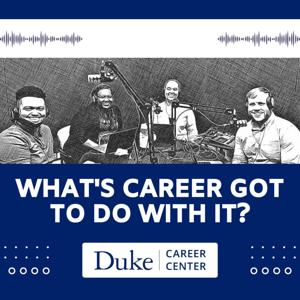
What's Career Got To Do With It?

What's Career Got To Do With It?

By Duke Career CenterEducation
Download on the App Store

All What's Career Got To Do With It? episodes

  • Season 5, Episode 4: AI at Work: Ethics, Image, and Intelligent Use
    Joining the podcast team today is Jessica Reif, PhD candidate in the Management & Organizations at Duke University's Fuqua School of Business as we discuss and answer, or many, to the question of how we ethically use AI in the workplace.
    This is the final of four episodes of this season leading up the Career Kickstart Series in October hosted by Duke Department of Alumni Engagement and Development where the Duke University Career Center podcast team ask alums to share advice about navigating early career transitions, building essential skills, and strengthening their Duke network.
    27 min
  • Season 5, Episode 2: Career Kickstart Series: Building Financial Confidence Early in Your Career with Anna Sheufelt
    Joining the podcast team today is Anna Sheufelt, Assistant Director of Educational Programming from the Office of Student Loans and Personal Finance as we discuss and answer, or many, to the question of “What the heck do I do with my money?”
    This is the second of four episodes of this season leading up the Career Kickstart Series in October hosted by Duke Department of Alumni Engagement and Development where the Duke University Career Center podcast team ask alums to share advice about navigating early career transitions, building essential skills, and strengthening their Duke network.
    36 min
  • What is the road less traveled with Shayna Heinrich '08
    Joining the podcast team today is Shayna Heinrich '08, Co-Founder and VP of Operations for The Social Institute, as we discuss an answer, or many, to the question what is the road less traveled?
    The road to the job of your dreams is not a hop, skip, and a jump away. Sometimes, it requires traversing inhospitable landscapes, dodging treacherous obstacles, and more patience than you ever fathomed. Metaphors aside, figuring out how to reach your end goal is not always clear. It takes time and persistence – a willingness to fail and commitment to trying. For this series, we thought we would ask Duke alums, what it was like to take the road less traveled to arrive at their current career.
    28 min
  • What is the road less traveled?
    The podcast crew talks with chiropractor and practice owner, Bryant Harris '05, about the road less traveled and the benefits and downsides. Was it worth it?
    Transcript:
    - Hello, and welcome to the "What's Career Got To Do With It" podcast, where we hope to provide a space for honest conversation and information that encourages the listener to take the next steps in their career journey. Wherever you are at in this process, we hope this episode will meet you with affirmation, guidance, and maybe some laughs along the way. On this episode, we have Dr. Bryant Harris joining us, who is a chiropractor and owner of True Center Chiropractic Care. Welcome, welcome.
    - What up, happy to be here.
    - Yes, so Dr. Bryant Harris is here to kind of talk to us about, you know, discussing or answering the question of what is the route less traveled?
    - Yes, sound effects are good. So welcome back home.
    - Yes, welcome back.
    - How we doing?
    - I'm doing great. I love it here.
    - You enjoying false fall?
    - Listen, you know, I'm up in D.C. We have false fall up there, too.
    - Oh, yeah.
    - Multiple days, but it's not humid, so it's just warm.
    - Oh, yeah, we're back to the humid.
    - So it's not that humid here. It was comfortable, but yeah.
    - Yeah, I love the humidity.
    - Good to you.
    - No, said no one ever.
    - Wow, gotta have a great flat iron. Anyhoo, well, why don't we open this up by giving you an opportunity to further introduce yourself, tell us a little bit about your work, and then we'll dive into that road.
    - Yeah, all right, so since this is a Duke podcast, I guess I should get some of my Duke credentials
    - That part.
    - In terms of that. So, as I said, my name is Dr. Bryant Harris. I'm a certified perinatal and pediatric chiropractor in Annapolis, Maryland. I do own my practice, Shoe Center Chiropractic Care, and a little shout-out to myself. I am the first black certified perinatal and pediatric chiropractor in the world. I graduated from Duke in 2005. I was a sociology major with a minor in biological anthropology and anatomy, which apparently is no longer here, and has a certificate in human development, which who knows if it's here as well. They've done and changed up the curriculum and all the degrees. So, yes, my degree might be obsolete now. So, yeah. So, talking about the road less traveled a little bit with this, and from when I was at Duke, I was told that I may have been the first chiropractor, or anybody had interest in becoming a chiropractor, and the first to become a chiropractor, with Duke being so, at the time, very much heavily pre-professional. You know, pre-med, pre-law. Other people would go to, like, you become a consultant or investment baking, and then go off to B school, and then you had some other people that did TFA. When I was here, if y'all don't know what TFA is, it's Teach for America, which was basically just a landing spot before they decided to go off to law school, medical, or go into consulting. So, I had all intents to become a medical doctor when I come into Duke, right? All intents. Just like so many other students, when they get here, it's like, yes, I'm pre-med, and then you have that teacher that said, look to the left, look to the right. One of those people are not gonna be next to you. These people are not gonna become a doctor. I was going through things, and at the time, we had like DUB4, which is a Duke University Black pre-health organization, and I was like interning in the hospital, doing all the things, and I was like, I came back after my freshman year to talk to my pediatrician, 'cause I wanna be a pediatrician, hence why I'm a perinatal and pediatric chiropractor now, and I was like, hey, doc, I just wanna make sure I'm doing everything I need to do in order to become a pediatrician. He was like, skirt so bright. I wanna be honest with you. If I had to do it all over again, I wouldn't become a pediatrician. I'm like, wait, pause, hold up.
    - Oh, whoa, whoa.
    - We should have

    35 min
  • Where do we go from here? Breaking thru the block.
    On today’s episode we will discuss an answer, or many, to the question, “ Where do we go from here? Breaking thru the block."
    Transcript: Michael "Rudi" ...: Hello and welcome to the What's Career Got to Do With It podcast, where we hope to provide a space for honest conversation and information that encourages the listener to take the next steps in their career journey. Wherever you are at in this process, we hope this episode will meet you with affirmation, guidance, and maybe some laughs along the way. On today's episode, we will discuss an answer or many to the question, where do we go from here? Breaking through the block. Nicole Mitchell: Duh, duh, dun. Michael "Rudi" ...: Immediately just had an image of the juggernaut running through a wall. I'm the juggernaut. Ängela Bonner: And I was in football pads, just taking out the defensive lineman. Okay. Nicole Mitchell: Welcome to your career advisors. Come see us. Brian Center, bottom level. Michael "Rudi" ...: Yeah, yeah. The conversations we have, from Marvel comics to actual helpful hints, I hope. Anyway, so this question, in many ways, makes me feel stuck. I think that's this ubiquitous feeling that we have is like uh oh, here I am. I'm in this environment, and I don't know what to do. And it's beyond that of finding purpose that we've touched on. It's beyond the identifying that next step or making a pivot. It's the space before that, perhaps, where you're just stuck in a scenario, a situation. So many different things that are impacting, and you literally feel like you can't go anywhere. So for us, what is that moment? What tunes us into that? Nicole, what tunes you into that feeling of being stuck? How do you know you're there? Nicole Mitchell: I think for me it's more questions than answers, where I've gotten to a point where I'm just asking myself question after question after question. I might answer one every now and then. But definitely when I get to the point of asking more questions than being able to give more answers, I know that I'm stuck, and that it's time to lean in to my mentors, my Career Center, my community to help guide me in the next steps. Ängela Bonner: I think I'm stuck when I'm not happy, and I'm always drained. That's my telltale that is it's kind of time to have some more conversations. Michael "Rudi" ...: Yeah, I think it's weird that there's like this physiological phenomena associated with this that we actually physically don't feel like ourselves. And when we're in that place, we can't actually do the things we typically like to do, or maybe we replace the things we typically like to do with other things that are not as helpful in our lives. And I think, for me, I'm a person that's constantly moving, and I notice if I stop moving, I'm typically actually stuck, and I'm like- Nicole Mitchell: Pun intended. Michael "Rudi" ...: Yes. What do I next? And so paying attention to those physiological signs, to those racing thoughts, those questions, if there's more questions, we don't have a lot of answers, and that puts us in a place of being stuck, the environment that we're in. Those all are things that help us tune into that. So that how do we get unstuck? What exactly are we supposed to do to get out of that place? Your doctor will tell you to go exercise. And doctors are very good at that. I mean, that is fruitful advice. Ängela Bonner: It helps. Michael "Rudi" ...: John Green talks about all the time on his TikTok channel of taking another stupid walk, my stupid mental health. And yes. Ängela Bonner: Oh my. Michael "Rudi" ...: No, it's good. We need sunshine. Those things are important. But how do we get unstuck? Where do you send students, I think, for trying to avoid that? Nicole Mitchell: I think, for me, the first thing is doing a little self exploration. So there's a reason why we're stuck. We're stuck because we're ready for our next move. We're stuck because we don't have enough informa
    23 min
  • Preparing for the Interview: Strengths and Weaknesses
    Transcript:
    - Hello and welcome to the "What's Career Got To Do With It" podcast, where we hope to provide a space for honest conversation and information that encourages the listener to take the next steps in their career journey. Wherever you're at in this process, we hope this episode will meet you with affirmation, guidance, and maybe some laughs along the way.
    - Joining us today is Jamie Byrd, director of Employer Relations at the Duke Career Center as we discuss and answer for many to the question, what are my strengths? And tell me all my weaknesses. No, that's not a question. And what are my weaknesses?
    - Uh huh.
    - Hey, Jaime.
    - Good morning! Thank you for having me.
    - My first true boss! You know I love you, Jaime.
    - Love you back. So good to be here. Thanks for having me.
    - So today we're talking about something that I think students often want to discuss in the interview process or just in general, even in networking of like, this is who I am, I know my strengths or I have no idea of my strengths. And then like I think in particular, having worked at Duke now, I've seen a lot of students who really want to focus on their weaknesses and be like, "How do I overcome this? This seems terrible. It seems like the worst thing. Like how do I even reframe that?" Because I think there's also a general understanding of like, oh you just reframe this weakness to turn it into a strength. That's what you always do. And I think it's a little bit more complicated than that. But Jaime, before we dive into those deep questions surrounding, how you can be a stronger person, what is weakness, what is failure, we'd love to hear from you a little bit about your career journey and how you got to where you are today. Yeah.
    - Well, good morning. Thanks again for having me. My career journey has been not a straight line. It's been kind of all over the map, but I have found my spot in student affairs and higher education over the last decade or so. When I was an undergraduate student, I was one of those kids that had multiple different majors. I was a business major for a while. Then I was an English major, then I was a communications major, which I stuck with. And then I added public relations and journalism to kind of round out some of that studying. But honestly, when I was in college, I went to a really small private school and I was involved in a lot of things, and I got to interface with a lot of student affairs staff, and I loved working with them. And so by the time I graduated, I thought, "How can I do what they do?" So I ended up going to get my master's in higher ed student affairs, and the rest is kind of history. I've been in student affairs ever since. So it's been 12 years, 13 years, and a decade of that's been here at Duke. So it's been a fun ride. Hopefully I'm not changing careers anytime soon.
    - You never know, you never know.
    - We won't let you go. We can't.
    - I always like to think like student affairs is like, a microcosm of the world outside as well, because like you have people trying to make it happen and trying to like be professional but then also you throw students in there and it just becomes like this whole background of a mess. But that's like the world. You get out there and you're trying to adult, you're trying to do the professional thing, but then life happens, people happen. There's maniacs on the road out there driving.
    - Who try to merge into the lane at the very last minute and won't get over earlier.
    - And for me on 147,
    - Oh okay, real.
    - It's a zipper merge.
    - No turning signal, no thank you. No, thank you.* But yeah, so we try to do all these things in our career. And Jaime, I appreciate you going through your trajectory to normalize the concept of finding something and going with it and just meandering and going in your path and just saying, "Hey, this is what I want to do. I'm gonna go give it a try. Oh, it seems to be working. I'm gonna stick with it. I'm gonna go with it." And I'm
    25 min