
Sign up to save your podcasts
Or

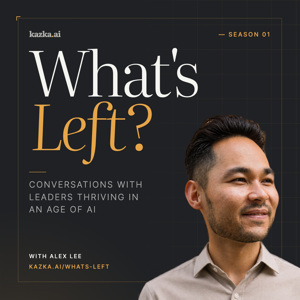


Jake Brenner runs a growing logistics company and builds software with AI every day, and he does not think the answer is to replace people with agents. In this conversation with Alex Lee, he makes the case that AI is most valuable right now as a way to build better tools for the people already doing the work. The CEOs and operators who get that right will see their teams start asking for more change, not less.
Jake and Alex have known each other for decades, and much of the episode comes from work they have done side by side. Jake walks through how ShipLab grew from an 800-square-foot warehouse in 2017 to close to 300,000 square feet, about 60 brands and a team of 30, and why getting bigger makes change harder. He describes rolling out robotic carts by starting with the job nobody wanted, hauling finished orders across a hot warehouse all day. By day one the robot had a name, and the team now goes looking for it when it is missing.
From there the conversation moves into how a business-side founder learned to build with Claude Code: dictating ideas instead of typing them, turning quick prototypes into ShipLab's internal platform, and recording team members while they use a new tool so the next version ships the following day. Jake is direct about what goes wrong, too. Tools break, teams need to be ready for that, and the person using the AI owns the outcome. He and Alex also tell the story of YourPath, the senior living guidance platform they built together, and why they pulled the AI back and put human advisors at the center.
The episode closes on the show's core question: if AI can do everything we can do, what's left? Jake's answer is the founder's gut, the accountability for every decision, and the drive to keep going when nobody is watching.
Jake Brenner
Jake Brenner is a San Diego entrepreneur and co-founder and CEO of ShipLab, a self-funded logistics company. He started it in an 800-square-foot warehouse in 2017, and it has grown to close to 300,000 square feet and about 60 brands. He isn’t an engineer, but he builds software with AI every day, designing tools his team actually asks for. He also co-founded YourPath.
YourPath
YourPath helps families find the right senior living community for someone they love. Each family is paired with a dedicated advisor who guides them through the process at little to no cost, and senior living communities fund the model. The idea came from Jake’s own family, who had to work out the process on their own when his grandparents needed care. YourPath uses AI to build better tools for its advisors, not to replace them.
Building a product got cheap and selling one did not, which is the gap Yen Anderson spends her days inside. She's the founder of Vortexa AI and an AI product advisor to early stage teams, so she reviews pitch decks all week and then goes home and builds throwaway apps for herself. She and Alex work through what still counts as a startup when anyone can vibe code a prototype, whether a relationship can hold as a moat once switching costs collapse, and what happens to the people whose jobs are mostly repetition. Yen also makes a case that cuts against how most companies sequence adoption, because she'd hand the first AI licenses to the analysts, the support staff, and whoever is carrying a philosophy or psychology degree they never got to use, on the grounds that those are the people who know how the work actually moves. The conversation gets into probabilistic systems in regulated industries, where a clean dashboard and a correct answer are two different things, and it closes on raising teenagers who treat chatbots as companions. For founders and operators, it lands as a practical read on where human judgment still pays.
Somewhere in the middle of learning what these tools can do, a lot of teams quietly stopped asking what a deliverable means. Daria Dubois, co-founder and chief innovation officer at Wild Signal, has spent the last year building an agency that runs on AI tools and still bills its value in human hours. Her team labels drafts by intent, discloses how much of a document a machine produced, and treats a handoff between colleagues as a transfer of ownership rather than a forward.
The conversation covers her path from robotics and virtual reality into brand communications, why a model earned her attention when it started giving her perspective she had not seen, how brand visibility inside language models works and why she thinks the current window closes, and the frustration that builds on a team when people expect a tool to be smarter than it is.
For founders and operators, this one is about culture. The tools arrive fast. The expectations people carry into them decide whether the work gets better or just faster.
In This Conversation
Follow: Spotify | YouTube | Apple
A solo founder automated his law firm down to the point where a voice agent answered his phones. Then he turned the voice agents off and started picking up the calls again.
Mike Brown is the founder of Crossbeam and won the Claude Code Hackathon in February 2026. He was a personal injury lawyer who had never written code. His product now works with cities and builders across California to move building permits through a process that takes six to nine months, on projects that take one or two months to build.
Alex and Mike get into the hackathon build and what it took to productionize it, why turning repeat work into skills changed how Mike thinks about hiring, and why he says critical thinking got harder rather than easier. They also cover how he learned, why slower models taught him better habits, and the moment he asked where he still fit in his own business.
For founders and operators, this one sits on a live question: when leverage stops being the constraint, you have to decide what work you want to keep.
Short List Highlights:
Guest block: Mike Brown, Founder, Crossbeam. Former personal injury lawyer who started building with AI about eighteen months ago and won the Claude Code Hackathon in February 2026. Crossbeam works with cities and builders to move building permits faster, now across California with a pilot in Laguna Beach.
Guest: Mike Brown | Crossbeam
Host: Alex Lee | Kazka.ai
Spotify | Youtube | Apple
A senior engineer asked his own leadership a question with nothing technical about it. Are we really letting go of coding? The answer was yes, and what came next was a conversation about people, not software.
Pedro Arellano is founder and CEO of Wallabi, a technology strategy and implementation firm where 90 percent of the team comes from Tableau. He and Alex sit with the question this show keeps returning to. When the machine can do the work, what's left of the person who used to do it?
Pedro's answer is expertise, and he tests it on himself. He holds a software engineering degree and hasn't written code in over twenty years. Hand him and one of his senior engineers the same AI coding tool and the same task, and the results aren't close. They also get into the rule Wallabi uses in client strategy sessions, where nobody is allowed to say the word AI, and why he draws a line between cutting a company's costs and expanding what it can attempt.
For founders and operators, the value is in the framing. Most of these conversations start at the tool. This one starts at the person.
Cole Murray has spent years watching AI land inside engineering teams before it reaches anyone else. What he sees isn't a technology story. It's an identity story. What happens to people who built their sense of self around a skill when a machine starts doing that skill too.
In this conversation, Cole and I get into what that looks like inside engineering and what it means for everyone watching from the outside. We talk about why the most resistant people on any team are often the ones who tried AI once and never looked again. We get into what genuine adoption actually requires, department by department.
And we get to the question.
If AI can do all the coding, what's left for engineers?
IN THIS EPISODE:
→ Why the most resistant people are often working from an outdated version of AI
→ Why your expertise matters more now, not less, and what happens when you bring nothing to the prompt
→ Founder-market fit: why who you are in a market matters more than what you build
→ The identity crisis inside engineering and what it means for every profession outside it
→ What AI still cannot do, and why that's actually good news
GUEST: Cole Murray · AI/ML Consultant · murraycole.com
HOST: Alex Lee · Founder, Kazka.ai · kazka.ai
Marian Pulford raised five million dollars to turn dilapidated buildings in Denver into an art center, then sat through permitting and watched it crawl. Her husband Austin, a licensed architect, told her that's just how the industry works. She built the company that fixes it.
Kestrel Labs checks a live building model against licensed code and cites the exact section a design element breaks. In this conversation Marian explains where she keeps AI out of her own product on purpose, why her customers demanded that before they would adopt it, and what happens to a firm when the person who knows all the code answers retires.
In this conversation• What Kestrel Labs does, and what the job looks like without it
• The Denver art center project, and the permitting process behind the idea
• The Replit prototype, and what fifty architecture firms said about it
• Deterministic detection, and why a probabilistic system could not earn trust
• The two places AI does the work in the product
• The ten thousand line error report, and the customer who asked for it
• The missing middle in architecture, and capturing knowledge before it retires
• The eighty-twenty split, and jurisdiction interpretation libraries
• Why she does not want the process to be frictionless
• What architects would do with the time back
• Running the company with AI, and the solo founder myth
• Hiring AI skeptics, and giving them the job of drawing the line
• What's left, and why slop is everybody's problem now
GuestMarian Pulford | Founder
Kestrel Labs
Alex Lee | Founder & CEO
kazka.ai
Spotify | YouTube | Apple Podcast | Website
Stephen Whitten is the founder of Logos Strategy Co., where he works with small and mid-sized service and operational companies. His team builds what he calls a business brain: a context layer that draws from a company’s structured and unstructured data and then governs the AI systems built on top of it. He and Alex Lee run two consultancies pointed at the same market, and they compare notes without agreeing on everything.
The conversation covers why enterprise layoff headlines mislead mid-market owners, why documenting processes may be the largest AI opportunity a company has in the next two years, how both firms stage AI maturity and where they part ways on the phrase "AI first," and the problem neither has solved: how to build governance into a company’s knowledge systems without quietly building surveillance.
For owners deciding what to do first, this one is about sequence, not tools.
www.kazka.ai
From the publisher's feed
What's Left? Is a podcast where each episode is a real conversation with someone navigating that question inside their own profession. Not to dismiss the fear, and not to pretend the loss isn't…