
Sign up to save your podcasts
Or


Data already shapes how we practice medicine. It helps us see variation, benchmark performance, and improve patient outcomes. Yet in medical education, data has often been used in far narrower ways, as static snapshots, checklists, or retrospective judgments.
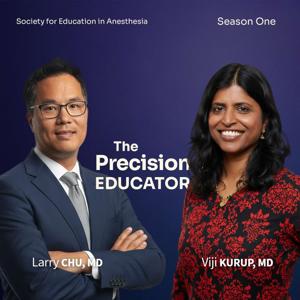
In this episode of The Precision Educator Podcast, Dr. Matthew Caldwell joins co-hosts Dr. Viji Kurup and Dr. Larry Chu in a conversation to explore what happens when clinical data is reimagined as a tool for learning rather than surveillance. Drawing on his work with the Multicenter Perioperative Outcomes Group (MPOG), Dr. Caldwell discusses how high-resolution perioperative data can help educators understand not only what residents do, but how their learning unfolds over time.
Together, the discussion examines how experience data can illuminate learning trajectories, support entrustment decisions, and strengthen coaching conversations without undermining trust. The episode also addresses the ethical and cultural risks of educational data use, including learner fear, faculty judgment, and institutional misuse, and why governance and transparency must be built in from the start.
A central theme of the conversation is data-informed coaching. Rather than delivering dashboards in isolation, the episode explores how data can anchor reflective, learner-centered conversations that promote agency, growth, and resilience across training.
Key takeaways from this episode:
Especially useful for:
Clinician-educators, program directors, CCC members, faculty coaches, and education leaders interested in using data to support learning, assessment, and coaching while preserving trust and educational integrity.
Related episodes:
For an introduction to the principles of precision education, start with Episode 1: What Is Precision Education? Rethinking How Physicians Learn.
For a deeper look at coaching as a core educational mechanism, listen to Episode 2 on coaching and personalization in medical training.
Send a text
 View all episodes
 By Stanford Anesthesia Informatics and Media (AIM) Lab
Data already shapes how we practice medicine. It helps us see variation, benchmark performance, and improve patient outcomes. Yet in medical education, data has often been used in far narrower ways, as static snapshots, checklists, or retrospective judgments.
In this episode of The Precision Educator Podcast, Dr. Matthew Caldwell joins co-hosts Dr. Viji Kurup and Dr. Larry Chu in a conversation to explore what happens when clinical data is reimagined as a tool for learning rather than surveillance. Drawing on his work with the Multicenter Perioperative Outcomes Group (MPOG), Dr. Caldwell discusses how high-resolution perioperative data can help educators understand not only what residents do, but how their learning unfolds over time.
Together, the discussion examines how experience data can illuminate learning trajectories, support entrustment decisions, and strengthen coaching conversations without undermining trust. The episode also addresses the ethical and cultural risks of educational data use, including learner fear, faculty judgment, and institutional misuse, and why governance and transparency must be built in from the start.
A central theme of the conversation is data-informed coaching. Rather than delivering dashboards in isolation, the episode explores how data can anchor reflective, learner-centered conversations that promote agency, growth, and resilience across training.
Key takeaways from this episode:
Especially useful for:
Clinician-educators, program directors, CCC members, faculty coaches, and education leaders interested in using data to support learning, assessment, and coaching while preserving trust and educational integrity.
Related episodes:
For an introduction to the principles of precision education, start with Episode 1: What Is Precision Education? Rethinking How Physicians Learn.
For a deeper look at coaching as a core educational mechanism, listen to Episode 2 on coaching and personalization in medical training.
Send a text