
Sign up to save your podcasts
Or



Can we love where we've arrived without loving everything it took to get here?
In 2012, Zahir Akram sold his house and almost everything he owned to open a yoga studio. He even slept on its sofa for the first few months.
What began as an attempt to rebuild his own life became something he could never have anticipated. A place where people found friendship, trained as teachers and discovered more about themselves.
But when I asked Zahir what he'd tell his younger self, his answer surprised me. Part of him would say, “Don't do it.” Another part would tell him to keep going, because the best years of his life were still ahead.
In this deeply personal conversation, Zahir shares the experiences that led him to yoga and how they shaped his understanding of suffering, self-worth and the value of questioning what we think we know.
We explore the difference between forcing things and allowing them to unfold, why stillness isn't necessarily the absence of movement, and the uncomfortable possibility that the communities which give us belonging can also prevent us from growing.
Drawing on Eastern philosophy, ancient mythology and his own experiences, Zahir challenges familiar ideas about progress, certainty and what it means to find ourselves.
You don't need to practise yoga or understand every philosophical reference to take something from this conversation. Bring your curiosity, question what doesn't resonate and see what you recognise in your own life.
Because sometimes the choices that shape us most are the ones we'll never quite know how to feel about.
About Zahir: Zahir Akram is the founder of Akram Yoga, where he teaches yoga and trains teachers. Explore his work, classes and teacher training at akramyoga.co.uk.
Where We Place Ourselves explores what happens to us because of where we choose to place ourselves, and how hearing someone else's story might help us see our own a little differently.
What if progress doesn't always mean moving forward?
I came back to yoga wanting to get better at it. More flexible, stronger, able to do things I couldn't do before.
Then I started going to Emma Talbot's classes, and somewhere along the way I began questioning what progress actually meant.
Emma has spent a decade practising yoga and believes you never really complete it. Your body changes, life interrupts, and what felt easy yesterday can feel impossible today. Yet you keep returning.
In this conversation, we explore why repetition helps us notice change, what discomfort can teach us about ourselves, and how easily the desire to improve can become another thing we're trying to control.
Emma said something that stayed with me. “If you're always doing something new, then you don't really notice.”
We're so accustomed to asking where we're going next that we rarely stop to consider where we choose to return.
And when I asked Emma what ten years of returning to the mat had done to her, she answered simply, “I'm more myself because of it.”
Perhaps some places matter not because they take us somewhere new, but because they help us notice who we're becoming.
In Where We Place Ourselves, I explore what happens to us because of where we choose to place ourselves. This time, the place is simply the mat.
Find Emma: Emma Talbot Yoga
What changes when we pause long enough to question what we think we know?
In this episode of Where We Place Ourselves, Archana Mohan speaks with Helen Hannan Evans, founder of Brand, Marketing and Communications consultancy The Listening People, about the experiences and assumptions that shape how we listen.
From growing up in 1970s Ireland to an unexpected moment of recognition sparked by Annie Lennox, Helen explores how we learn to see the world, and how we can learn to see it differently. Together, we discuss the instinct to fix before someone has finished speaking, the judgement we bring to AI, and why fresh ideas often come from people outside our field.
Helen also shares how she has shaped a working life that brings together what she values about corporate life and running her own business. And when a closing question leaves her momentarily without an answer, she gives the conversation something fitting: space to think.
A conversation about curiosity, questioning assumptions, and making room for what we haven’t heard yet.
Work that has inspired Helen
The Art of Possibility by Rosamund Stone Zander and Ben Zander
The work of Oscar Trimboli focused on Deep Listening
What if success isn't about what we achieve, but what we refuse to abandon along the way?
Remi Olajoyegbe has spent much of her life between worlds. Born to a Nigerian father and an Assamese mother and raised in Britain, she describes herself as a bridge between cultures, ideas and people.
In this conversation, we explore what it means to find our place without making ourselves smaller to belong. We talk about the line between service and self-sacrifice, why wisdom may become more valuable as intelligence becomes abundant, and what community and lived experience give us that technology cannot.
But our conversation keeps returning to one question: what does it mean to live a successful life?
After a career that included investment banking, long nights and burnout, Remi has arrived at a strikingly simple definition. Success is living a life in which you are not abandoning yourself.
Perhaps finding our place isn't about fitting into the world at all.
Perhaps it's about becoming more fully ourselves within it.
Connect and find out more about Remi and her work here: https://www.isumataqcollective.com https://uk.linkedin.com/in/remi-olajoyegbe https://iamremi.co.uk
What if the answer isn't somewhere out there, but something you already know?
Susan Ní Chríodáin began her career in finance, where she was often labelled “the numbers person”. But numbers were something she did. They were never all of who she was.
In this conversation, we talk about the labels work gives us, why senior people still need to feel seen, and what Susan discovered when she stopped looking for the “right” way and began trusting her own. We explore creativity, friction, AI, writing, the strange freedom of getting things wrong and why, sometimes, the most useful thing another person can do is simply listen.
Susan's journey has taken her from numbers to coaching, from certainty to experimentation and, unexpectedly, to poetry. Underneath it all is a deceptively simple idea: perhaps we don't always need another answer. Perhaps we need enough stillness to hear what we already know.
A conversation about work, creativity, humanity and learning to start close in.
Please note the work Susan references at the start of this episode comes from the poem Start Close In by David Whyte.
Links to Susan's work are below:
Website: https://www.beyond-thenumbers.com/
Life Beyond the Numbers: https://podcasts.apple.com/gb/podcast/life-beyond-the-numbers/id1530212404
Why Name? [poetry podcast] https://podcasts.apple.com/gb/podcast/why-name/id1863221435
LinkedIn: www.linkedin.com/in/susannichriodain
Substack: https://thewholeequation.substack.com/
In this episode of Where We Place Ourselves, Archana sits down with coach and therapist-in-training Alice Thompson-Boyd to explore what happens when external success no longer feels like home.
Together they unpack Alice's journey from co-founding one of Scotland's most celebrated social enterprises to stepping away from a life that looked successful on paper but felt increasingly disconnected from who she was becoming.
Their conversation explores purpose, burnout, identity, leadership, internal versus external validation, and the question that sits beneath so many of our decisions. Is the juice worth the squeeze?
Along the way they discuss why transformation happens in the fire rather than after it, why placement may matter as much as purpose, and how learning to become the CEO of our own lives changes everything.
This is a conversation about letting go, finding alignment, and discovering that the place we belong may have been waiting for us all along.
Links to Alice's work: Alice Thompson Coaching
In this reflective solo episode of Where We Place Ourselves, Archana explores the emotional backstory behind making a podcast and the quiet struggle of creating something public.
Beginning with Mira Nair’s words, “You cannot be an artist if you strive to please,” this episode asks whether that is as true in life as it is in art.
Archana reflects on the desire to be taken seriously, the pull towards polish and credibility, the disappointment of rejection, and the moment when striving becomes visible enough to question. What begins as a reflection on podcasting becomes a wider meditation on creativity, belonging, visibility, and the difference between being well known and being truly known.
This episode is about the mess behind the making, the people worth knowing, and the question that sits at the heart of the series. Where do you place yourself when things feel unresolved?
In this episode of Where We Place Ourselves, I explore how music, attention, and reflection shape the way we think and communicate.
What looks like distraction may actually support deeper thinking. Drawing on a simple moment from everyday life, this episode reflects on listening, focus, and how we show up in conversations at work and beyond.
Topics include:
A quiet reflection on what happens when we stop filling space. This podcast was previously titled Where We Place Ourselves. It is now continuing as Echoes, from Els.
In this first episode of Echoes, from Els, a summer spent mostly alone becomes something unexpected. Not isolation, but recognition.
Through small moments, this episode explores solitude, the idea of the “uncarved block,” and the subtle thresholds we cross when we step back from the noise. Not as something to solve. But as something to enter.
TakeawaysWhat does it mean to be known over time?
In this episode of Where We Place Ourselves, I speak with one of my closest friends, Robin. Someone who has known me since the mid-90s, when we were both just beginning to understand who we might become.
This is a conversation about growing up, friendship, and the quiet beauty of being there for someone not just in the easy moments, but across the many versions of a life.
We talk about the feeling of being unstoppable when we were younger, and how that shifts as life unfolds. About the different versions of ourselves we bring to work, to relationships, and to the spaces where we feel most at ease.
Robin shares how humour became a way of holding perspective not because life is always light, but because sometimes it’s what makes it livable.
And one line from this conversation stayed with me:
“The world is tough… but not in here.”
A reminder that while we can’t always control what happens outside of us, we can create spaces in our homes, in our friendships, where something softer, lighter, and more human exists.
This is a conversation about being witnessed, about growing alongside someone, and about the rare gift of a friendship that stays.
We explore:
It left me thinking about how the most meaningful relationships in our lives aren’t the ones that change us, but the ones that stay with us as we change.
If this conversation stayed with you, following the podcast helps it reach the people who need it and lets you know when the next episode is released.
And if you’re thinking of someone who has known you across time…maybe send this to them.
From the publisher's feed
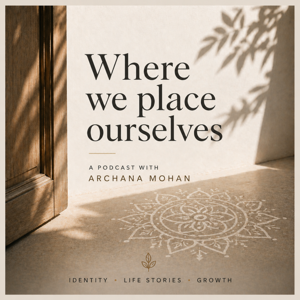
Where We Place Ourselves is a reflective podcast about identity, personal growth, and how we understand our lives over time.
Through slow, thoughtful conversations, each episode…
If you're interested in psychology, life stories, and personal reflection, this podcast creates space to think more deeply about who you are and how you’ve changed.