
Sign up to save your podcasts
Or

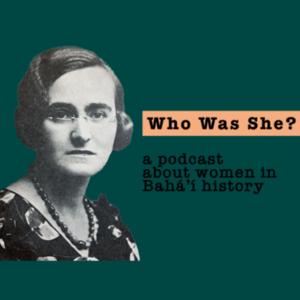


What was the reaction of other Esperantists and Zamenhof's to Lidia’s new faith? What inspired Lidia to travel to teach Esperanto across borders and oceans? Find out in episode 4 of Who was she? Podcast.
TRANSCRIPT:
Welcome to Who was she? Podcast where I, Tara Jabbari share the stories of women throughout Baha’i history. This season is about the life of Lidia Zamenhof, an Esperantist and Baha’i who traveled through three continents to teach languages in efforts to bring unity to humankind.
In the previous episode, we learned how Lidia met Martha Root who became her spiritual mother after Lidia decided to become a Baha’i. However, her new faith was not welcomed by all. Many Esperantists and Jews were not pleased with her decision, and believed she was abandoning her background. For Lidia, she never felt like she was abandoning her Jewish background because for her, it was not a religion.
She revealed that after she became a Baha’i, people accused her of endangering the Esperanto movement, “especially in Poland, if I identified myself, bearing the name of the creator of Esperanto, with a new, unfamiliar and still unrecognized religion.’ But the lack of support didn’t sway Lidia’s passion for her new faith. She explained, ‘I value more highly my sincere relationship to God, whom I recognized revealing Himself in Baha’u’llah than I do pleasing “public opinion.”’
As for Lidia’s family, Adam and Zofia, Martha Root wrote that while they were kind to her, they simply were not very spiritual and did not understand Lidia’s beliefs. She wrote that when Lidia decided not to attend the Universal Congress of Esperanto in 1929 in order to save money for her eventual pilgrimage to Haifa, the most sacred place to Baha'is, her siblings laughed and teased her about it. They preferred she would stop trying to translate Baha’i Writings to Esperanto, to separate the family name Zamenhof from the Baha’i Faith. But they also did not try and keep Lidia away from Baha’is and certainly were hospitable to Martha.
As Lidia continued to read the Baha’i Writings, she realized that while They are originally written in Persian and Arabic, the largest body of translations was in fact in English. Therefore, she must learn English, so she can continue her spiritual journey and to be able to translate the Writings into Esperanto.
She studied English for three hours a week and eventually started to translate the book, Baha’u’llah and The New Era by J.E. Esslmont. Published in 1923, it remains One of the most popular introductory books on the Baha’i FaithEsslemont explains the history and core Teachings of Baha’u’llah including the principle for a universal language and mentions Esperanto as a movement trying to achieve this principle.
Martha Root was so proud of her spiritual daughter, writing, “She is her father’s daughter spiritually as well as physically. She is so just, so modest, so sincere and she is one of the finest translators I have ever met.”
In 1930, Lidia was granted permission to attend pilgrimage to Haifa. Today, on Mount Carmel, the Shrine is adorned with 19 terraces of elaborate gardens, encompassed by a Gold Dome and the Resting Place of The Bab, the precursor to Baha’u’llah and fellow prophet of the Baha’i Dispensation.
But at the time Lidia visited, the Resting Place was a simple structure of stone beside three large cypress trees. Every morning, Lidia came to the Holy Shrines to pray. She wrote of a particular day, “one morning, when I arose after a long prayer my eyes fell on a flower that was lying on the threshold. A red spider, a very tiny one, not larger than a pin head, was running around the calyx of the flower. I stretched out my hand and gave it a careless push with my finger. It seemed to grow still weaker and smaller and it fell down from the flower, down from the Threshold, down toward the ground. But suddenly there happened something that made me stare with a strange feeling: the little spider did not fall to the ground. It stopped half way as if the law of gravity ceased suddenly to exist for him - and then, as if in spite of this law it drew itself higher and higher, till the calyx of the flower gave him refuge again and hid him from my sight. Quick as lightening and dazzling as lightning there came to me a sudden realization that this little spider was a sign sent to me by God. A sign to tell me that a soul who still knew how to keep a ray of faith, be that ray as tiny as a spider’s thread, is not to be lost in despair; even from the depths of a chasm it will be led upward, till it reaches its heavenly abode, till it comes to God.”
Lidia also spent time in Jerusalem, gifting the Hebrew University a manuscript her father had written in the Yiddish language. On her last visit to the Baha’i Shrines, she wrote, “As I was praying, the feeling of despondency began to grow less heavy. Little by little the despondency disappeared. And when it had disappeared a joy came. A joy with no outward care. A joy born in the heart as if the heart was suddenly touched by a smiling sunray. That joy kept growing as a seatide, until it flooded my soul. And still, it kept growing until it was so great that if it were one degree greater, it would simply cause my heart to burst! All sadness, all doubts, all the dark hours of battle were gone and the joy was there, a heaven-sent joy, a divine confirmation. Whoever receives such a confirmation forgets his doubts. Whoever experiences once such joy, cannot be truly unhappy even in the darkest hours of his life.”
Lidia returned to Europe with more drive to not only teach Esperanto but also the Baha’i Faith to bring about universal peace. She will not only teach both of her passions in Europe but it will bring her to other continents.
This has been Who was she? Podcast, follow us on our Instagram, Facebook and Pinterest @whowasshe podcast. And please, rate and subscribe wherever you listen to this podcast. Logo was designed by Angela Musacchio. Music was composed and performed by Sam Redd. I am your host, Tara Jabbari.
Hosted on Acast. See acast.com/privacy for more information.
Martha Root taught Lidia the Baha’i Faith and became a big influence in her life. This episode shares a bit of her history and the beginning of her relationship with Lidia.
TRANSCRIPT:
Welcome to Who was she? Podcast where I, Tara Jabbari share the stories of women throughout Baha’i history. This season, we are exploring the life of Lidia Zamenhof, an Esperantist and Baha’i who traveled through three continents to teach languages in efforts to bring unity to humankind. In the previous episodes, we learned about Lidia’s parents and family, their struggles and passion to unite people through the use of language. In 1925, Lidia met Martha Root who she would consider affectionately as her spiritual mother.
Martha Root was born into a baptist family in 1872. Raised in Pennsylvania, she showed an early interest in reading books rather than learning how to sew or cook. By age 16, she had graduated high school with honors and then went to Oberlin College where she designed her own program to study languages: specifically Latin, Greek, French, German, and English. She eventually transferred to the University of Chicago and earned her Bachelors in Literature in 1895., Upon graduating, Martha became a school teacher and journalist. In 1908, she met Roy C. Wilhelm who was speaking about his recent travels to Akka. There he met, ‘Abdu’l-Baha, the Son of the Founder of the Baha’i Faith, a new world religion. Intrigued by this she began reading the Writings of the Baha’i Faith and meeting other Baha’is including Thornton Chase, the first American Baha’i. In 1909 Martha converted to the Baha’i Faith. Over the years, she wrote about the Faith for newspapers and attended the first annual Baha’i convention held in Chicago in 1911.
By 1912, Abdu’l-Baha was traveling to North America after years of imprisonment. Martha attended as many of His talks as she could, and even began arranging some of His talks in Pittsburgh. It was also During this time Martha Was diagnosed with breast cancer. They instantly bonded and with Abdu’l-Baha’s guidance, Martha went into remission for many years. She expressed interest in traveling to teach the Faith to different parts of the world which delighted Abdu’l-Baha. In January 1915, she traveled to Egypt, living there for 6 months as a journalist, and later in the year, she traveled to Bombay, Japan, and Hawaii. She was studying Esperanto as she believed it would help her along her travels which proved to be right. For the next five years, Martha stayed primarily in North/Central America to meet with officials including the President of Mexico to teach them about the Baha’i Faith.
She also strengthened her Esperanto and wholeheartedly believed that the international auxiliary language should be a neutral one and sympathized with the principles of Esperantism. She wrote to the Eserpantists the she would like to arrange a Baha’i meeting during their Geneva congress. She wrote to them, “Our aim is the same as yours, the Baha’is Movement is the Esperanto of religions.” On August 6th, 1925 in Geneva, Switzerland, Martha spoke during the annual Universal Congress of Esperanto. Simply called, “The Baha’i Meeting,” the room held 100 guests and had portraits of ‘Abdu’l-Baha and Dr. Ludwik Zamenhof.
Lidia also attended this meeting. At first glance, it did not make much of an impression on Lidia, “I came only out of politeness, I did not pay any special attention to what was going on. The words were going into one ear and out the other.”
However, Martha Root remembered seeing Lidia and her sister, Zofia from that meeting and she was determined to meet with them again. She planned to visit Warsaw as she was drawn to Lidia who, she wrote to a friend, “Seemed so sad.” Martha believed that the words of Abdu’l-Baha and the Baha’i Faith would bring a light in Lidia’s life.
A few months later, there were plans to unveil a monument dedicated to Dr. Zamenhoff. Lidia received a telegram from Martha Root asking if she could speak at the unveiling ceremony on the relation of Zamenhof’s life work to the principles of the Baha’i Faith. Lidia was amused and granted Martha’s request.
In April, 1926, Esperantists from around Europe attended the ceremony of the monument of Dr. Zamenhof in Warsaw. Martha spoke during the ceremony, quoting Abdu’l-Baha’s words praising Esperanto and Dr. Zamenhof’s statements about the Baha’i Faith and his interest in the Baha’i movement. Dr. Zamenhof had believed that the idea of a neutral language could never succeed without a world religion.
Lidia admired Martha’s speech, where she spoke so fervently about her faith in near-perfect Esperanto tinged with an American accent. As Martha had hoped, The Zamenhof’s hosted her for two weeks where Lidia helped Martha with her Esperanto and Martha helped Lidia with her English. Martha felt guided to Lidia, she wrote to a friend, “For months I have been praying for this, I feel that Abdu’l-Baha and Dr. Zamenhof are wishing this closer coming together of the two movements.”
The two bonded, with Martha as her teacher, Lidia declared herself a Baha’i and they referred to each other as spiritual mother and child in letters.
Lidia explained later why she became a Baha’i. “In the Teaching of Baha’u’llah, I found the universality which only the truly God-given teaching can give to searching mankind. That is why it attracted me at the beginning.” She even said in her own words, she became “profoundly convinced that Esperanto was created directly under the influence of Baha'u'llah although the author of the language did not know it.”
Lidia had another passion and purpose in her life. In 1928, two years after she met Martha Root, Lidia served as the honorary president at the Baha’i sessions during the annual Universal congresses of Esperanto. But her newfound faith was not welcomed by all, and many Esperantists believed Lidia was abandoning her background. Despite her lifelong wish for everyone to be accepted, she was again disappointed with how people responded to her becoming a Baha’i.
Next episode, we will learn more of how Lidia felt about her faith, her Jewish background, how she juggled her duties to the Baha’i Faith and Esperanto, as well as the beginning of her travels outside of Europe.
This has been Who was she? Podcast, follow us on our Instagram, Facebook and Pinterest @whowasshe podcast. And please, rate and subscribe wherever you listen to this podcast. Logo designed by Angela Musaccio. Music was composed and performed by Sam Redd. I am your host, Tara Jabbari.
Hosted on Acast. See acast.com/privacy for more information.
In this episode, we learn more about how and why a young Lidia became an active Esperantist and meet Martha Root, her spiritual mother who taught her the Baha’i Faith.
TRANSCRIPT:
Welcome to Who was she? Podcast where I, Tara Jabbari share the stories of women throughout Baha’i history. This season is about the life of Lidia Zamenhof, an esperantist and Baha’i who traveled through three continents to teach languages in efforts to bring unity to humankind.
In the previous episode, we learned about Lidia’s father, Ludwik Zamenhof and how he developed his new language, Esperanto. In this episode we will learn how Lidia became an active Esperantist and was starting to be seen as a new leader for the Esperanto movement.
As the family continued to grieve, Klara took Ludwik’s passing the hardest. Lidia often wrote how she witnessed her mother age suddenly. But she had a duty to be strong for her children, especially for her teenage daughter and to continue her husband’s work progressing Esperanto.
For Lidia, when she was a girl, she actually did not like learning Esperanto. Slightly embarrassed, her parents continued to speak with her in the language but she was stubborn and independent, refusing to respond in Esperanto. However, eventually, she did see that the language was an example of bridging gaps between people and it’s significance in theirs and others lives. In later years, all of her letters were written solely in Esperanto. She witnessed how many people Bonvenigis, or welcomed a language that would striving for unity during a world war.
By 1918, World War 1 ended and Poland became an independent nation after over 100 years. The country now found itself poor and overpopulated. the Jews suffered greatly and anti-semitic violence broke out in 130 towns and villages throughout Poland. The country found itself clashing with the Red Army and there continued to be a lot of unrest throughout the neighboring countries.
A teenage Lidia took initiative and began translating literature into Esperanto. Lidia began her mission, she would propagate the Esperanto language in order to fulfill her father’s wishes. As she grew older, her cousins and neighbors wrote that she was of slight build, not handsome but had an “interesting face.” When it came to going to university, Lidia did not go the traditional route of medicine like her siblings. Instead, she was accepted into the University Of Warsaw with the intention of studying law, just as her mother wished. Even though she was of Jewish background and anti-Semitism was in high gear, she was able to be accepted into the Polish university where, at the time, had a strict quota of limiting how many Jews could attend university. While her mother’s wishes were fulfilled, Lidia revealed to a friend that her heart was not into the subject. She continued to work hard in school and in Esperanto while falling victim to prejudice and anger by her fellow Polish citizens for her background.
During the Universal Congress of Esperanto in 1924, Lidia accompanied her mother who was fragile, and suffering from liver cancer. One of the speakers that year was Edmond Privat, a disciple of Ludwik. He spoke of what is needed by Esperantists today, “Our task is very clear: we must slay the dark dragon of misunderstanding among peoples, we must spread that language in which dwells the youthful spirit of the new humanity.”
Inspired, Lidia began to take a more public role in the Esperanto movement. Soon, Esperantists learned there was another passionate Zamenhof who expressed openly and fearlessly of the need for unity.
After World War I, the Esperanto language grew with new people learning the language everyday. In 1924, the League of Nations and the Universal Telegraph Unions unanimously recognized Esperanto as a “klara lingvo” or “clear language” for telegraphy.
It was also the year Klara Zamenoff passed away. With the matriarch gone, Espernatists hoped another member of the Zamenhof family would become a leader in their movement, particularly the eldest child, Adam. But Adam had other responsibilities with his own family and his growing medical practice. Zofia, was also busy pursing her career in medicine.
It would be Lidia, now 20 years old, who would carry on her father’s passion project. She no longer had her long blond hair in braids, replacing it with a short bob that was common for the time and was only 5 feet tall but the petite Lidia became more active in the Esperanto Conferences, she would be recognized for her “thoughtful blue eyes.”
Unusual for the time, Lidia never married or had children. It was recalled that at least six Zamenhof women did not marry at all, including Zofia, Lidia’s sister. Instead, the real expectation was to be doing some kind of work which was a service to humanity. While Zofia became a doctor, Lidia would become a teacher of the Esperanto language, traveling across oceans and influencing all that crossed her path.
Lidia was less intrigued of home making, having never learned how to cook, was shy and could be introverted. She also had few true friends that she confided in. One Esperantist, recalled, “The young men used to say Lidia Zamenhof has only one lover, which is the Esperanto language!”
Lidia was more interested in the life of an intellectual and believed, similarly to her father that world peace could not be accomplished until all the peoples of the world could communicate with each other. Esperanto was the ideal means for that. She also identified herself as an atheist, having witnessed and been victim to how religious persecution only tore people apart.
But the Seventeenth Universal Congress of Esperanto held in Geneva, Switzerland would introduce Lidia to someone who would change her life forever.
She would meet an American journalist, teacher, and Esperantist, Martha Root. They would bond over the common interest to bring peace for people through the power of language. Martha herself was a member of the Baha’i Faith, and believed in the power of religion. This was the same faith that spoken to Ludwik Zamenhof, and the same faith whose followers were encouraged to learn Esperanto.
This meeting united these women so closely that they referred to each other lovingly as spiritual mother and daughter. Lidia was now inspired to travel and teach Esperanto across borders and oceans.
On the next episode, we learn more about Martha Root and her influence on Lidia.
You can also find more information on our Instagram, Facebook and Pinterest @whowasshe podcast. And please, rate and subscribe wherever you listen to this podcast. Logo was designed by Angela Musacchio. Music was composed and performed by Sam Redd. I am your host, Tara Jabbari.
Hosted on Acast. See acast.com/privacy for more information.
The first episode on Lidia Zamenhof will focus on why and how her father invented the language Esperanto which would change not only her life but the world.
TRANSCRIPT:
Welcome to Who was she? Podcast. I am your host, Tara Jabbari. After a decade working in documentaries, marketing and all things digital media, I found that podcasting is a strong medium to share stories. After years of producing for others, I decided to start my own biographical podcast.
Who was she? Podcast will focus on the stories of women throughout history that were active in the Baha’i Faith. This season is about the life of Lidia Zamenhof, a woman who traveled through three continents between World War one and two to teach languages in an effort to bring unity to humankind. Using the biography, Lidia by Wendy Heller, learn about who made an impact in Lidia’s life and how she impacted others.
Her father was the inventor of the language Esperanto and like the language, Lidia won the hearts of many who encountered her despite numerous skeptics and biases.
In order to understand Lidia, you have to know more about her father Ludwick Zamenhof.
Esperanto began because Ludwick witnessed many challenges and he concluded that the language barrier was the most common reason for these challenges.
Ludwik Zamenhof was born in 1859 to Markus and Rozalia Zamenhof. He was the first of nine children and grew up in Bialystok, Lithuania. At the time, the town became a crossroads for people of diverse cultures and nationalities. Families from Russian, Polish, German and Jewish backgrounds all lived in the same area but kept to themselves, sticking to their own familiar languages and were suspicious of others. Based on the example set in the Old Testament’s Tower of Babel and from his own experiences, Ludwik believed the mistrust and confusion among the people were brought upon them because they did not speak the same language and would not learn each others. Since choosing one existing language would require people to agree that this was the superior language, he decided to create a whole new one that would make it easier for people to communicate and therefore unify.
When he was 15 years old, he began creating this new universal language and over the next several years, he shared with his brother and friends who began to learn it. As he progressed on the new language, his father, Markus, a professor of linguistics was worried. A few of his friends expressed concern to Markus that Ludwick was showing signs of insanity by trying to make a so-called universal language. Father and son butted heads until they reached a compromise. Ludwick would study medicine and postpone his work on creating a new language. In return, Markus would keep all of his work safely while Ludwick went to Moscow University. When he kept his end of the bargain, Ludwick asked his father for his notebooks but was heart broken to hear that Markus burned it all. Ludwick would have to work from scratch all over again. The result was a torn relationship between father and son that would take many years to heal.
Ludwick moved to Warsaw, Poland and eventually opened his own ophthalmology practice. In 1887, Ludwick married Klara Zilbernik. Klara’s family was very fond of Ludwick and his passion to create a universal language. Her father even agreed to use half the money from her dowry to allow Ludwik to publish the first book entirely written in the new language. The forty page book included translations of poems as well as a vocabulary of nine hundred words with a Russian translation. Ludwick signed his first book with a pseudonym, “Dr. Esepranto.” Esperanto means, “He who Hopes”
The book was a success and many people started to learn Esperanto. With the continued help and support of his in-laws, Ludwick was able to write another series of books translating the works of Shakespeare and parts of the Old Testament into Esperanto.
Ludwick and Klara’s family grew with the birth of Adam,in 1888 and Zofia, in 1889 and by 1903, with the popularity of Esperanto on the rise, they were expecting their third child. Count Leo Tolstoy received a copy of the first book and reported that he learned the language, quote, “after not more than two hours study”.
On January 29th 1904, Lidia was born. By 1905, the First International Congress of Esperantists was held in Boulogne-sur-Mer, France. These annual congresses would be a huge part of Lidia’s life growing up and would introduce her to other passions and purposes.
As the youngest child, Lidia’s siblings were considerably older than her and her parents were in their 40s. Both Adam and Zofia followed in their father’s footsteps and went to medical school. Lidia was homeschooled until the age of 10. Her parents taught her the importance of honesty and while she had a lot of their attention, they never spoiled her. Klara, her mother, described a 6 year old Lidia as a quote, “very able, bright and hard-working.”
Though The family lived on Dzika Street in the Jewish quarters of Warsaw but the family did not practice Judaism. Therefore, they were regarded with hostility by other Jews and because they were of Jewish background, they were still victims of anti-semits.
Ludwick in particular, wrote his wish that there was either no religion or one religion that all people belong to. He believed that language as well as religion were the great barriers for people to regard each other as friends and family.
But during the Esperanto Congresses, Lidia would witness unity for the first time and she observed how much respect and adoration people had for her father.
Over the years, there was a growing interest in Esperanto. In an interview with a progressive religious magazine, the Christian Commonwealth, the interviewer asked Dr. Zamenhoff his thoughts on how much the language spread and about a new religion, the Bahai Faith.
The Baha’i Faith started in Persia, what is now present day Iran in the mid 19th century. Its Prophet Founder, Baha’u’llah was exiled to Akka, Palestine, present day Israel. He wrote principles and laws to allow humanity to progress including the equality between men and women, elimination of prejudice and the concept of a universal language. The achievement of one universal language, He affirmed, would be the sign of the ‘coming of age of the human race.’
Baha’u’llah died in 1892 and His Family was still incarcerated in Akka until the fall of the Ottoman Empire. Now free, Abdu’l-Baha, Son of Baha’u’llah traveled throughout Europe and North America in the 1910s.
In February 1913, Abdu’l-Baha spoke about Esperanto in Paris which was reported in the Baha’i magazine, Star of the West. He said:
‘In the world of existence an international auxiliary language is the greatest bond to unite the people. Today the causes of differences in Europe are the diversities of language. We say, this man is a German, the other is an Italian, then we meet an Englishman and then again a Frenchman. Although they belong to the same race, yet language is the greatest barrier between them. Were a universal auxiliary language now in operation they would all be considered as one…
‘Now, praise be to God, that Dr. Zamenhof has invented the Esperanto language. It has all the potential qualities of becoming the international means of communication. All of us must be grateful and thankful to him for this noble effort, for in this way he has served his fellow-men well. He has invented a language which will bestow the greatest benefits on all people. With untiring effort and self sacrifice on the part of its devotees it will become universal. Therefore every one of us must study this language and spread it as far as possible so that day by day it may receive a broader recognition, be accepted by all nations and governments of the world and become a part of the curriculum in all the public schools. I hope that the language of all the future international conferences and congresses will become Esperanto so that all people may acquire only two languages - one their own tongue and the other the international auxiliary language. Then perfect union will be established between the people of the world.’
Abdu’l-Baha encouraged Baha’is all over the world to learn Esperanto. The interviewer from Christian Commonwealth asked Zamenhof his thoughts on Abdu’l-Baha’s recent talk, to which he replied: ‘I feel greatly interested in the Baha’i movement, as it is one of the great world-movement which, like our own, is insisting upon the brotherhood of mankind, and is calling on men to understand one another and to learn to love each other. The Baha’is will understand the internal idea of Esperanto better than most people. That idea is, “on the basis of a neutral language to break down the walls which divide men and accustom them to see in their neighbour a man and a brother”.’
Eventually Esperanto was taught in Persia and continued to grow in other countries.
As the years continued, Ludwick’s health declined. On April 14th, 1917, Dr. Zamenhof peacefully passed away in his home.
His family found some of his essays sprawled around his desk. One read: “I do not remember exactly in which year of my life I lost my religious faith, but I remember that I reached the highest degree of my unbelief at around the age of 15 or 16. That was also the most tormented period of my life. In my eyes, life lost all meaning and value...All seemed so senseless, useless, aimless, so absurd!
“I came to feel that perhaps [death is] not disappearance, perhaps death is a miracle...that something is guiding us for a high purpose…” He never finished the essay.
How did she cope with her father’s death? What happened to the Esperanto movement? We will find out in the next episode of Who was she?
You can also find more information on our Instagram, Facebook and Pinterest @whowasshe podcast. And please, rate and subscribe wherever you listen to this podcast. Logo was designed by Angela Musacchio. Music was composed and performed by Sam Redd. I am your host, Tara Jabbari.
Hosted on Acast. See acast.com/privacy for more information.
This season is about Lidia Zamenhof, an Esperantist, and Baha'i who traveled the world to teach languages in an effort to bring unity to humankind.
So please subscribe and learn about this amazing woman who traveled through three continents in an effort to bring unity through the power of language. You can also found more information on our Instagram, Facebook and Pinterest @whowasshepodcast
Music composed and performed by Sam Redd: https://soundcloud.com/samredd
https://www.linkedin.com/in/sam-redd-9157494/
Producer, writer, and host is Tara Jabbari: https://about.me/tarajabbari
https://tarajabbari.wordpress.com/
TRANSCRIPT:
Welcome to Who was she? Podcast. I am your host, Tara Jabbari. After a decade working in documentaries, marketing and all things digital media, I found that podcasting is a strong medium to share stories. After years of producing for others, I decided to start my own biographical podcast.
Who was she? Will focus on the life of a woman throughout Baha’i history. The first season is about Lidia Zamenhof.
Lidia’s story explores the subjects of the power of language and faith. Her father invented the universal language, Esperanto and she came from a Jewish family and became a Baha’i. She grew up during World War 1 and was killed during World War 2 in a concentration camp, despite heroic efforts to save her life.
How can one person’s life intersect with so many others, connect across borders and inspire a biography which inspired this podcast?
Over the next few weeks, I will share her story with you and the lives that were most affected by her and those who affected her life as well. They include her father, Ludwick Zamenhoff, her spiritual mother, American Journalist, Martha Root and the Baha’i German soldier, Fritz Macco who worked for the Resistance undercover while having to serve the Nazi Party.
I want to thank the author Wendy Heller and George Ronald Publishing for their blessing to let me use Heller’s biography, Lidia The life of Lidia Zamenhof Daughter of Esperanto as a main and instrumental resource for this podcast.
So please subscribe and learn about this amazing woman who traveled through three continents in an effort to bring unity through the power of language. You can also find more information on our Instagram, Facebook and Pinterest @whowasshe podcast Music was composed and performed by Sam Redd. I am your host, Tara Jabbari. Join us next time as we begin our journey about Lidia Zamenhof.
Hosted on Acast. See acast.com/privacy for more information.
From the publisher's feed
A podcast where your host shares the stories of women throughout Baha'i history. You can also find more information on our Instagram, Facebook, and Pinterest @whowasshepodcast
Learn…
Hosted on Acast. See acast.com/privacy for more information.