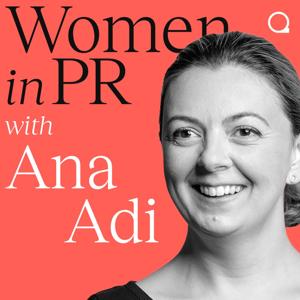
Women in PR

Women in PR

By Ana AdiBusiness
Download on the App Store

Women in PR episodes

  • #3 Michaela O'Brien_Women in PR with Ana Adi
    P.T. Barnum, Ivy Lee, Arthur Page, Eddie Bernays: the fathers of public relations. American, white, males.
    And then there’s the history of PR presented often as a linear, constant improvement, englighting…from manipulation and propaganda, to public information, to symmetrical communication, from corporations opposing activists and investigative journalists and calling them names like muckrakers to listening to them, collaborating with them and embedding their demands.
    What is this PR history teaching us? Are we missing anyone?
    Out guest today will help us find some answers. Dr Michaela O’Brien used to work in strategic communications and consultancy roles for nonprofits including Amnesty International, the British Library, Business in the Community, Carers UK and the Refugee Council before she joined academia. She is now heading the Westminster School of Media and Communication at the University of Westminster (that is overseeing about 21 undergraduate and post-graduate programmes to you and I), leading their master’s program in Media, Campaigning and Social Change at Westminster and hosting their Communication and Media Research Institute (CAMRI). One of her central research theme is activism and communication.
    33 min
  • #2 Ildiko Kovacs_Women in PR with Ana Adi
    Why do people get into PR? If you go ask communicators around about their jobs, they’ll tell you it’s frustrating but fun and that it’s the variety and diversity of their daily tasks and environment that keeps them into the profession. More than 70% of European PR practitioners listed that their tasks are “interesting and manifold” as the key to their job satisfaction. And that figure is rather similar around the world: whether Asia-Pacific, Latin America or North America. This is at least what the results of the Communication Monitor series, a cluster of surveys taking the pulse of strategic communication in worldwide indicate.
    Perhaps this is the key of success for PR and for some the main attraction to the profession. Perhaps while we figure out how to teach and develop PR in a manner that is unifying yet encompassing of national and cultural differences (and by we I mean, Global Alliance and their capabilities framework, us here at Quadriga, other academics and professionals many active in associations like CIPR, PRCA, EACD and AMEC) we should focus on the fact that PR is a fun profession.
    Ildiko, this episode’s guest, will mention passion for PR a lot but also a dedication, a curiosity to make it better. Half Hungarian and half Romanian with an experience of over 15 years in PR & Comms, Ildiko is managing globally the communication for the 22 tire plants of the Continental and a team of around 25 people. She is also a Quadriga University alumna.
    41 min
  • #1 Edna Ayme-Yahil_Women in PR with Ana Adi
    The C-Suite – is that something you strive for or where you are invited in? And more importantly, as a communicator, how do you make yourself listened to once you get there?
    The management paradigm, of which Grunig and his excellence theory in public relations being its strongest representative, argue that for PR to truly matter, the senior PR council should not only be part of but actively be involved in decision-making. This shifts PR from a purely technical role to a strategic and managerial role. One way to get there, Grunig (and all his supporters argue) is through education, through professionalization.
    Now this debate started in the 1980 but is as current as ever and that is how do you get into PR and how do you succeed in PR? Are PR practitioners born communicators or they become so after pursuing either a degree, or some other sort of organized form of studying PR or comms.
    In a sense, studying PR would put someone right at the heart of what the profession requires but also would have them exposed to all the questions about how PR came to be and what the future looks like: what is PR’s role in society, ethical conundrums, loyalties.
    On the other hand, starting straight into PR and learning on the go as a trainee or apprentice one would be focused on solving problems and therefore be more atuned to ..maybe… how the world ticks. My guest in this episode has done Edna now heads MarComms at Panalpina in Switzerland. She is an American who studied both in the US and Europe. She is a traveler, an explorer, a mother, a writer, a strategist.
    And she is also the managing Vice-President of EACD, the European Association of Communication Directors. Founded in Brussels in 2006, the EACD is a network for communication professionals from all fields promoting diversity, overcoming cultural barriers and fostering professionalism in communications. And today, I will ask her how she got to where she’s at.

    47 min
  • Women in PR_with Ana Adi_teaser
    Women in PR is a weekly podcast about inspiring women that have embraced PR and made it shine, changing it for the better every day. It’s about mentors, founders, researchers, role models, leaders.
    Women in PR is hosted by Prof. Dr. Ana Adi, Professor of PR/Corporate Communications at Quadriga University of Applied Sciences in Berlin and is brought to you by Quadriga University of Applied Sciences in Berlin and professional-podcasts.com.
    7 min

About Women in PR

From the publisher's feed

Women in PR is a weekly podcast about inspiring women that have embraced PR and made it shine, changing it for the better every day, and research questioning current assumptions about the profession. It’s about mentors, founders, researchers, role models, leaders.