
Sign up to save your podcasts
Or



In what is easily our friendliest interview so far, Yuri and Matt engage with industry leaders Kemi Olugemo and Barbara Salami to consider how artificial intelligence is redefining the role of the expert, what it's like to try bridging socioeconomic and cultural divides, and how hopes and fears comingle when the pace and the scope of changes continues to become more violent every day.
They also discuss KAINDLY.AI, a newly founded organization dedicated to helping organizations design for equitable access will build collective capability, shared confidence, and the kind of trust that sustains transformation.
Notes and episodes: worldbrainnoexperts.substack.com
Three tech writers and a photographer walk into a bar. The writers are mostly not writing for human readers directly anymore. How is this funny?
Tom Johnson, a technical writer at Google and a publishes thoughts on trends in his work at idratherbewriting.com. Tom sat down with Yuri, Matt, and another tech writer, Floyd Jones, to talk about how AI has altered the work Tech Writers do.
Notes and episodes: worldbrainnoexperts.substack.com
In this episode of World Brain: No Experts, Matt and Yuri interview technologist and author Chris Fregly about the accelerating integration of AI into software development and large-scale computing systems.
Drawing on experience at companies like Netflix, AWS, and Databricks, Fregly argues that AI-assisted coding is no longer optional but inevitable, asserting that teams should move toward fully AI-generated code rather than cautious hybrid approaches. He describes a workflow in which multiple models review and critique each other’s output, emphasizing evaluation systems (“evals”) over traditional unit tests and encouraging comfort with ambiguity and non-determinism. The conversation explores tensions between productivity gains and maintainability concerns, particularly around claims that AI-generated code introduces inconsistency or “slop.” Fregly agrees but takes about how disciplined (but exhausting) prompt design, evaluation harnesses, and system-level instrumentation can mitigate these risks.
Will super-intelligent agents soon exist? "I hope so," says Chris.
Show Notes for Episode 4
https://open.substack.com/pub/worldbrainnoexperts/p/show-notes-for-episode-4?r=9fpi3&utm_campaign=post&utm_medium=web
Subscribe to find out about new episodes:
https://worldbrainnoexperts.substack.com/
Jobst Landgrebe, co-author (with Barry Smith) of Why Machines Will Never Rule the World: Artificial Intelligence Without Fear, joins Matt and Yuri for a wide-ranging argument about what AI can and cannot do. Landgrebe claims that minds and living systems are complex systems shaped by history and irreversibility, and that LLMs can imitate language without understanding meaning in open contexts. Yuri pushes back with an “approximation” critique—planes don’t fly like birds, yet they outperform birds—asking why AI couldn’t surpass humans in many domains without “real” understanding. The conversation moves from philosophy and neuroscience to economics, scaling narratives, and the political risks of AI-enabled surveillance and propaganda.
Show notes
Substack
In the first episode of World Brain: No Experts, Matt Brandabur and Yuri Marder use H. G. Wells’ 1938 World Brain essays as a starting point for an argument about artificial intelligence, expertise, and human identity. Yuri sees AI as a transformative force on the scale of language itself—while Matt insists that machines cannot reproduce the lived quality of biological consciousness. The conversation ranges across creativity, shared truth, and what it means to understand anything at all.
Show notes
Substack
Jobst Landgrebe describes himself as a scientist, entrepreneur, philosopher. He first published Why Machines Will Never Rule the World in 2023 and followed up with The Absolute Limits of Artificial Intelligence in January 2025.
In this lively and wide-ranging interview, Yuri and Matt unroll a surprizing range of assertions and arguments related to the potentials, limitations, and real threats posed by AI.
In this episode, Matt and Yuri treat AI less as a single “thing” and more as a cultural mirror—an unsettling Rorschach test that reveals what humans and institutions fear, desire, and project. Matt argues that the current frenzy resembles a mass hallucination driven by investor fantasies of automation, while Yuri counters with a grounded case: in his daily work, AI has become an indispensable collaborator that removes bottlenecks and accelerates real output.
Show notes
Substack
Episode 2.1 FIXED AUDIO
Yuri and Matt are back, but this time we've brought our robot friend to summarize the pilot episodeas only a robot friend can.
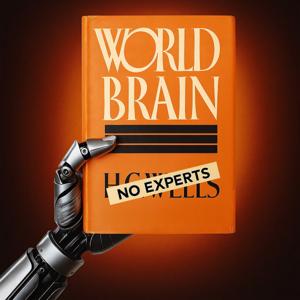
Taking the HG Wells essay collection as a departure point, this podcast asks the following questions of a range of people:
From the publisher's feed
Taking the HG Wells essay collection as a departure point, this podcast asks the following questions of a range of people: