
Sign up to save your podcasts
Or

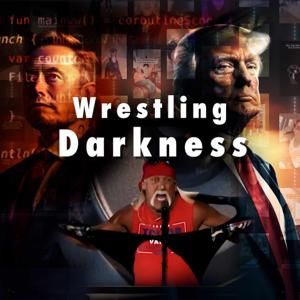


My guest in episode 4 of Wrestling Darkness is Professor Lawrence Lessig who explains in his essay, The Age of the Fantasist, how and why algorithmic media came to reward narratives that lie to us.
“The fantasist doesn’t worry that he will not please everyone. He’s not aiming for everyone. Indeed, he is aiming precisely to avoid appealing to everyone. Division drives attention in a world of fragmented media.” —Lawrence Lessig
Perhaps you’re not prepared for a conversation that bridges artificial intelligence (AI) and professional wrestling. Don’t worry, neither was Professor Lessig! But we did arrive at a helpful framework for decoding today’s media landscape, an important first step if we decide we wish to change it.
AI selects for people (fantasists) that resemble professional wrestling because it knows such fact-free hyperbole causes people to click, to watch, and to share. The aggregate impact is a threat to humanity, Lessig warns, because it divides us, and thus, makes us ripe for the conquering.
AI is “the most extraordinary technology humanity has ever even conceived of,” he said during harrowing presentation at TedxBerlin in February. But, it is one we need to watch “with the paranoia of the hunted.”
If you like episode 4, the previous episode most closely related to this one is episode 2.
—Eric
PS: I am entering a Fair Use battle with World Wrestling Entertainment (WWE) and other corporations that own its content. Right now, the first two episodes of Wrestling Darkness are blocked on YouTube. The guests for these episodes have written books about professional wrestling and are critical of wrestling. But the Fair Use doctrine was not intended to insulate entertainment corporations from criticism by academics or journalists. The U.S. government defines the Fair Use as a legal doctrine intended to promote freedom of expression by permitting the unlicensed use of copyright-protected works in certain circumstances, including nonprofit educational purposes.
Regardless of the outcome, you can see all four episodes on Substack, and hear them on all the usual podcast apps such as Apple Podcast and Spotify.
To support Wrestling Darkness and other content on the Eric Byler Substack feed, please subscribe or make a tax deductible donation.
Oscar Keohan and Jacob Johns traveled from Australia to tour the U.S. in the weeks leading up to the 2024 presidential election. But an unexpectedly dark turn at a Trump rally in North Carolina overshadowed their de Tocqueville-like experience.
Supplemented by video recordings, they share with us why they felt sickened by the way the president-elect manipulated his fervent supporters, and the way the crowd responded.
Donald Trump’s journey from Wrestlemania to the White House and the truth-bending madness that has metastasized in politics, news infotainment, and online echo chambers is summarized midway through this episode, which means viewer/listeners can begin here and circle back to episodes 1 and 2.
To support Wrestling Darkness and other content on this feed, please make a tax deductible donation and/or subscribe.
The music for Wrestling Darkness was composed by Michael Brook, who scored all four of my feature length films. The jazzy improv rendition of the song is performed by David Scott Binanay & Stephen Munoz, who also played at my wedding!
—Eric
Abraham Josephine Riesman, author of the best-selling biography Ringmaster: Vince McMahon and the Unmaking of America., explains how the production of cheap, addictive entertainment such as pro wrestling, cable news, and reality TV, changed the culture of American.
Our conversation traces a cultural transformation that began in the mid-1980’s, as the truth-bending madness of professional wrestling took hold in adjacent sectors such as cable news, Jerry Springer and similar talk shows, and reality TV.
With Donald Trump's celebrated Wrestlemania appearance, followed by his emergence as the leader of the Birther movement, wrestling-style fandom would go on to revolutionize politics, government, and society as well.
In Episode 1, Dr. Sharon Mazer and I focused more on violence against women depicted in wrestling programs. We also delved a bit deeper into Donald Trump’s political rearing in the wrestling arena.
To support Wrestling Darkness and other content on the Eric Byler Substack feed, please make a tax deductible donation and/or subscribe.
The music for Wrestling Darkness was composed by Michael Brook and performed by David Scott Binanay & Stephen Munoz.
The Wrestling Darkness podcast and the other content found on the @EricByler substack feed is supported by the 501c3 non-profit ID Alliance.
Dr Sharon Mazer is the author of Professional Wrestling: Sport and Spectacle, and the only woman in the Netflix documentary Mr. McMahon, argues that Donald Trump’s political career and persona are direct outgrowths of his appearances in Wrestlemania and other professional wrestling programs, and that the structure and format of wrestling has “escaped the arena” and warped American culture.
We drill down on "incels" — involuntarily celibate men, and other men who hate women — as a consumer group and a voting block in today's America, and how they were cultivated by mass media, wrestling first and foremost.
The docuseries, directed by Chris Smith, has many fascinating and important threads, and even a heartwarming story about Vince McMahon’s relationship with his son, Shane.
But Professor Mazer and I focus on violence against women depicted in professional wrestling, and allegedly inflicted on employees of Vince McMahon over many decades.
To support Wrestling Darkness and other content on the Eric Byler Substack feed, please make a tax deductible donation or subscribe.
A woman once told me she got divorced because of a film I made.
Seeing the film deepened her misgivings about her husband’s racism, and after years of questioning herself, she left him.
The woman was Asian and her husband was white — just like my mom and dad, and just like a couple played by Ryan Kutrona and Takayo Fischer in American Knees.
Above: Selected scenes from American Knees. Below: The message I intended.
Love is all
Hank and Keiko take turns squeezing hands with Miles (Stephen Bishop), expressing with great fervor how delighted they are to welcome him into their home. Unspoken, yet obvious, is the fact that they are uncomfortable with his Blackness.
Hank thinks he is impervious to accusations of racism because he married an Asian woman. He objects when his daughters date men of color not because of his own feelings, but because he wants to protect his daughters from (white) society’s judgement.
Julia (Annie Katsura Rollins) and Aurora (Allison Sie) respond to this paradox in different ways. Julia stews with muted anger when her mother deploys Asian-mom insinuation to pressure her about her African American boyfriend. Aurora has taken flak from her dad about an Asian American boyfriend, but that relationship is over now. She plans to appeal to his better nature to pave the way for Julia’s marriage.
Hank is the character I altered most in adapting Shawn Wong’s canonical novel. I made Hank more charming, unassuming, and lovable because I wanted audiences to feel the ache of confronting racism in someone who means the world to you.
Someone like your Dad.
As he shrinks in her eyes
It is not only white men who want power over women’s bodies. But when gender insecurities are compounded by racial insecurities, the result can be ghastly.
In locker rooms, at pro wrestling events, and at political rallies, men think they appear strong and masculine when they talk about asserting power over women. But in the eyes of women, the opposite is true.
When Hank explains why he is meddling in his daughter’s romantic life, Aurora is overwhelmed with sadness and disappointment.
He feels his own diminishment as he shrinks in her eyes. It’s tragic for them both.
In seconds, the father she loved melts away and in his place, she sees the man he always was. What should she do now?
Aurora’s quandary, which always brings tears to my eyes, was inspired by the following words from the novel:
“Each time you let something pass that’s generally insulting or racist about Asian people and it isn’t specifically directed at you, you’re in a sense passing for white.”
“Passing for white” is an especially painful notion for mixed race Americans because it means that we are hiding behind White privilege, exploiting our lighter skin or other attributes to benefit from racist hierarchies that we otherwise denounce.
With these words, which I borrowed in the screen adaptation, Shawn Wong explained to me why I felt ashamed when my baseball teammates used racist stereotypes to poke fun at an Asian player in the other dugout. I could have said, “Hey, my mom is Chinese.” But I didn’t.
Before and since then, I have “let it slide” when people in my presence made homophobic remarks and objectified women. Usually, it was in settings where cohesion was preferable to conflict (a family gathering, a sporting contest, a news room, a film set). Sometimes, I just didn’t feel like starting an argument.
So where we draw the line?
I draw the line when bigotry is made into government policy. I consider it a civic duty to interrupt that process in any way I can.
In the film, Aurora’s family has enacted a family policy under which Julia’s African American boyfriend is welcome in private settings but not at Hank’s retirement party. This policy hurts her sister in ways she cannot accept.
When she fails to change her father’s mind, she tacitly forgives him. But she decides not to attend the party.
Thankfully, my father has never put me in such a position. But, like millions of Americans of every background, I lament the walls that Fox News and Donald Trump have created between us.
I share some of the blame. When I went to Wesleyan University and came home angry and defiant on matters of race and racism, I said things that hurt him.
I have since learned to be respectful in such conversations. But my father and I usually avoid the subject. We talk about things we both love, his grandkids mostly, and baseball.
Every now and again we try, but these days racism and politics have fused to a degree that neither of us can tell them apart, and parsing the lines between fact and fiction is as tedious as it is fruitless. It aggravates us both.
I can’t make my father in my own image any more than he can make me in his. And even if that was my goal, it would be a selfish one — more about me than about making the world a better place.
My father raised me well. He was and is warm, kind and loving. And now that I’m a father myself, I realize that I learned and gained from him all the best parts of me that I bring to fathering my own children. I value nothing more. The least I can do is love him in spite of Fox News. He is much happier. I am as well.
Also depicted in the selected scenes above: Chris Tashima as Raymond, Joan Chen as Betty, Kelly Hu as Brenda.
Eric Byler is a reader-supported publication. To receive new posts and support my work, consider becoming a free or paid subscriber.
The Headless Klansman of Selma is the story of a Confederate monument that venerates the first Grand Wizard of the Ku Klux Klan. Like the Trump political phenomenon, the statue originated as a backlash against the results of a free and fair election.
The people of Selma, Alabama elected the city’s first ever African American mayor on September 12, 2000. The defeated mayor, a former segregationist, quietly approved the KKK monument as a message for his successor and those who supported him.
The monument was vandalized in 2012, leaving it headless, and our film follows the ensuing battle to its May 23, 2015 conclusion.
Donald Trump’s golden escalator ride was three weeks later on June 16, 2015. The day after that, Dylann Roof brought a gun to a Bible Study at an African American church and killed nine people. This led to the removal of the Confederate flag from the South Carolina State Capitol grounds, a process I documented extensively.
The power of white grievance
On Feb 20, 2016, I was back at the South Carolina state capitol covering the presidential primary when I stumbled across a “Confederates for Trump” rally. This video was the result.
The Confederates weren’t exactly thrilled that Trump had said he supported the removal of their flag. But they knew instinctively that Trump was a suitable replacement, perhaps a better one. They told us Trump would save America from immigrants, Muslims, and the “ethnic cleansing of white people.”
The organizer of the rally gave us a copy of a conservative newspaper that included an article about how President Obama was a secret Muslim.
Trump’s Birtherism campaign, and his candidacy, were a backlash against the results of the 2008 election. There is a pattern here. Look up the term “Massive Resistance.”Or just consider that the Civil War was a violent backlash against the election of Abraham Lincoln. The Confederate flag being placed atop the South Carolina capitol in 1961 was a backlash against the Civil Rights movement. And, Selma’s KKK statue was a backlash against the 2000 mayoral election.
But unlike the Headless Klansman, Trump emerged after the 2008 election as a walking and talking, flesh-and-blood symbol of resentment — a rebuke and a retaliation against multiracial democracy and the outcomes it can sometimes produce. And, he had policy proposals to prevent that.
The Trump story and the Confederate monuments story fused, in my mind at least, in August of 2017 at the “Jews will not replace us!” rally — which began as a fight over a Confederate monument in Charlottesville, VA.
The torch bearers didn’t just chant about Jews. In reference to the perception that Russia had helped Trump win in 2016, they chanted:
“Russia is our friend, the South will rise again!”
The invisible word
Historian and author Tim Tyson said something that really stayed with me when we interviewed him for what became The Headless Klansman.
“When I grew up, there was an invisible word in parenthesis in front of the word Southerner, or South. And that was the word ‘white.’ When you said, ‘The South will never submit!’ you meant white!’”
Professor Tyson’s foil in Headless Klansman is Todd Kiscaden, a wealthy engineer who donated hundreds of thousands of dollars, as well as in-kind construction work, to support the Klansman monument.
Mr. Kiskaden defends the Ku Klux Klan as a “social club” designed for masquerading and parading. When the KKK discovered that their hoods and robes happened to frighten “skulkin’ around town, unemployed, getting into all sorts of mischief negroes,” they transformed into a “law and order” club. He doesn’t mention the thousands of innocent people who were tortured, murdered, and left hanging from trees, but rather the righteous objective of the KKK: to encourage African Americans to get jobs. If you don’t believe my summary, here is the KKK narrative in full:
History, if not basic common sense, will tell you that the former slaves were accustomed to hard work. Overwhelmingly, they intended to work as subsistence farmers. Jim Crow laws made it a crime, however, for them not to have jobs working for white men. It was “loitering,” punishable by incarceration, after which they could be sold back into slavery as part of their sentence. Sharecropping and working as domestic servants were the only jobs available to them, so that’s what the majority of them did. And as for the “skulkin’ around” business? That’s just one of many lies that were used to justify murder and terror.
The preferred lie was “rape” of course. Do I need to remind you which politician in the present-day likes to describe nonwhite people as “rapists” while having been credibly accused of rape and sexual assault by 26 women?
But let’s hone in on the “lazy loitering former slaves” lie. Did you notice in the film that two defenders of the Klansman monument connected “entitlement programs” with slavery? We heard that dozens of times in our travels. This is not just because they consider welfare programs morally equivalent to slavery. Present-day political beliefs about entitlement programs are rooted in grievances and lies made up by former slaveholders to justify the violent overthrow of democratically elected governments and decades of racial oppression.
False narratives that justify oppressing nonwhite people remain a dominant and fundamental part of our political discourse, as the Trump/Vance pet-eating lie attests. We need to come to terms with the fact that (white) false narratives lead to (white) political violence. Dylann Roof’s church massacre, Payton Gendron’s grocery store massacre (where he shot and killed African Americans and apologized to white people), the Tree of Life synagogue massacre, and January 6th insurrection are recent examples. History is filled with them, although most are forgotten.
Mr. Kiskaden gave us a copy of a book that he said proves his version of history. It is called “An Authentic History of the Ku Klux Klan.” A decade later, I haven’t removed the shrink-wrap. But in the coming days, I will read this book. I’ll let you know how that goes.
Mr Kiscaden told us that when he goes to Civil War reenactments, he dresses up as both Confederate and Union generals. His performance as a Union general portrays a tyrant who intends future federal governments to oppress us by forcing us to have Obamacare.
Professor Tyson explained, rightly, “Arguments about history are always about the present.”
Fanatical Trump voters don’t mind when his racism and other forms of bigotry are out front and center. For decades, as propaganda pushed them further and further to the right, they held their noses and voted for candidates they felt were not racist enough. Along came Trump. It’s their time now.
Tepid Trump voters are the ones who rely on invisible words. Racism, political violence, and the racist lies that stoke political violence — these are the paths to (white) power when accepting the results of free and fair elections won’t do.
The tepid and the fanatical Trump supporters have formed a powerful coalition. But let’s not pretend the invisible words are invisible anymore.
To support this and other content on the Eric Byler Substack feed, please make a tax deductible donationand/or subscribe.
Courtney Hester-Green is a U.S. military veteran whose daughter was born with Edwards syndrome and not expected to survive a year. Today, at age 5, she has a full life thanks in large part to Medicaid.
This is Courtney's impassioned plea to the United States Senate to block efforts to cut $716 billion from Medicaid — the largest cut in the program’s history — to pay for tax cuts for the super rich. This would be a death sentence for her child, she said, but not only hers.
"If we don't stand up for Medicaid now, hundreds of thousands of children like her will die with much more common conditions than hers," she said. "Much more common. Treatable. Preventable."
Between 9.7 million and 14.4 million people would lose their health coverage if the current bill were signed into law, according to the CBPP.
Courtney spoke at the foot of the U.S. Supreme Court building at a Moral Monday event featuring Rev. Dr. William J. Barber II and the Repairers of the Breach coalition.
A few minutes later, Rev. Barber and eight others were arrested in the U.S. Capitol rotunda for praying against the Trump budget bill. The Repairers of the Breach movement is organizing civil disobedience actions at the U.S. Capitol on the first Monday of each month this summer.