
Sign up to save your podcasts
Or



Can’t focus on writing because you keep picking up your phone, checking one thing and suddenly finding yourself twenty or thirty minutes deep into social media, world events, commentary or the endless scroll?
Maybe you genuinely care about what’s happening. Maybe you tell yourself you’re simply staying informed. But by the time you finally put your phone down, you feel worried, angry, agitated or mentally scattered, and the fictional world you were about to step into suddenly feels much further away.
So how do you stay connected to what matters without giving the noise of the wider world unlimited access to your attention? And when doomscrolling has already pulled you out of your writing headspace, how do you actually get back to your novel?
In this episode of Write The Darn Book™, I’m sharing my own recent experience with this, including the contrast I noticed after spending several months largely away from social media, and why I’ve become much more conscious of what all that scrolling is actually doing to my attention and creative state.
We’ll look at the difference between meaningful action and endless consumption, how to separate what you can influence from what you cannot control, and the simple three-step strategy you can use when you realise your phone has taken you somewhere you never intended to go: put it down, come back to the room, come back to the story.
Why “I’ll just quickly check something” can turn into a pattern that quietly takes you much further away from your writing than you intended
How to separate what you can influence from what you cannot control, and recognise the difference between meaningful action and compulsive consumption
How to protect your writing attention, reset after doomscrolling and use Put It Down → Come Back to the Room → Come Back to the Story to find your way back into the manuscript
Why different Dove, Owl, Peacock and Eagle Writing Personality tendencies can affect both what pulls you into the scroll and what helps you return
Why caring deeply about what is happening in the world does not require giving technology, social media or the news unlimited access to your time, energy and attention
How to narrow your focus from everything happening everywhere to one character, one scene and the next sentence in front of you
What pulls your attention away from the page, and what helps you return, can look different depending on how you’re naturally wired to write.
Find out your unique Writing Personality by taking my free Writing Personality Quiz at maddisonmichaels.com/quiz.
My new book, Unlock Your Writing Personality, is now available to pre-order on Amazon and will be released on 12 January 2027.
The book takes you much deeper into the Writing Personalities and how your natural wiring can shape the way you create, experience resistance, approach your writing process and find your way back to the page.
Pre-order on Amazon: [INSERT AMAZON PRE-ORDER LINK]
Episode 36: Why Your Phone Is the Real Reason You Can’t Sit Down to Write (And How to Take Your Focus Back)
If today’s episode helped you recognise how quickly a “quick check” can pull you away from your manuscript, Episode 36 takes a closer look at the broader pull your phone can have on your writing focus and what you can do to protect your attention at the page.
You are the vessel for your story. Let the words flow through you and onto the page.
Have you ever read another author’s work and thought, Why doesn’t my writing sound like that? Maybe you love their sentence rhythm, their dialogue or the way their voice seems to flow effortlessly on the page, and suddenly you start questioning the way you naturally write.
Your writing voice isn’t something you create by sounding more like somebody else. It grows from your experiences, your perspective and the way you naturally notice and express what’s happening on the page.
In this episode, we’re getting specific about what writing voice actually is and how to recognise the places where yours is already showing up. We’ll also explore how reading and studying authors you love can strengthen your craft without turning into imitation, and why trusting your own observations and language is what helps your writing become distinctly yours.
You’ll also hear how your natural creative wiring can influence the details you notice, the language you choose and the way you express emotion, dialogue and description.
If you’ve spent so much time following writing advice or comparing yourself with other authors that you’re no longer sure what naturally works for you, my Writing Personality Blueprint Session can help you understand your writing patterns more clearly.
We look at your Bird Writing Personality tendencies alongside your NLP Writer’s Mind modality and translate those insights into practical information about how you naturally think, create and write.
Find out more at maddisonmichaels.com/blueprint
If self-doubt and overthinking are making you second-guess every creative decision, listen to:
Episode 76: How to Overcome Self-Doubt as a Writer: Break the Overthinking Spiral and Get Back to Writing
Because your reader doesn’t need another version of somebody else’s voice. They need the story, idea or message expressed through your particular way of seeing and saying it.
One difficult scene becomes a question about the plot. Then the characters. Then your voice. Before long, you’re questioning the whole book and wondering whether you have any idea what you’re doing.
That’s the self-doubt spiral.
And when you’re caught inside it, the natural response is usually to think harder. You analyse the chapter again. You reread the opening. You compare your draft to someone else’s finished book. You keep searching for certainty.
But more thinking can actually feed the spiral.
In this episode of Write The Darn Book, Maddison explores how to overcome self-doubt as a writer by recognising the difference between useful manuscript evaluation and overthinking that turns one writing problem into a judgement about your entire ability.
You’ll learn how to recognise the spiral earlier, why your physical state matters just as much as the thoughts running through your head, and how to return to the manuscript without waiting until every doubt has disappeared.
The next time you feel yourself disappearing into overthinking, begin with the reset before you try to solve the manuscript.
Ground. Name. Move.
Come back into the room and your body. Name what is happening and identify the specific trigger. Then make one small move towards the manuscript.
One sentence. One note. One clear writing question.
Because your book doesn’t need you to feel completely certain about every word. It needs you to stay connected to it long enough to discover what it can become.
You are the vessel for the story. And part of becoming that vessel is learning how to hold uncertainty, trust your creative voice, understand your patterns and keep returning to the page when self-doubt gets loud.
If you want help truly embracing yourself as a writer, strengthening your self-trust and working through the patterns that keep pulling you away from your book, that is exactly the work we can do together through Write The Darn Book™ coaching.
You can book a free 15-minute clarity call with Maddison at:
maddisonmichaels.com/call
We’ll talk about where you are with your writing, what feels hardest right now, and whether coaching feels like the right support for you and your book.
Episode 68: Missed Your Writing Plan? How to Reset, Rebuild Self-Trust and Keep Writing
If self-doubt has already pulled you away from the manuscript or disrupted your writing rhythm, Episode 68 will help you rebuild self-trust and return to the page without turning a difficult writing week into evidence that you’ve failed.
Can dictation help you write faster? For some writers, speaking a scene or idea can create a completely different kind of creative flow than typing it. For others, dictation feels awkward, disconnected or harder than simply putting their hands on the keyboard.
The difference might have a lot to do with how you naturally process information.
In this episode of Write The Darn Book™, Maddison explores dictation for writers through the lens of the four NLP modalities: Visual, Auditory, Kinesthetic and Auditory Digital. You’ll discover why one writer might happily walk for an hour speaking a chapter into their phone, while another needs to watch the words appear on a screen for dictation to feel useful.
Maddison also shares how her own Auditory Digital and strong Visual tendencies shape the way she uses dictation, and why the goal is never to force yourself into somebody else’s writing process. Dictation can be used for far more than drafting polished prose. It can help you brainstorm scenes, capture chapter ideas, talk through plot problems and get your thoughts moving when the manuscript feels stuck.
Why speaking your story can sometimes create more flow than typing, particularly when perfectionism or overthinking has crept into the writing session.
How Visual, Auditory, Kinesthetic and Auditory Digital writers might experience dictation differently, and how to adapt the tool to your own creative wiring.
A simple two-minute dictation experiment you can use for your next scene, chapter or idea without expecting the words to arrive polished.
Your writing process belongs to you. Dictation might become part of your everyday writing rhythm, an occasional brainstorming tool, or simply another way back into your book when you need a fresh doorway onto the page.
Want to understand more about your own creative wiring?
maddisonmichaels.com/quiz
LISTEN NEXT:
Write The Darn Book™
Why can’t I finish my book?
If you’ve been writing the same manuscript for years, that question can start to feel deeply personal. You might wonder whether you lack discipline, whether you’re capable of finishing, or whether you’re simply destined to keep starting and stopping.
But the length of time you’ve been working on your book doesn’t tell you why it remains unfinished.
In this episode of Write The Darn Book, we’re diagnosing what’s actually keeping your manuscript from moving forward. Because an unfinished book can be caused by very different things. You might have a structural problem inside the manuscript, you might be trying to write in a way that works against your natural creative wiring, or finishing itself might represent something far bigger than typing the final sentence.
We’ll also look at how your NLP modality, whether you lean Visual, Auditory, Kinesthetic or Auditory Digital, can influence the way you process manuscript problems and find your way forward.
If you’ve realised you’re ready to finally finish your book but you need personalised support to work through both the manuscript and what’s happening around it, my Write The Darn Book™ 90-Day Transformation Method is designed to do exactly that.
You can book a free 15-minute clarity call with me at maddisonmichaels.com/call.
We’ll talk about where your manuscript is now, what’s been getting in the way, and whether working together feels like the right next step.
Listen next: Episode 73, The Writer’s Odyssey Plan: 3 Possible Futures to Help You Decide What Comes Next. If this episode has helped you recognise that a decision needs to be made about your book, Episode 73 will help you step back and look at the bigger writing future you actually want to create.
maddisonmichaels.com
What if the writing life you’re working towards isn’t the only one available to you?
Writers can become so focused on the next manuscript, the next deadline, getting published, finding an agent or simply trying to finish the book in front of them that they rarely step back and ask a bigger question: What do I actually want my writing life to look like?
In this episode of Write The Darn Book, I’m adapting the Odyssey Planning concept specifically for writers and inviting you to explore three different possible writing futures.
You’ll imagine where your current path could take you, what might happen if you made one brave change, and what your writing life could become if money, expectations and other people’s opinions temporarily stopped making the decisions.
The goal isn’t to choose one perfect future. It’s to notice what keeps appearing across all three, because those repeated desires can tell you an enormous amount about the writer you’re becoming and what you might be ready to create next.
You don’t need your entire writing career mapped out.
You simply need enough curiosity to ask what else might be possible.
If this episode has shown you a writing future that genuinely lights you up, but you can also see the gap between where you are now and the writer living that life, that’s exactly the kind of work I do inside my one-to-one coaching.
The Write The Darn Book™ 90-Day Transformation Method brings together the inner and outer work of writing: identity, resistance, creative wiring and confidence alongside structure, writing rhythm, milestones and the practical plan that moves your actual book forward.
You can book a free 15-minute clarity call with me at:
maddisonmichaels.com/call
It’s simply a chance for us to talk about where you are, where you’d love your writing to go next, and whether working together feels like the right next step.
Episode 72: Writing When You Have No Motivation
If this episode has helped you see where you want your writing life to go, Episode 72 will help you keep moving when the motivation to get there disappears.
Write The Darn Book™ with Maddison Michaels
You are the vessel for the story. Let the words flow through you and onto the page.
What do you do when you still want to finish your book, but you have absolutely no motivation to write?
Maybe the excitement that carried you through the beginning has disappeared. Opening your manuscript feels heavy, the next chapter feels like work, and you keep waiting for that spark of inspiration to come back before you write again.
But motivation was never designed to carry you through an entire book.
In this episode of Write The Darn Book™, I’m looking at what happens when motivation disappears, particularly through that long middle stretch where the novelty has faded and the finish line still feels a long way away. I’ll also share why losing motivation doesn’t necessarily mean you’ve chosen the wrong book, lost your creativity, or somehow become less of a writer.
Instead of trying to manufacture motivation, I’ll take you through my simple Three-Part Motivation Substitution System, using meaning, cues, and a writing minimum to help you keep moving even on the ordinary days.
And because the same approach won’t work for every writer, we’ll look at how to personalise each part of the system for your Dove, Owl, Peacock, or Eagle writing tendencies, so you can build a way of returning to the page that actually works with the way you’re wired.
This week, choose one writing habit that currently depends on motivation and turn it into an identity-anchored habit.
Choose a clear cue, decide on a small writing minimum, and connect it to the writer you’re becoming.
For example:
“When I make my morning coffee, I’ll open my manuscript and write for ten minutes because I’m a writer who returns to my story.”
Then test it for one week.
You don’t need to feel wildly inspired every time you sit down to write. Your feelings can shift while your relationship with your book stays steady.
If this episode helped you move from waiting for the right feeling to choosing your next action, listen to Episode 64: How to Start Writing Your Book Without Waiting For Permission.
It’ll help you take that identity shift even further, from wanting to write your book to becoming the writer who actually acts.
You are the vessel for the story. Let the words flow through you and onto the page.
Social media has changed what readers want from books, especially during those crucial first moments when they’re deciding whether to pause, click, buy or keep reading. Online content often has only a few seconds to earn someone’s attention, and those rapid patterns of novelty, anticipation and reward now shape the way many people approach books too.
Readers can still become completely absorbed in long, layered and emotionally rich stories. The real change is how quickly they want to understand why a book deserves that deeper attention.
In this episode, we explore how social media has influenced reader expectations and what that means for your opening pages, scene structure and storytelling choices. You’ll learn how to engage modern readers while protecting your authentic voice, honouring the natural pace of your story and staying grounded in the kind of book you genuinely want to write.
After listening, open your first chapter or section and read it through four different lenses: hook speed, economy, emotional immediacy and payoff. Choose one meaningful revision that makes the promise of your book easier for the reader to feel.
Listen next: Episode 67, Writing Your Protagonist: How to Build a Main Character Readers Root For From Page One.
Enjoying Write The Darn Book? Follow the podcast so you never miss an episode, and share this one with another writer who wants to strengthen their opening pages while remaining true to their voice and story.
Does your inner critic start editing before you’ve even finished the sentence?
It might tell you the scene is boring, the writing isn’t good enough, or a real writer would know how to do this properly. Because that criticism arrives in your own voice, it can sound less like fear and more like the truth.
But you don’t have to silence your inner critic before you can write.
In this episode of Write The Darn Book, Maddison explores why the inner critic is often a protective response rather than an enemy, and why arguing with it can sometimes make it even louder. You’ll learn how to separate its commentary from your identity, uncover what it’s trying to protect you from, and give it a more useful role in your writing process.
You’ll also discover how the inner critic might show up differently depending on your Dove, Owl, Peacock or Eagle Writing Personality, and whether you process your writing experience through a Visual, Auditory, Kinesthetic or Auditory Digital modality.
By the end of the episode, you’ll have a practical three-part negotiation you can use to keep drafting, even when self-doubt and negative self-talk are still muttering in the background.
Your inner critic can have an opinion. It simply doesn’t get control of the keyboard.
If your inner critic, perfectionism or self-doubt keeps pulling you away from the page, you don’t have to work through it alone.
Book a free 15-minute clarity call with Maddison at maddisonmichaels.com/call. It’s a relaxed mutual-fit conversation where you can explore what’s keeping you stuck and whether one of the Write The Darn Book™ coaching pathways feels like the right next step.
Episode 68: Missed Your Writing Plan? How to Reset, Rebuild Self-Trust and Keep Writing
Listen next if your inner critic becomes especially loud after you’ve fallen behind, missed a writing goal or struggled to follow the plan you created.
Is your plot stuck, even though you’ve already written plenty of scenes?
Sometimes a novel loses momentum because it needs a stronger idea. But often, the scenes you need are already there. They’re simply appearing in an order that weakens the connection between action, choice, and consequence.
In this episode of Write The Darn Book, Maddison shares a practical scene card shuffle to help you step back from the pages of your manuscript and see the shape of your plot more clearly.
You’ll learn how to place every scene onto a separate card, diagnose the points where your story’s momentum drops, and experiment with a new sequence without committing to a major rewrite. You’ll also discover how one carefully moved scene can strengthen several chapters, close a plot gap, or give your messy middle the momentum it’s been missing.
Because a stuck plot doesn’t automatically mean your story is broken. Sometimes, it means the right scene is standing in the wrong place.
Write every current scene on a separate card and lay them out in manuscript order. Choose the section where your plot feels weakest, then move one card.
Test what happens when a discovery comes earlier, a consequence moves closer, or an emotional scene lands after a more powerful trigger.
You’re not trying to repair the entire book in one sitting. You’re looking for one change that creates a stronger chain of cause, choice, and consequence.
If your plot is moving but your protagonist’s choices still need greater emotional weight, listen to Episode 67: Writing Your Protagonist: How to Build a Main Character Readers Root For From Page One.
Follow Write The Darn Book so you never miss an episode, and share this one with a writer whose messy middle might need a scene card shuffle.
From the publisher's feed
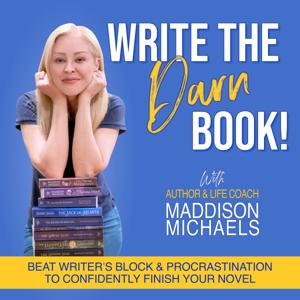
Welcome to Write The Darn Book™, a mindset-first, craft-supported, spiritually aligned podcast for fiction writers who feel called to write a novel, but keep getting stuck somewhere between the idea and the finished draft.
If writer’s block, procrastination, self-doubt, perfectionism, overthinking, or the everyday chaos of life keeps pulling you away from the page, you’re in the right place.
And my friend, you are not broken!
You are a writer with a story inside you. And sometimes what you need isn’t more pressure, more hustle, or another generic writing routine. Sometimes what you need is a deeper understanding and awareness of how your mind works, how you are uniquely wired to write, what’s happening within the manuscript itself, and what actually helps you move from stuck… into creative flow.
I’m Maddison Michaels, an award-winning, multi-published author of 9 books, certified Life Coach, NLP Practitioner, and creator of the Write The Darn Book™ Method.
And I know exactly what it feels like to desperately want to write your book, but still struggle to actually get it to the finish line, because that was me for years. That’s why the work we do here focuses on both sides of finishing: the writer and the manuscript.
Each week, we’ll explore the inner work of writing, including writer’s block, procrastination, self-doubt, perfectionism, fear, resistance, creative flow, writer identity, nervous-system safety, confidence, self-trust, NLP tools, intuition, and the deeper patterns that shape how you show up to the page.
But we’ll also get practical with the manuscript itself, exploring how to write a novel, story structure, character, dialogue, pacing, first chapters, messy middles, revision, writing routines, publishing pathways, query letters, author life, and the practical steps that help you keep your story moving towards the finish line.
Because writing a novel is never just about the manuscript. It’s also about the writer you become while you’re writing it.
Each episode will help you:
✨ Break through writer’s block, procrastination, and self-doubt
✨ Develop a stronger writing mindset and deeper creative confidence
✨ Understand your writing personality and unique creative wiring
✨ Build a writing process that works with how you’re uniquely wired to write
✨ Strengthen your craft, story structure, and manuscript momentum
✨ Use NLP, emotional regulation, and neuroscience-supported tools to reconnect with flow
✨ Navigate the practical realities of writing, revising, querying, publishing, and finishing
✨ Trust your voice, honour your story, and finally finish writing your novel
Whether you’re writing your first novel, returning to a manuscript you’ve been carrying for years, or you’re already published and trying to find your way through the next one, I’m here to support both you and your manuscript all the way to the finish line.
So grab your cup of liquid gold, settle in, and let’s write the darn book together. 💕
And remember... You are the vessel for your story. Let the words flow through you and onto the page.
🌟 Make sure you hit follow so you can binge listen and never miss a new episode every Wednesday!
And if you’d love to discover how you’re uniquely wired to write, take the free Writing Personality Quiz at maddisonmichaels.com/quiz
For deeper personalised support, you can also book a Writing Personality Blueprint Session at maddisonmichaels.com/blueprint