
Sign up to save your podcasts
Or

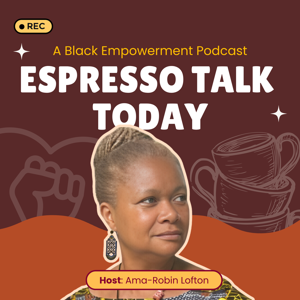


Have you ever wanted to have a (free and authentic) conversation with a cardiologist? That's what the Espresso Talk Today team wanted--and that's what we had! We met with Dr. Clyde Yancy, cardiologist and former president of the American Heart Association! Nothing was off the table. We discussed everything from heart health to heart failure. Dr. Yancy shared his 8 essential steps for optimal heart health and four symptoms that you should never ignore. And, of course, we discussed the importance of race and racism in Black health. You can also discover why people in certain communities live the longest and the happiest. Join us for this uncommon and informative conversation.
Resources:
Association of Black Cardiologists
American Heart Association
Repaying student loans does not need to be painful. It also does not need to be difficult. However, it can feel confusing and scary. Financial aid expert, Kim Bradley, returns to the show to discuss student loan repayment options. Kim Bradley will discuss different repayment options and the future of loan repayment and loan forgiveness possibilities. Ms. Bradley also presents the four federal student loans and how they can be easily repaid. You will also learn what to do in the event of a financial emergency. Finally, she presents a 911 rescue website (see below)! Kim is gentle and patient. Join us for this informative discussion.
Kim's advice: Do your research before choosing a school and getting a loan!
Student Loan 911 Rescue
If you or someone you know needs money for college, start here: https://studentaid.ed.gov
Report: Black Women are uniquely burdened by student loan debt
Hypertension. Depression. Cardiovascular disease. African Americans have a higher risk of suffering from these chronic illnesses. Earlier onset. Earlier deaths. Why? Systemic racism. Many counties have declared racism to be a public health crisis. Public health can protect health in Black and Brown communities by addressing racism-based issues like poverty, food insecurity, toxic environments, inadequate housing, and even lack of education. The Espresso Talk Today team is joined by Dr. Georges Benjamin, Executive Director of the American Public Health Association. Dr. Benjamin will discuss chronic health problems in the Black community and how public health is perfectly positioned to protect and improve Black health by addressing the persistent problem of systemic racism. Listen to this podcast and learn what you can do to protect your personal health and promote health in the Black community. Racism destroyes lives. Public health saves lives! Don't miss this important episode.
Video: Healthy Births & Black Americans: Why are death rates still higher?
American Public Health Association: apha.org
The Espresso Talk Today team discusses their experiences with racism denials. Three generations of Black Americans have a real talk about their thoughts when they hear these statements and how they respond to them. We also discuss the importance of Dr. Philippe Copeland's work to empower Black Americans against racism and to create an antiracist society. We all bring great thoughts and important experiences to this show.! Join us for real talk about this real everyday issue faced by African Americans.
8 Forms of Racism Denial:
1. Refuting--that's not racist!
2. Minimizing--it's not as bad as it used to be
3. Replacing--talk about something other than race e.g. gender
4. Defending--deploying the black friend. I can't be racist because I have Black friends.
5. Excusing--I was just kidding. You're overreacting! Different generation.
6. Myopia--ignoring the context in which statements are made.
7. Revising history--avoiding accountability for embracing people who engaged in racism in the past. Lost cause Confederacy. War was not about slavery but states rights. War of northern aggression.
8. Distorting: turning reality inside out. The real problem is the mistreatment of white people.
"I don't see race!" "That wasn't racist; that was a compliment!" These statements are racism denials. What is racism denial? How can anyone deny that racism? The answer: we all deny racism at some time! Racism denial is both a political strategy and a coping mechanism. We will discuss these two uses of racism denial and the eight different types of racism denial. The Espresso Talk Today team is joined by Phillippe Copeland, Ph.D. of Boston University Center for Antiracist Research to explain racism denials, how to recognize them, how to respond to them, their effects, and his goal for an antiracist society. Grab your espresso (and a pen) and listen to this enlightening show!
Collective grief. Suffocated grief. Anticipatory grief. Black grief is unique. Western society tries to define grief and describe the grief process. Swiss-American psychologist Elisabeth Kubler-Ross extensively studied the grief process; her research has set the standard for understanding grief. However, this standard is not fully relevant or applicable to the Black grief experience.
Espresso Talk Today is joined by psychologist Mary Chappell, Ph.D. who will discuss the uniqueness of Black grief, the failure of western society to acknowledge Black grief, the problem that this causes, and how Black people can support each other during the grief process. Dr. Chappell also discusses the warning signs of grieving persons who need extra support. Please join us for this compassionate and life-affirming discussion about this difficult subject.
Grief Therapists:
Association of Black Psychologists (Directory for Black Mental Health and Wellness professionals)
Betterhelp.com
Financial aid specialist Kim Bradley returns to the podcast show! In this show, Kim Bradley discusses the most important form to apply for financial aid: the FAFSA! The FAFSA is the Free Application for Federal Student Aid. Kim will discuss the important ways to complete this form, costly mistakes, and things that you must do. These are the must-dos and must-don'ts for this important form. Kim Bradley will walk you through the FAFSA beginning with your name! Don't take anything for granted. Don't make assumptions. Follow the instructions. This podcast show can help you get the money you need for college! Don't end up in the problem pile!
Important Information:
October 1: FAFSA Application Submission Launch Date. Apply ASAP!
Official website of the College Board! Everything about applying for college: www.bigfuture.org
Official Federal Student Aid Official Website: www.studentaid.gov
Phone number: 1-800-4-FEDAID
Note: This podcast show is part of ETT's Financial Empowerment series.
What is Black Activism? Who are today's Black activists and what are they doing? We are discussing the importance of Black activism and the great work of young Black activists today. ETT is also presenting non-traditional ways of engaging in Black activism. Join us for the practical and enlightening show.
Yes, Black History Month comes only once per year. From the special museum and library exhibits to the musical and cultural festivals, Black History Month is a vibrant time of remembrance, learning, and celebration. But there is no need to start singing the end-of-Black-History-Month blues!
Doug (making a special appearance!) and Robin discuss this special month and how they plan to celebrate Black history and culture throughout the year. They also discuss how Black history and culture are under attack and how to respond to this white supremacist attack.
Grab an expresso and join this uncommon conversation!
I was taught that Africa has no history! Teachers, textbooks, television, and movies have hidden Africa's history and its contributions to humanity. This is a White supremacist history of Africa. It is still being taught today. In this short presentation, educator and YouTube content creator, Kirk Wadi joins the Espresso Talk Today team to give us a quick taste of real African history that includes advanced civilizations, complext trading systems, and great learning centers. Join us to learn true African history!
From the publisher's feed