
Sign up to save your podcasts
Or

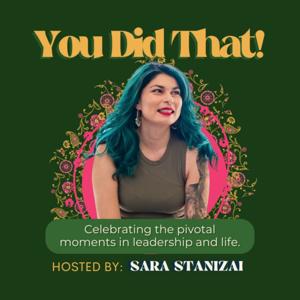


In this episode of You Did That!, I welcome Madina Wardak, an LA-based social worker and youth advocate of Afghan origin. Known as @burqasandbeer on Instagram, Madina engages in dialogue tackling mental health and politics from university campuses all the way to her beloved homeland.
Main Topics Discussed:
Why did you name your platform “Burqas and Beer” and what was your goal for it?
Surprisingly, I don’t get a lot of hate for the name. It’s actually more of a conversation starter! Back then, I would write these very lengthy Facebook statuses about how identity ties into politics. One of my cousins suggested I start a blog, which I launched in 2015. That happened to be the same year the first Afghan-American Conference took place. I spoke there about gender double standards in the Afghan community. It was well-received but rocked the boat a little bit because I talked about male privilege in the Afghan diaspora. That cemented my reputation in the community as someone who spoke her mind. I don’t claim to represent the Afghan community because I don’t want to have to be pressured by expectations; but I know my voice matters. Still, I want it to be my voice. That’s why I chose the unique name Burqas and Beer.
Was there a moment when this felt like an “official” calling—that this was more than just posting Facebook statuses?
I do remember being at an Afghan gathering, and an older woman coming up to my mom telling her how much she loved my writing. That was probably the first “real” moment. And every time other Afghans tell me that my content really resonated with them or impacted them in a certain way, I get reminded that I have a responsibility with this platform.
What were some of the challenges you faced while building this platform?
There’s always the challenge of being an Afghan woman. Really, being a woman in general. I’ve definitely faced a lot of resistance from trolls who’ve tried to silence me or have said that I don’t represent Afghan women in the “right” way. When the Taliban takeover happened, there was a lot of pressure to speak on certain topics and apologize for certain things. It was hard being under that microscope. I’ve been called a Taliban supporter. On the internet, the person on the other side of the screen is no longer a person, but an idea. I was getting a lot of people’s projections, specifically from the Afghan community. One time, my address and my parents’ pictures were leaked. And the crazy thing was, it ended up being some 17-year-old kid from the UK who did a lot of it. There’s often no room for empathy—for understanding that I’m just a person. It’s only this year that I’ve been getting paid for the content I post; so I was doing all this on the side until recently. The biggest lesson I learned is that I’m responsible only for what I say and do, and the work that I’ve done for the community should speak for itself.
How does it feel seeing more Afghan people rising up to do prominent work like yours?
It’s fashionable to be woken up nowadays, so the biggest challenge is navigating your political and social values to discover how you can make a difference in your own unique way.
Learn more about Madina Wardak:
Follow her on Instagram: www.instagram.com/burqasandbeer
Visit her website: www.madinawardak.com
In this episode of You Did That!, I welcome Nik Stancil, an Associate Professional Clinical Counselor with Prospect Therapy in Long Beach. Through therapy and workshop facilitation at Prospect Therapy, Nik provides consulting services for queer and trans individuals seeking to increase productivity, define and reach new goals, and generally improve their quality of life.
Main Topics Discussed:
What are you celebrating about yourself today?
Nik: I am the first openly queer and trans person in my family, and in my bubble. This has bled over into every part of my life, including my work. I wouldn’t be doing what I’m doing now if I didn’t embrace this part of me. I find a lot of pride and identity in my work; so, the ability to translate the empowerment of Queerness that I celebrate into my work is what keeps me motivated.
Tell me about the moment you decided to embrace your identity.
Nik: There were two: the internal and external moments. Internally, the first time somebody referred to me using he/they pronouns, I burst into tears. That made me realize that this is real and it’s not going anywhere. Externally, it was my top surgery. That was when the people around me realized that they had to adjust to this path I chose for my life. It was during that time when they told me that they finally began to see me as I really am.
Were you ever pressured to transition in stages as opposed to all at once, internally and externally?
Nik: Yes and no. I understand the idea of taking one step at a time. At the same time, I also wanted to be done with this emotional labor I was going through. But, you can’t rush it, particularly those building blocks of how you see yourself. In a way, I appreciate the amount of time that needs to pass during the physical part so that I can emotionally process everything that’s happening. I’m also glad the process is hard, because it’s made me a better person.
What were some of the challenges you faced both within yourself and from the people and systems around you?
Nik: Looking back, I’m still surprised about how hard it was to convince myself to go through with it. Sometimes, I don’t know how I was able to do it. I’m so grateful that I did; but, I wish, for my clients’ and other people’s sake, that I was able to really narrate step-by-step how I made it all happen. The conversation you have with yourself is the most important one. Gender is super-confusing. Coming out to my family was also challenging, but a little easier than you’d think because I’d already spent years processing my thoughts and emotions beforehand.
What made those challenges a little easier for you?
Nik: You are one of them. Having a boss that’s not going to fire me or question me. Telling Sara that I wanted to use they/them pronouns, I’m non-binary, and that I’m going on this gender journey, and hearing a simple “cool” from her was amazing. I also had friends that told me that they didn’t care what gender I am, and that made the biggest difference.
Learn more about Nik Stancil:
Follow them on Instagram: www.instagram.com/nikstancil
Request a therapy appointment with Nik Stancil: https://www.prospecttherapy.com/nikstancil
In this episode of You Did That!, I welcome Liz Parr, the owner of Guvnor's Boxing Club in Long Beach, California. She is also a Womens Boxing 5x US Champion and a Team USA Athlete. She is currently on the long, long road to creating champions, all while owning/running her own boxing club. Most importantly, she is remembering to create a life outside of work. You can learn more about her classes, her athletes, and a little bit about her life by following her instagram page @guvnorsboxingclub.
We are celebrating her for not only excelling in her athletic career, but for starting her own business in a male-dominated field.
Main Topics Discussed:
Where did the name “Guv’nors Boxing Club” come from?
Liz: A lot of different things. My husband’s from Manchester, and we support Manchester City. The hooligans are called “guv’nors”. There’s somebody called Lenny McLean who was an underground bare-knuckle boxing champion—all-around gangster, badass, fucking bipolar guy. He was also “The Guv’nor”. I love him so much. My gym was named after the feeling I felt when I watched him.
When was the moment your business became official to you?
Liz: When they handed me the keys and all of the money went out of my account. Not only did I give everything that I had, but I also went negative. I remember my stomach hurting and wanting to puke. I didn’t know anything about running a business, and not a lot of people wanted to help. When I felt that there was nothing left, it became real.
Do you know other women who have done what you did?
Liz: I don’t, but I don’t think that there aren’t any. There are probably women out there like me but don’t put themselves out there as much. They just go about their business. They’re doing their thing. What they do is on a need-to-know basis.
What other challenges did you face when you started your business?
Liz: Money. When you’re self-made—when you don’t have any credit or anyone who is going to cosign for you, it’s a lot harder. There was nobody loaning me money, and I wouldn’t have accepted anyone anyway, because I never want to sink somebody else if I fail. I’d rather go down by myself.
How does it feel not having a lot of people who look like you in professional boxing or owning a boxing gym?
Liz: It’s being advertised more than back then. It’s bigger in other countries like Mexico, who have been headliners for a long time. I just think that, sometimes, the general population doesn’t care about women’s sports unless they’re actually a fan of the sport. The people I respect were really excited for me, and I got help from many trainers. I just think of it as a job that needs to be done, and I’ll do that job regardless of how you feel about me. Other people’s opinions don’t pay me.
What is the favorite thing that you learned about yourself as a result of this process?
Liz: That I love training kids. Even though I knew it then, I know it more now. I like to watch them learn, and hopefully imprint a little bit of my personality in them! I really love this special connection to them, where I’m not their parent or really their friend. I’m this person who is teaching them things that they can apply in their life years down the line.
Learn more about Guv’nors Boxing Club:
Follow them on Instagram: www.instagram.com/guvnorsboxingclub
In this episode of You Did That!, I welcome Tom Nguyen, Founder, Instructor, and Range Safety Officer at L.A. Progressive Shooters. He founded the Los Angeles gun club in 2020 with the goal of creating a non-intimidating and inclusive community, focused on safety and education, for people new to firearms.
Main Topics Discussed:
Why did you find L.A. Progressive Shooters?
Tom: I like to joke that it was an accident, since I found it right around the time of the pandemic and a lot of civil unrest in 2020. I’ve never seen so many people in my communities—the BiPoc and Queer communities—who never cared for guns in their lives before to suddenly consider owning them. In these communities, we don’t have a lot of positive role models when it comes to gun owners, so my mission is to bring more people into this world and change those stereotypes.
What’s your approach as a firearms instructor?
Tom: I like to describe myself as “the most un-gun gun instructor”. I don’t answer for the gun industry. I answer to my community. I just want people to be safe and responsible when making this life-changing decision. If at the end of training, someone says that they’re still not ready to own a gun, then I say, “Great, at least you now know what you’re turning away from.”
When did L.A. Progressive Shooters officially start in your mind?
Tom: In the summer of 2020. I joined a lot of gun clubs but found that they were not as tolerant nor as inclusive as I wanted them to be. They were spaces that were cis-male dominated and could be very homophobic and transphobic. I knew there had to be a place where people could ask questions and not be judged automatically. I created the L.A. Progressive Shooters page on Facebook. I used the word “progressive” because I want to wear this on my sleeve unapologetically to let people know that we’re not marketing to everyone. We know exactly who we want in our community. This is a safe space for everyone that does not feel safe in traditional spaces. We’re here for everyone else.
When you had your first range day with 15-20 strangers showing up who had never handled firearms, what was going through your mind?
Tom: What was going through my mind was the huge burden of responsibility. “What exactly have I done here?” But people responded. People were hungry for this. I knew it was real when I met this Mexican-American couple who drove two hours just to get to this meetup, because they never felt comfortable in other gun communities.
What would your younger self think if they saw you now?
Tom: They would be happy for all the wrong reasons because I was a trigger-happy juvenile. I’ve matured so much since then in ways that my younger self could not appreciate.
Learn more about L.A. Progressive Shooters:
Visit their website: www.laprogressiveshooters.com
Follow them on Instagram: www.instagram.com/la.progressive.shooters
In this episode of You Did That!, I welcome Jessie Santiago, the owner of Salon Benders, a full-service beauty salon based in Long Beach, CA focusing on LGBTQIA+ competency and wellbeing. Jessie has been working in the beauty and wellness industry for over two decades, having first tried her hand at doing hair at age 17.
Main Topics Discussed:
What led to your fast success as a hairstylist?
Jessie: To be totally real, I lean into stuff that makes me feel completely terrified. I was really focused. I never found something that I was good at because I never felt very smart as a child and as a young adult. When I tried doing hair for the first time, I found something that really clicked with me and I was passionate about. From then on, I did everything I could to perfect my craft. I knew it had to work because while I love doing hair, I also needed my passion to pay my bills.
Why did you start Salon Benders? Were there any trade-offs you had to make when you got started?
Jessie: I think it’s so important to talk about this. Everything was a trade-off: It was my physical and mental health, identity, and culture. I had to whitewash, assimilate, code-switch, be low-key about being queer, be skinny, be beautiful—there were all these things that I had to be to be lucrative and be seen as a professional in this industry. I did all of this for 20 years. Right before I opened Benders, I met my partner Cal. He later asked me whether I ever considered working within my own community and offering my services to other trans and queer people. I never really considered it because I was struggling with my own identity and mental health. I had a lot of trauma within my own community because I didn’t identify as “gay” or “straight” when those were the only two categories anyone talked about when I grew up. The moment that Salon Benders became official was a year before we got our space, when I created the Salon Benders brand on social media. It was just myself starting out. But it all really dawned on me when an older trans woman reached out to me for a house call. I saw her as a sister, and I knew that this was the work I wanted to do: to prioritize trans women, especially trans women of color.
Where did the name “Salon Benders” come from?
Jessie: Cal and I always knew we wanted to open a salon but we didn’t know what to call it. We spent the next six to seven months throwing around all of these different ideas. I am connected to my culture and spirituality, and meditation is a part of that. My grandmother taught me how to ground and reach out to information that somebody might call “collective consciousness”. So, I was lying down one day, deep inside of my higher consciousness, and I asked, “Who are you? What speaks to Cal and I?” We broke every societal rule there is: We’re queer, poly, trans, brown, small, tattooed, fem, loud. We bend or break all of these norms. We’re benders. We bend everything. So, I decided to open my salon to everyone else who was questioning, asking, and bending.
So my first guest is myself.
Hi! I'm Sara Stanizai. I'm a therapist, a business coach, a speaker, and a facilitator. My work focuses on the African diaspora and particularly the queer and trans community. More broadly, I love working with children of displaced people across the board. People who really feel like they have imposter syndrome. And I love reminding people that impostor syndrome is actually not a syndrome. It’s a reasonable reaction to a world created without you in mind. We're not supposed to fit in. So we're not monsters. They are.
I named my podcast You Did That! because I want to celebrate people doing things.
And what I want to celebrate today is that I started my own business back in 2018 and specifically that it has allowed me to really return to my own community in such a beautiful and just amazing way. So I consider the starting of my business, technically, I consider it January 8, 2018, and I chose that because that is the day that I got Prospect Therapy’s tax id number. And I was like, it's official. So it's no longer me working for someone else. I have my own company to work for it. And I knew very early on who I wanted to work with.
My favorite thing that I've learned about myself as a result of this process is that I can do difficult things.
I can play the long game. I have often felt very impatient and impulsive and I lose interest in things. And if it gets hard, I just kind of put it down and I'm like, I don't like it anymore. And this work has been so important to me and it's something that I have literally created out of my own blood, sweat, and tears, late nights, and problem-solving, and paying lots of people to like help me and coach me through this. You know, every time I had a new idea, I just kept plugging away at it. And I think my favorite thing that I've learned about myself as a result of this is that I actually don't give up that easily and I work really hard. And I really love the type of leader that I have become.
I think what has surprised me the most honestly is how much my specific personality, my own brand of weirdness, that is what helped me be successful.
I used to think that you had to blend in, and you had to be corporate, and you had to wear a really nice suit. And you had to look, and dress, and speak, and act a certain way and there are only certain limits of parameters that you can work within. And I find that I’m most successful when I do things in a way that only I can do them. And that has been really pleasantly surprising.
What would my younger self think if they saw me now?
I think that she would think that I was the coolest person ever. And she would really like my hair. She would be glad that I like the same music for the last 25 years. And she would be really excited and she would have no idea how we ended up here. And she will be like, “Wow! You didn’t become like an Elementary School teacher,” which by the way I’ll be terrible at that. I think she will really be surprised at the turn my life has taken. She would have never thought in a million years that I would be my own boss. Not along the box of other people. And she would see that I’m still helping people because that’s something I’ve always wanted to do, that I’ve always been a problem solver. And in my own way, I guess I am teaching certain things too. That I’m cheerleading other people into their own greatness. She would think that’s pretty cool.
Thanks for listening and stay tuned for our next episode with a guest who is ever cooler than I am. If you have any questions you know where to reach me.
Welcome to the first episode of You Did That!
I’m Sara Stanizai. I am really excited to share these stories with you. I had been thinking about starting a podcast for a long time, but honestly, I didn't really listen to a lot of podcasts. I thought it was just like white dudes with a microphone, pontificating about stuff. But then I figured why not? I think there are a lot of stories that need to be told, I mean, I love hearing about them and learning from people. So I'm excited to share this with you.
So this podcast really is about celebrating the black sheep.
And what I mean by that is the people who often feel like they are the first or only one of themselves in their community. And they feel like they don't have a role model. They didn't have a template. They didn't have someone guiding them to do these things. And it's not just in business or leadership, sometimes in their love life or their personal choices, or in their religious beliefs. There are all kinds of ways that people really set out on their own and we often feel like we are alone in this. That we have to be alone in it. And so I'm really lucky in my work as a therapist and a coach, as a facilitator and speaker. I hear these stories from people all the time. Like, I didn't know there was anyone like me. And my hope with this podcast is that you do hear some of your own stories and you do get inspired by people, and you realize that I'm not the only one like me.
One thing I'm really interested in.
When we make these decisions, it can really change the course of our life. I never intended to start this podcast. But you know those seeds are planted and you really pay attention to what you want, what makes you excited and what you can't stop thinking about or talking about, what people keep bringing up to you, and just to pay attention to those things I'm really interested in. Often those ideas are born in these really private moments or decisions that we look back on. And we didn't realize it at the time, but then, when we looked back on it, we realized that was the moment I became this version of myself. That was the moment I decided to do this.
A little bit about me.
My name is Sara Stanizai. I am a licensed therapist and a business coach. I’m a facilitator and speaker. My focus is on the queer first-gen experience. I myself am a queer Christian. My family is from Afghanistan. I was born in Los Angeles, and I grew up with that common internalized displacement of being a child of immigrants or really refugees.
So what can you expect when you listen to You Did That!?
You are going to meet people who are trailblazers in their own way. You might meet people who are starting businesses, who are excelling in their field, who are really standing out and had started doing something before it was cool or before they felt cool about it and how courageous that decision is to keep going even though you're getting all this resistance from other people and also from within yourself. You’re gonna meet people who maybe it has nothing to do with their professional life but they were open about their sexuality and became the cool gay uncle. You're going to meet people who moved across the country and separated from their families. You'll meet people who decided to quit corporate America and become an artist. You're gonna meet people who maybe are the first person to marry outside of their culture or religion. So these are the people that are doing really cool things. But what's the coolest thing about it is that they did it really on their own and got to redefine themselves. And that's really what I'm obsessed with.
So thank you for listening. I hope you're inspired and motivated and excited just like I am.
From the publisher's feed