
Sign up to save your podcasts
Or



Based on Podcast App listening data
Greg Jenner is joined in Victorian England by historian and curator Subhadra Das and comedian Desiree Burch to learn all about the life of scientist and eugenics pioneer Francis Galton. He was many things: a Victorian gentleman scientist, an inventor of whacky devices, a pioneer of fingerprinting technology, the less famous cousin of superstar naturalist Charles Darwin, and an important figure in the development of statistics. But more importantly – and more troublingly – Francis Galton originated the now discredited science of eugenics. His theories about how to apply principles of good breeding to humans, and his advocacy of ways to improve Britain’s so-called ‘racial health’, led directly and indirectly to many horrors in the decades after his death, from the forced sterilisation of certain groups to the Holocaust.
This episode traces his life from child prodigy to prolific scientist, exploring his obsession with understanding the world through measurement and statistics, and how this mindset eventually led him to pioneer eugenic theories. Along the way it takes in his African travels, unwise self-experimentation during his medical degree, and his troubling views on women.
This is a radio edit of the original podcast episode. For the full-length version, please look further back in the feed.
Hosted by: Greg Jenner
Greg Jenner is joined in ancient Greece by historian Dr Emily Hauser and comedian and actor Kiell Smith-Bynoe to learn about the epic poems the Iliad and Odyssey. Traditionally attributed to the poet Homer, these works tell parts of a legend that has fascinated us for centuries: the story of the Trojan War.
Featuring a cast of unforgettable characters – Achilles, Odysseus, Paris, Helen, Hector and Agamemnon – the war between ancient Greece and Troy has inspired writers, artists and filmmakers for over a millennium. But the Iliad and Odyssey only recount episodes of this much bigger story. The Iliad, focusing on the hero Achilles, takes place in the closing stretches of the war. And the Odyssey tells the tale of Odysseus’s perilous voyage home after the Greeks have triumphed
In this episode, we trace the origins of the poems in the 8th century BCE, looking at whether Homer really wrote them and how these originally oral tales came to be written down, before exploring the fantastical tales they tell. Along the way, we also look at whether or not the Trojan war really happened, how the ancient Greeks defined heroism, and examine the role of gods and monsters in the poems and the lives of their heroes.
This is a radio edit of the original podcast episode. For the full-length version, please look further back in the feed.
Hosted by: Greg Jenner
Greg Jenner is joined by Dr Corin Throsby and Stuart Goldsmith to look at early cultural fandom in the 18th and 19th centuries. Although many consider Beatlemania to be the start of what is now considered fan culture, Greg and his guests consider some much earlier and often hilarious examples of the birth of fandom. This episode was recorded live at the 2022 Hay Festival.
This is a radio edit of the original podcast episode. For the full-length version, please look further back in the feed.
Research by Emmie Rose Price-Goodfellow
When Germany's biggest magazine Stern announced in 1983 that they'd found the long-lost diaries of Adolf Hitler, the world was poised to rewrite history. Unfortunately, they were fake.
Greg Jenner is joined by Dr Martha McGill and comedian Marjolein Robertson in early modern Scotland to learn all about beliefs in witches, fairies, ghosts and more. Jacobean Scotland is famous for witch trials, partly inspired by King James’ obsession with witches – he even published a book on the subject, ‘Daemonologie’. But beliefs in other supernatural beings existed in early modern Scotland too. Protestant ministers discouraged and then encouraged the telling of ghost stories to reinforce the faith of their congregations. One minister theorised that fairies were halfway between men and angels. People worried that the devil might enter through their pores or eyes. And at his trial, a man told a story about his voyage to fairyland and relationship with the Faerie Queen herself. This episode explores these myriad beliefs, asking what cultural and social purpose they served, and how they came to be recorded in the nineteenth century by writers like Sir Walter Scott.
If you’re a fan of gothic ghost stories, histories of magic and superstition, and scary fairies, you’ll love our episode on Scottish supernatural beliefs.
Greg Jenner is joined in medieval England by Dr Erin Goeres and comedian Alison Spittle to learn all about the tumultuous events of 1066, famously depicted on the Bayeux Tapestry, to celebrate its arrival in London. The death of Edward the Confessor without an heir in January 1066 kicked off a three-way battle for the English throne. The contenders? His brother-in-law, Harold Godwinson, who had himself crowned before Edward’s body was cold. His cousin William, already duke of Normandy. And the Norwegian king and famed warrior, Harald. Over the course of just a few short weeks in early autumn, the fight between these three decided the fate of a nation. This episode explores the personalities of these men, taking in Harald’s dramatic life of exile in Constantinople, William’s illegitimacy, and Godwinson’s political credentials – and troublesome little brother, Tostig. And it tells the story of the battles they fought for the throne, at Fulford, Stamford Bridge, and most famously Hastings. And it asks, how accurate is the Bayeux Tapestry, and did Harold really get an arrow in the eye?
If you’re a fan of larger than life historical figures, bloody battles and messy medieval family drama, you’ll love our special episode on 1066.
The programme is part of Radio 4's Norman Day, marking the arrival of the Bayeux Tapestry in Britain with programmes reassessing the Norman Conquest and its meaning for us today.
If you want more on the events surrounding 1066, we’ve got episodes on Emma of Normandy and the Bayeux Tapestry. And for more from Alison Spittle, listen to our episode on the Early Medieval Papacy.
Greg Jenner is joined in medieval Korea by Dr John Lee and comedian Erika Ehler to learn all about the Goryeo and Joseon dynasties. Nowadays, Korean culture has a global reach and international fanbase – but what about the country's medieval history? During the period known in Europe as the Middle Ages, the ancient kingdoms of Korea were unified, and the resulting polity ruled in turn by two dynasties, the Goryeo and the Joseon. This episode explores this period in Korea’s history, from the foundation of the Goryeo state in 918, through the Mongol invasions of the thirteenth century and the coup that brought the Joseon dynasty to power, to the Japanese invasions of the 1590s. Along the way, we take in a foundation myth involving a garlic-eating bear, look at the position of women and enslaved people in Joseon society, explore the architectural styles of the period, and tell the story of Sejong the Great and the creation of Hangul.
If you’re a fan of Korean culture, palace coups and political intrigue, and the everyday details of life in the past, you’ll love our episode on medieval Korea.
Greg Jenner is joined by Professor Viv Gardner and comedian Morgan Rees in 19th-century Wales to learn about the fabulous, theatrical life of Henry Cyril Paget. Born into an important aristocratic family – his ancestor had been Wellington’s second-in-command at Waterloo – Henry had a very different approach to his wealth and social status. After a childhood spent in Paris, he moved to Anglesey, and after inheriting his title and fortune, set about spending it on his passions: jewels, clothes and the theatre. He remodelled the family home, Plas Newydd, renaming it Anglesey Castle and making it the home of his theatre troupe. But after just a few years he was bankrupt, and forced to auction off many of his extravagant possessions. This episode explores his fabulous life, taking in his difficult relationship with his father, his brief marriage and questions about his sexuality, and just what he blew his enormous fortune on, before his tragic early death.
If you’re a fan of fabulous theatrical performances, forgotten queer figures from history, and past gossip and scandals, you’ll love our episode on Henry Paget, the dancing marquess of Anglesey.
Greg Jenner is joined by Professor Yangwen Zheng and comedian Hugh Dennis to learn about the global history of tea, and how it became Britain’s national drink. Despite its popularity in the UK, much of our tea is grown in India and Kenya, while the tea plant itself is native to China. The story of how it made its way into Britain’s kitchens – and the nation’s hearts – is surprisingly bloody, encompassing war, colonialism, and even botanical theft. This episode charts the global history of tea from its Chinese origins, taking in the Mongol invasions, the contested role of a Portuguese princess in bringing the drink to Britain, the devastation wrought by the Opium Wars, and the theft of tea plants from China to India. Along the way, it also looks at how it moved from the tables of the rich in Britain to become the fuel of the workers, and the moment tea became a matter of national security.
If you’re a fan of Chinese history, skulduggery and industrial espionage, and how European colonialism shaped the modern world, you’ll love our episode on the History of Tea.
Greg Jenner is joined in ancient Rome by Professor Lucy Grig and comedian Ivo Graham to learn all about Emperor Constantine the Great and the Christianisation of the Roman empire. Born not in Rome but in the Balkans, Constantine’s life was shaped by the turbulent politics of the late third century. He grew up as Emperor Diocletian – remembered now as a savage persecutor of Christians – was establishing the Tetrarchy, with four rulers now in control of the empire. One of these was Constantine’s father, Constantius. But when Constantius died in York, his son was acclaimed emperor in his place, kicking off a violent civil war. This episode traces Constantine’s life, from his childhood through to his elevation as emperor, taking in his extraordinary victory at Milvian Bridge, the vision that allegedly encouraged his conversion to Christianity, and his founding of Constantinople as a New Rome. It also examines his relationship with his mother, later known as Saint Helena, the bloody path he carved to the imperial throne, and his role in the pivotal Council of Nicaea, a landmark event in Christian history.
If you’re a fan of religious revolutions, bloody Roman power politics, and historical nepo babies, you’ll love our episode on Constantine the Great.
From the publisher's feed
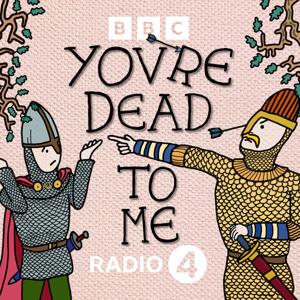
The comedy podcast that takes history seriously. In each episode of You’re Dead to Me from BBC Radio 4, Greg Jenner is joined by a comedian and an expert historian to learn and laugh about the…
History isn’t just about dates and textbooks – it’s about extraordinary characters, amazing stories, and some very questionable fashion choices. How long did it take to build an Egyptian pyramid? What does the Bayeux Tapestry reveal about medieval life? Why did it take nearly half a millennium for Joan of Arc to become a saint? And was Catherine the Great really all that great? Whether you want to explore ancient landmarks like Stonehenge and Machu Picchu, dance through the history of Broadway and Bollywood, or find out how the Tudors rose to power, Greg and his guests promise to teach you something new that you won’t have heard in history lessons.
Previous episodes of You’re Dead To Me have covered everything from royals to revolutionaries, actors to activists and divas to dictators. Take a stroll through the history of high-heeled shoes or get the scoop on the history of ice cream. Maybe you’d like to paint like the cave artists of the Palaeolithic era, work out like a Victorian bodybuilder, or fight like a Spartan? We’ve even hosted a special, live episode with the BBC Concert Orchestra to explore the dramatic life of Wolfgang Amadeus Mozart.
Whatever your historical interests, Greg and his guests make even the trickiest topics easy to follow. Join them for a history lesson that’s as entertaining as it is enlightening - with no homework required.
Ranked by our users in the last 21 days

7,578 Listeners

522 Listeners

1,044 Listeners

288 Listeners

5,517 Listeners

3,175 Listeners

2,106 Listeners

2,001 Listeners
4,820 Listeners

4,764 Listeners

824 Listeners

239 Listeners

346 Listeners

233 Listeners

307 Listeners

3,348 Listeners

1,892 Listeners

2,047 Listeners

77 Listeners

810 Listeners
1,385 Listeners

517 Listeners

628 Listeners
498 Listeners
1,148 Listeners

378 Listeners

232 Listeners

60 Listeners

73 Listeners

72 Listeners