
Sign up to save your podcasts
Or

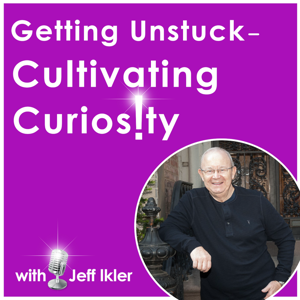

Hi, I'm Jeff Ikler, host of the Getting Unstuck - Cultivating Curiosity podcast. This summer, I'm periodically releasing mini-episodes that, in under 10 minutes, dive into an evergreen idea from a previously broadcast episode. The content in these mini episodes is designed to be readily applicable to your life or work.
This week's episode was inspired by a conversation with educator Dr. Deb Gustafson in December 2019, when she explained how, as a principal, she had applied Jim Collins' flywheel principle from Good to Great in her elementary school.
The idea
The flywheel is an individual's, team's, or organization's intentional ordering of only five to six key, repeated actions to achieve desired outcomes. Critical to success is the idea that the first action triggers the next, which in turn triggers the next. Each action is thus dependent on the one that came before it.
What prompted Deb's effort was her recent inheritance of the district's worst-performing elementary school. Rather than throw a series of unrelated strategies at the problem, Deb used the flywheel as a thinking tool to help her architect a plan for sustainable improvement.
Two important principles of the flywheel concept are ONE, a clear explanation of the desired result toward which everyone in the organization can work, and TWO, the selection of the all-important priority step from which the remaining elements cascade.
Here's how the two elements played out in Deb's planning. After studying her student population, Deb realized that her students were extremely dispirited, lacked self-esteem, and felt they had no future. Given those findings, she decided that the desired result couldn't just be a lofty academic goal; it had to reflect the needs of the whole student. So she structured the desired results as: "Help kids become the best people they can be."
Deb decided that, to achieve the desired results, the all-important priority step in the flywheel had to be hiring teachers who loved kids. As she told me, "I can teach people how to teach, but I can't teach them how to love. What these kids needed was to feel valued and capable of succeeding. If we did that well, academic success would follow."
I've included Deb's flywheel model in the show notes on my website. Take a minute to review the steps and how they were designed to achieve the school's desired results.
And the results, you ask? Deb's school quickly became the district's highest-performing elementary school, and her approach served as a model for other leaders and schools throughout the district.
Extending the ideaThe beauty of the flywheel is that it constrains thinking to what is essential to bring about desired results. Instead of wild brainstorming that results in "We could do this and this, and this," the flywheel demands discipline: "If we do these few things in this order really well, we'll increase the likelihood of success."
But imposing that limitation is really challenging for lots of organizations. Author of the essential read, Essentialism, Greg McKeown argues for a relentless pursuit of "less, but better." One of the biggest mistakes he notes is to dilute what is important by having "priorities." Here he explains the surprising history of the word priority and how its meaning has shifted over time:
The word "priority" came into the English language in the 1400s. It was singular. It meant the very first or prior thing. It stayed singular for the next five hundred years. Only in the 1900s did we pluralize the term and start talking about priorities. Illogically, we reasoned that by changing the word we could bend reality. Somehow we would now be able to have multiple "first" things.
One of the strategies that I really liked from McKeown's book is the idea of W.I.N. : asking yourself "What's Important Now?" Yes, it's a very mindful question because it helps us from sliding back into the unresolved past or ruminating about the yet-to-be-seen future. As McKeown concludes "It is mind-bending to consider that in practical terms, we only ever have now."
And W.I.N.? is a flexible question in that it can be asked relative to the macro level of life where we're constantly trying to bring work, play, family into harmony and flow. (Note, I don't say "balance" because there ain't such a thing, is there?) And it can be asked at the micro level regarding all those discrete work or home projects staring us in the face.
So…push yourself a bit, and ask "What's Important Now?" For inspiration, you can always watch the famous clip from the movie City Slickers, which never fails to get the juices flowing.
Referenced Interview with Dr. Deb Gustafson
Good to Great by Jim Collins
 View all episodes
 By Jeff Ikler
5
3232 ratings
Hi, I'm Jeff Ikler, host of the Getting Unstuck - Cultivating Curiosity podcast. This summer, I'm periodically releasing mini-episodes that, in under 10 minutes, dive into an evergreen idea from a previously broadcast episode. The content in these mini episodes is designed to be readily applicable to your life or work.
This week's episode was inspired by a conversation with educator Dr. Deb Gustafson in December 2019, when she explained how, as a principal, she had applied Jim Collins' flywheel principle from Good to Great in her elementary school.
The idea
The flywheel is an individual's, team's, or organization's intentional ordering of only five to six key, repeated actions to achieve desired outcomes. Critical to success is the idea that the first action triggers the next, which in turn triggers the next. Each action is thus dependent on the one that came before it.
What prompted Deb's effort was her recent inheritance of the district's worst-performing elementary school. Rather than throw a series of unrelated strategies at the problem, Deb used the flywheel as a thinking tool to help her architect a plan for sustainable improvement.
Two important principles of the flywheel concept are ONE, a clear explanation of the desired result toward which everyone in the organization can work, and TWO, the selection of the all-important priority step from which the remaining elements cascade.
Here's how the two elements played out in Deb's planning. After studying her student population, Deb realized that her students were extremely dispirited, lacked self-esteem, and felt they had no future. Given those findings, she decided that the desired result couldn't just be a lofty academic goal; it had to reflect the needs of the whole student. So she structured the desired results as: "Help kids become the best people they can be."
Deb decided that, to achieve the desired results, the all-important priority step in the flywheel had to be hiring teachers who loved kids. As she told me, "I can teach people how to teach, but I can't teach them how to love. What these kids needed was to feel valued and capable of succeeding. If we did that well, academic success would follow."
I've included Deb's flywheel model in the show notes on my website. Take a minute to review the steps and how they were designed to achieve the school's desired results.
And the results, you ask? Deb's school quickly became the district's highest-performing elementary school, and her approach served as a model for other leaders and schools throughout the district.
Extending the ideaThe beauty of the flywheel is that it constrains thinking to what is essential to bring about desired results. Instead of wild brainstorming that results in "We could do this and this, and this," the flywheel demands discipline: "If we do these few things in this order really well, we'll increase the likelihood of success."
But imposing that limitation is really challenging for lots of organizations. Author of the essential read, Essentialism, Greg McKeown argues for a relentless pursuit of "less, but better." One of the biggest mistakes he notes is to dilute what is important by having "priorities." Here he explains the surprising history of the word priority and how its meaning has shifted over time:
The word "priority" came into the English language in the 1400s. It was singular. It meant the very first or prior thing. It stayed singular for the next five hundred years. Only in the 1900s did we pluralize the term and start talking about priorities. Illogically, we reasoned that by changing the word we could bend reality. Somehow we would now be able to have multiple "first" things.
One of the strategies that I really liked from McKeown's book is the idea of W.I.N. : asking yourself "What's Important Now?" Yes, it's a very mindful question because it helps us from sliding back into the unresolved past or ruminating about the yet-to-be-seen future. As McKeown concludes "It is mind-bending to consider that in practical terms, we only ever have now."
And W.I.N.? is a flexible question in that it can be asked relative to the macro level of life where we're constantly trying to bring work, play, family into harmony and flow. (Note, I don't say "balance" because there ain't such a thing, is there?) And it can be asked at the micro level regarding all those discrete work or home projects staring us in the face.
So…push yourself a bit, and ask "What's Important Now?" For inspiration, you can always watch the famous clip from the movie City Slickers, which never fails to get the juices flowing.
Referenced Interview with Dr. Deb Gustafson
Good to Great by Jim Collins

103 Listeners
278 Listeners
53 Listeners

96 Listeners
65 Listeners
106 Listeners
64 Listeners
40 Listeners
18 Listeners