
Sign up to save your podcasts
Or

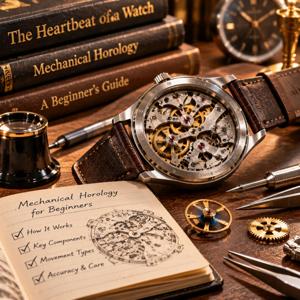


There is something fascinating about a mechanical watch. Unlike a digital device that displays time through an electronic screen, a traditional mechanical timepiece keeps time through a carefully coordinated system of springs, gears, and tiny moving components. It does not need a conventional battery to power its movement. Instead, it stores energy mechanically and releases that energy in a controlled way.
For someone new to horology, the movement inside a watch can seem mysterious. Yet its basic principle is surprisingly understandable. Once you know how energy travels from the mainspring to the hands, you can begin to appreciate why mechanical watches have fascinated enthusiasts for generations.
1. What Makes a Mechanical Watch Different?A mechanical watch uses stored spring energy to drive its timekeeping mechanism. The mainspring is wound tightly inside a barrel, storing energy that is gradually released as the spring unwinds. A series of gears transfers this energy through the movement, while the regulating system controls how quickly it is released.
This is fundamentally different from a quartz watch. A quartz movement uses an electronic circuit and a vibrating quartz crystal to regulate timekeeping. Mechanical movements rely on physical components moving in a carefully controlled sequence. Both technologies can be useful, but they offer different ownership experiences.
Many enthusiasts appreciate mechanical watches because the movement can be understood as a miniature machine. Each component has a specific role, and the performance of the complete system depends on how accurately those components work together.
2. The Mainspring: Where the Energy BeginsThe mainspring is one of the most important components in a mechanical watch. When the wearer winds the crown, energy is stored in the spring. As it gradually unwinds, it provides the power needed to operate the movement.
The amount of time a fully wound watch can continue running is called its power reserve. The power reserve varies according to the movement's design and construction. Some watches need daily winding, while others can continue running for several days when fully wound.
Automatic watches add a rotor, a weighted component that moves as the wrist changes position. This movement transfers energy to the winding system and helps keep the mainspring charged. Manual-winding watches do not use this mechanism, so the wearer winds them directly through the crown.
3. The Gear Train: Transferring Mechanical EnergyAfter energy leaves the mainspring barrel, it passes through a gear train. This arrangement of wheels and pinions transfers power toward the regulating mechanism and ultimately drives the hands.
Each gear has a carefully selected relationship with the others. Their sizes and tooth counts determine how rotational movement is transmitted and how the hands move at different rates. The minute hand must complete one rotation in an hour, while the hour hand moves much more slowly.
Understanding the gear train helps explain why mechanical watchmaking requires precision. Even small variations in component dimensions, friction, or alignment can influence how the movement performs.
4. The Escapement: Controlling the Release of EnergyIf the mainspring released all its energy at once, the watch would not keep time. The escapement solves this problem by allowing energy to pass through the gear train in controlled intervals.
In a common lever escapement, the escape wheel interacts with a pallet fork. The pallet fork alternately locks and releases the escape wheel, creating a sequence of controlled movements. This process delivers small amounts of energy to the balance assembly and helps maintain its oscillation.
The familiar ticking sound of many mechanical watches is associated with this repeated action. It is not simply decorative noise; it is a reminder that the movement is regulating the release of stored energy.
5. The Balance Wheel: The Timekeeping RegulatorThe balance wheel is a small oscillating component that works with a hairspring. Together, they form the regulating system that determines the rhythm of the movement. The balance wheel swings back and forth at a designed frequency, while the hairspring provides the restoring force that helps it return.
This regular oscillation controls the escapement and allows the gear train to advance at a consistent rate. The frequency of a movement is commonly expressed in vibrations or beats per hour, depending on the convention used. Understanding this relationship provides a useful introduction to mechanical timekeeping.
6. Learn More Through Structured Watch ResearchOnce you understand the basic movement, it becomes easier to explore different mechanical watch designs. A beginner's guide to mechanical watches and horology can be a useful starting point for learning terminology and comparing watch categories. Treat commercial catalogues as browsing resources rather than proof of authenticity, manufacturer authorization, or product quality. Verify important technical information through official brand documentation and established horology publications.
When researching a particular movement, record its type, power reserve, frequency, winding system, functions, and recommended maintenance. Separate manufacturer specifications from opinions expressed in reviews. This simple habit makes it easier to understand differences between movements without relying on marketing descriptions.
7. Why Mechanical Watches Can Gain or Lose TimeNo mechanical watch is perfectly immune to changes in its environment. Position, temperature, shocks, lubrication condition, and the state of the hairspring can influence timekeeping. Gravity can also affect the movement differently depending on how the watch is positioned.
Manufacturers and watchmakers use adjustment and regulation techniques to improve performance. Some movements are tested in several positions to evaluate consistency. Higher-end watches may also undergo additional testing, although the exact standards vary by manufacturer and certification system.
For beginners, the important lesson is that mechanical accuracy is a result of many interacting factors. A watch that gains or loses a small amount of time does not automatically indicate a serious fault. If performance changes noticeably, a qualified watchmaker can inspect the movement.
8. Complications Add More FunctionsA complication is a function beyond the basic display of hours, minutes, and seconds. Common examples include date displays, chronographs, moon-phase indications, and additional time-zone displays.
A chronograph uses additional components to measure elapsed time. A calendar mechanism tracks date information, while a moon-phase display represents the changing appearance of the Moon over its cycle. These functions require additional mechanical coordination and can make a movement more complex to design and service.
Complications should be appreciated for both their engineering and usefulness. A simple movement can be beautifully designed, while a complicated movement can be fascinating because of the additional mechanical problems it solves.
9. How to Care for a Mechanical WatchMechanical watches benefit from sensible daily care. Avoid unnecessary shocks, follow the manufacturer's instructions for winding, and keep the watch away from strong magnetic fields when its movement is not designed to resist them. Water resistance should never be assumed simply because a watch has a screw-down crown or a sporty appearance.
Mechanical movements also require periodic professional maintenance. Lubricants can age, seals can deteriorate, and components may need inspection or adjustment. Service intervals depend on the movement, manufacturer guidance, and actual usage. Keep service records and use a qualified watchmaker familiar with the movement.
10. Why the Mechanical Experience Still MattersIn an age when phones and computers display time instantly, mechanical watches offer a different kind of satisfaction. Their appeal is not based only on accuracy or convenience. It comes from the relationship between design, engineering, craftsmanship, and daily interaction.
Winding a manual watch, observing a moving seconds hand, or seeing a balance wheel oscillate through an exhibition caseback can make timekeeping feel tangible. These small experiences help explain why mechanical watches remain meaningful to collectors and enthusiasts.
Conclusion: Appreciate the Engineering Behind Every TickA mechanical watch is a compact system in which every component contributes to a larger purpose. The mainspring stores energy, the gear train transfers it, the escapement controls its release, and the balance assembly regulates the rhythm. Together, these elements transform stored mechanical energy into a continuous display of time.
For beginners, understanding these fundamentals is an excellent first step into horology. Explore different movements, learn the terminology, and pay attention to how engineering decisions affect everyday ownership. The more you understand what happens beneath the dial, the more rewarding every mechanical watch becomes.