
Sign up to save your podcasts
Or



Dawn reveals what weeks of uncertainty could not—a new world rising from the mist. Under the command of Christopher Columbus, Portuguese ships anchor before an island untouched by Europe, where silence speaks louder than triumph.
Step by step, the unknown becomes real. Sand underfoot. Water clear as glass. A flag raised in the name of John II of Portugal. Rituals of claim unfold—but so does something far more fragile: first contact.
Eyes meet across distance. No shared language, only gestures, gifts, and cautious curiosity. Two worlds stand face to face, unaware that this quiet moment will echo across centuries.
As exploration begins, questions grow. This is not the India they expected. The land feels different—larger, deeper, unnamed. And in that realization lies the true discovery: not a route, but a new reality.
This episode captures the instant history changes—not with conquest, but with a landing. Because sometimes, the most powerful moment is not when a world is taken… but when it is first seen.
Three ships leave Lisbon and sail into the unknown—not as conquerors, but as men balancing between courage and doubt. Led by Christopher Columbus, the expedition ventures west under the authority of John II of Portugal, carrying not certainty, but a question.
At first, the ocean is calm. The rhythm of wind and stars gives the illusion of control. But as days turn into weeks, whispers spread among the crew. Fear grows quietly—through glances, rumors, and the haunting thought that beyond the horizon may lie nothing at all.
Storms break their strength. Doubt turns into defiance. And on the edge of mutiny, Columbus must prove not just his vision—but his leadership. Promises are made, time is bought, and hope hangs by a thread.
Then come the signs: birds, drifting branches, a shift in the sea itself. Until, at last, a single cry changes everything—land.
This episode captures the most fragile moment of discovery—not the triumph, but the uncertainty before it. Because the greatest journeys are not defined by reaching land, but by the courage to sail when none can see it.
In the salt-laden air of Lisbon, where maps blur the line between truth and imagination, a single audience will decide the fate of the world. When Christopher Columbus steps before John II of Portugal, he brings more than a proposal—he brings a gamble.
Advisers laugh, pilots doubt, and reason argues against the unknown. The ocean is vast, the calculations uncertain, and the risks undeniable. Yet in a court shaped by ambition and maritime vision, one question rises above all: what if the impossible is worth the risk?
In this episode, we witness the moment history almost took a different path—the silence in the royal hall, the clash between caution and boldness, and the decision that could open the western ocean under the Portuguese flag.
Because sometimes, empires are not born from certainty—but from a single voice willing to say yes.
What if Christopher Columbus had sailed not for Spain, but for Portugal—and opened not just a continent, but an entire global system?
This episode explores the world beyond North America in a timeline where Portugal becomes the first true global empire. South America transforms into the core of a vast Lusophone world, stretching from the Caribbean deep into the continent’s interior. Silver-rich regions and river networks fuel expansion, turning the continent into the economic heart of a Portuguese-led system.
Across Africa, coastal trading posts evolve into deeper colonial structures, tightly linked to Atlantic trade. In Asia, Portugal strengthens its grip over key routes and ports, shaping commerce from India to China and limiting the rise of rival powers. Even Oceania enters the story, as Portuguese exploration pushes toward Australia and New Zealand, opening new arenas of competition.
What emerges is not just an empire—but a connected world. Oceans become highways, continents become nodes, and Lisbon stands at the center of a truly global network.
This episode reveals how one decision could have reshaped every continent—creating a world where Portugal is not just a pioneer of discovery, but the architect of global history.
What would the modern world look like if the Atlantic had been shaped by Portugal from the very beginning? This episode follows the long shadow of that decision into the twentieth and twenty-first centuries.
As the modern era begins, a vast Portuguese-Atlantic world stretches across continents—linking Europe, the Americas, Africa, and parts of Asia through trade, language, and shared history. Instead of a Spanish-dominated Latin America, a powerful Lusophone world emerges, united by language and commerce, reshaping global culture and diplomacy.
In this reality, global conflicts such as World War I and World War II still erupt—but with a different balance of power. Portuguese influence in the Atlantic becomes strategically crucial, while a more fragmented North America and a less dominant United States alter the course of the Cold War.
By the twenty-first century, Portuguese stands among the world’s leading global languages, connecting a vast network of nations across multiple continents. Lisbon remains a symbolic center of a global legacy born from one pivotal choice.
This episode explores how a single decision in the 15th century could echo across centuries—reshaping wars, cultures, and the very language of the modern world.
What if the Atlantic Ocean had become, not a contested frontier, but a controlled sphere? In this episode, we explore a world where Portugal accepts Christopher Columbus and transforms the ocean into the backbone of a global empire.
With early control of the Caribbean, Portugal turns the Atlantic into a network of trade routes linking Europe, Africa, and America. Lisbon rises as the central hub of a new world system—while Spain, shut out of early discoveries, is forced to seek alternative paths and challenge Portuguese dominance.
As plantations spread and the Caribbean becomes the economic heart of empire, other powers—France and England—enter the race, carving out their own spheres in North America. The result is a fragmented continent, divided between Portuguese, French, and English ambitions.
But the consequences reach far beyond America. Without a dominant Spanish empire, Europe evolves differently. Portugal emerges as the first true global maritime power, while the rise of Britain slows and conflicts—from colonial rivalries to the Napoleonic Wars—take on a more global dimension.
This episode reveals how one decision could reshape oceans, empires, and the balance of power—turning the Atlantic into the center of a Portuguese world.
At the edge of two eras, Middle Ages Europe stands on the threshold of transformation. Old structures still hold, but new ambitions are already reshaping the world. Trade, faith, politics, and knowledge are in motion—and the oceans are becoming the stage where the future will be decided.
Spices, silk, and riches from the East drive European desire, yet access is blocked by distance, cost, and control. Since the fall of Fall of Constantinople, routes have grown harder, pushing kingdoms to seek new paths. Among them, Portugal emerges as a bold maritime pioneer, exploring Africa and mastering the Atlantic.
Into this world steps Christopher Columbus—a man with a radical idea: reach Asia by sailing west. In real history, he is rejected. But what if that decision changed?
This episode explores a Europe on the brink—and the moment one choice could reshape the entire world.
From the publisher's feed
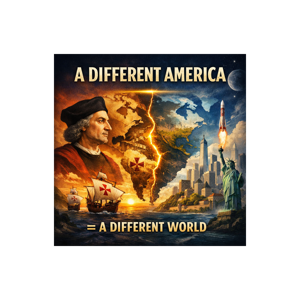
What if a single decision changed the course of history?
The podcast A Different America explores alternative perspectives on key moments in history — especially the…
The series combines documentary-style analysis with carefully constructed alternative scenarios. It is grounded in real historical facts, political contexts, and the possibilities of the time, and then explores how Europe, the Americas, and global civilization might have developed differently.
This is not fiction without foundation. It is a thoughtful exploration of how little it might have taken for today’s world to be entirely different.
Because a different America means a different world.