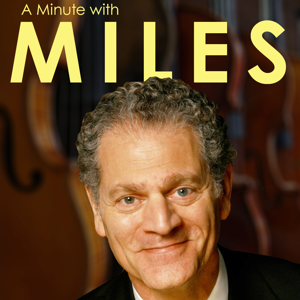
A Minute with Miles

A Minute with Miles

By Miles HoffmanMusic
Download on the App Store

A Minute with Miles episodes

  • Composers on Mozart
    Many composers over the years have tried to express in writing what the music of Mozart has meant to them—and to the world. Here are a couple of examples of Mozart appreciation from two 20 th century composers who were also wonderful writers. First, from Aaron Copland: “Each time a Mozart work begins…we composers listen with a certain awe and wonder, not unmixed with despair..."
    1 min
  • Letters from Mahler
    In the letters of great composers, certain themes come up again and again, especially the composers’ struggles to get their works performed, and the desire—often frustrated—to have those works understood and appreciated. Here’s Gustav Mahler writing in 1906: “For the time being I must rest content with knowing that in a few places there are small circles of art-lovers for whom my work has some meaning, even perhaps some value. The first obstacle to its performance, no matter where, consists in
    1 min
  • Sergei Rachmaninoff
    Sergei Rachmaninoff was an example of one of the great “types” in the history of classical music: the virtuoso performer who was also an important composer. And indeed he was one of the greatest examples of this type, because both his performing and his composing activities were on the highest level. During his time, in fact, Rachmaninoff was considered by many to be nothing less than the greatest pianist in the world—and if you go online and check out some of the many Rachmaninoff recordings, I
    1 min
  • Jean Sibelius
    Jean Sibelius was a fascinating man. He was born the year the American Civil War ended and he died in the year of Sputnik. He was a prolific composer—in addition to seven symphonies, many other orchestral works, choral music, music for the stage, and chamber music, he wrote more than a hundred songs—but over the last thirty years of his life he wrote virtually nothing. He was the greatest of Finnish composers, but he was a Swedish Finn: his first language was Swedish, and in fact he didn’t even
    1 min
  • Common Injuries for Musicians
    There’s very little that’s natural about the physical positions and movements that are required to play most musical instruments, and during the course of practicing and performing, awkward movements may be repeated literally thousands of times a day and millions of times a year, and unnatural positions may be maintained for untold numbers of hours. Muscle strain, tendonitis, nerve damage—all fall in the general category of “overuse” syndromes, and all are unfortunately extremely common among
    1 min
  • Performers Vs. Creators
    There’s no question that good performers are necessary in order to bring musical compositions to life. I play the viola, and I’m always aware that when I’m playing a concert, the quality of my performance is of great importance in bringing the music to life for the people who are in that particular audience. So yes, in the limited sphere of my performances and my audiences, my role is critical, and if I play Mozart well, or Brahms, or Beethoven, I’m playing at least a small part in sustaining a

    1 min
  • Music That Lasts
    People often wonder, “Which pieces by contemporary composers will be familiar to classical music lovers fifty… a hundred… two hundred years from now”? Well, it’s not foolproof, but one pretty good indicator is that if a piece remains unloved after fifty years, or has entirely dropped out of sight, it’s not likely to be in the standard repertoire after a hundred years.
    1 min
  • Debussy on Bach
    Here are a few words that one great composer wrote about another—and I wonder if you can guess who was writing about whom. Ready? “Once again one finds almost the entire piece is pure musical arabesque…In reworking the arabesque he made it more flexible, more fluid, and despite the fact that [he] always imposed a rigorous discipline on beauty, he imbued it with a wealth of free fantasy so limitless that it still astonishes us…” “We can be sure that [he] scorned harmonic formulas. He preferred
    1 min
  • Debussy and Ravel - an Unlikely Friendship
    Claude Debussy and Maurice Ravel were roughly contemporaries, and as two of the greatest figures in late 19 th and early 20th century French music, they tend to be linked in people’s minds. But although they had similar training and came under many of the same influences, their musical styles and techniques were really quite different. And each admired the other’s talents, but that didn’t stop either one of them from criticizing what he saw as the other’s weaknesses.
    1 min
  • Maurice Ravel
    A famous music critic once referred to the French composer Maurice Ravel as “this most conscious, most naturally artificial of composers.” And in fact Ravel specifically said that he wasn’t seeking “profundity” in the music he wrote. He was merely seeking… perfection —some sort of technical perfection in composition, as he defined it, with “absolute beauty” as the guidepost and goal. But here’s the problem: I’m not sure we should completely believe him. Ravel once said, “In my opinion the joie
    1 min

About A Minute with Miles

From the publisher's feed

Illuminating 60-second flights through the world of classical music with host and longtime NPR commentator Miles Hoffman. Produced by South Carolina Public Radio.You can enjoy an archive of these…