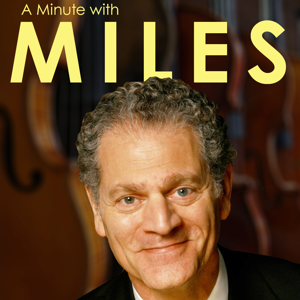
A Minute with Miles

A Minute with Miles

By Miles HoffmanMusic
Download on the App Store

A Minute with Miles episodes

  • Timpani 2
    The timpani, or kettledrums were the original percussion instrument of the orchestra. The “kettle” of a kettledrum is called the “bowl,” and is made of copper or brass. The “head” of the drum, the surface that the player strikes, is a piece of Mylar plastic stretched over the rim of the bowl.
    1 min
  • Timpani 1
    The timpani, also called kettledrums, have been regular members of the orchestra since about 1700. Their history can be traced back to ancient times in the Middle East, but they first appeared in Europe in the 1400's—they were originally imported from Turkey for use in cavalry bands. Timpani are tuned drums—they play notes, not just booms.
    1 min
  • A Quote from Claude Debussy
    Claude Debussy in 1903 wrote about the importance of giving his imagination free rein. Five years later Debussy expanded on the theme in a published interview. “You know,” he said, “People leave their homes to get away from themselves and from their surroundings. I confess that I live only in my surroundings and in myself. I can conceive of no greater pleasure than sitting in my chair at this desk and looking at the walls around me day by day and night after night..."
    1 min
  • Picturesque Titles - Debussy
    Robert Schumann called taking the titles of musical compositions too literally “clumsy.” Schumann’s friend Franz Liszt, on the other hand, coined the term “program music,” and said that when a piece has a program, or story, the musical ideas should clearly reflect the unfolding of the story—although that’s the same Franz Liszt who attached a “program” to his symphonic poem Les Préludes long after he had actually written the music.
    1 min
  • Picturesque Titles - Schumann
    Like many 19 th -century composers, Robert Schumann often gave his works picturesque titles. Schumann’s Scenes from Childhood , for example, a set of pieces for solo piano, includes pieces with titles such as “Pleading Child,” and “Frightening.” How literally should we take these titles – and perhaps the picturesque titles of other composers’ works?
    1 min
  • Scherzo 2
    Beethoven replaced the minuet in his four-movement pieces with the scherzo . Scherzo means “joke,” in Italian, but in Beethoven’s scherzos you won’t usually find anything that qualifies as out-‘n-out funny . What you usually will find is a certain playfulness, with lots of fast notes, abrupt accents, surprises, and quick changes of musical direction.
    1 min
  • Scherzo 1
    During the time of Haydn and Mozart, the third movement of a four-movement piece such as a symphony or string quartet was invariably a stylized dance movement called a minuet. By the end of the 1700's, though, Beethoven, in one of his many innovations, had largely replaced the minuet with a movement he called a “scherzo.”
    1 min
  • Syncopation 2
    Syncopation disturbs the regular flow of rhythm and it shifts the emphasis in music from strong beats to weak beats, or to in-between beats. I’d like to stress, though, that syncopation is a general term: there’s no limit to the number or variety of possible syncopated rhythms or syncopated patterns, and no limit to the ways they may be used.
    1 min
  • Syncopation 1
    There’s an old joke about the husband who’s been out late drinking, and when his wife asks him where he’s been, he latches onto a word he saw on the cover of a book in the window of a music store, and he says that unfortunately he had come down with a case of… syncopation.
    1 min
  • Dvorak, Tchaikovsky, and Melody
    Already during their lifetimes, Antonin Dvorák and Peter Ilyich Tchaikovsky were among the most famous composers in the world. Their music is extremely sophisticated, the product of highly skilled composers, and their beautiful melodies have always been especially beloved. Some critics, though, have criticized Dvorák and Tchaikovsky as being “just” melodists. Well. First of all, they both labored long and hard at their compositions. It turns out it’s not so easy to write melodies, especially

    1 min

About A Minute with Miles

From the publisher's feed

Illuminating 60-second flights through the world of classical music with host and longtime NPR commentator Miles Hoffman. Produced by South Carolina Public Radio.You can enjoy an archive of these…