Sign up to save your podcastsEmail addressPasswordRegisterOrContinue with GoogleAlready have an account? Log in here.
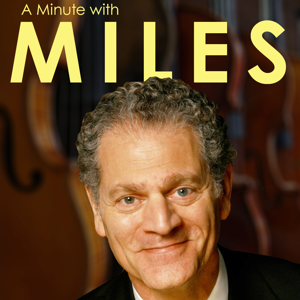
Illuminating 60-second flights through the world of classical music with host and longtime NPR commentator Miles Hoffman. Produced by South Carolina Public Radio.You can enjoy an archive of these segm... more
FAQs about A Minute with Miles:How many episodes does A Minute with Miles have?The podcast currently has 1,516 episodes available.
December 05, 2016Progress in Science Vs. Progress in MusicIn fields such as science and technology, or in medicine, we’re used to achievements that represent Progress, progress that is obvious and indisputable. We do things better than we did before. But in the field of music, Progress has at times been a misleading concept....more1minPlay
December 02, 2016StringsThe strings of stringed instruments—violins, violas, cellos, basses, guitars, and harps—may be made of steel, nylon or other synthetics, or of gut. Often the steel, nylon, or gut serves as the core of the string, and around the core is a tight winding of very fine wire—wire of steel, aluminum, or silver....more1minPlay
December 01, 2016The Flute, Part 2I mentioned yesterday that by the mid-1700's the modern flute, technically called the transverse flute, had to a great extent replaced the recorder. The replacement wasn’t complete, though: both Johann Sebastian Bach and George Frideric Handel had continued to write for both instruments. Then again, by the time of Haydn and Mozart, just a few decades later, most orchestras included a pair of flutes, and no recorders....more1minPlay
November 30, 2016The Flute, Part 1The flute is one of mankind’s oldest instruments, and in one form or another it’s been known to virtually every culture around the world. The modern flute used in Western classical music is known technically as a “transverse” flute because the player holds it out to one side and blows across a hole in the side of the instrument. Other flutes, such as the recorder, are “end blown”—the player blows directly into an opening in one end of the instrument....more1minPlay
November 29, 2016Robert Mann - Performer and TeacherPerformers are always seeking the most effective and compelling ways to bring a composer’s musical ideas to life. I stress the plural, “ways,” because there’s never just one way. Some musicians sometimes forget this, unfortunately, but the best musicians, and the best teachers never do. When I was a graduate student, the string quartet I played in was working on a Bartók string quartet, and our faculty coach was Robert Mann, founder and first violinist of the Juilliard Quartet....more1minPlay
November 29, 2016Original Intent - A Copland StoryWhen musicians and music scholars prepare performances of works by dead composers, they often get stuck in arguments over determining what the composers’ “original intent” was. And while I certainly recognize the importance of scholarly accuracy and authenticity, and of staying true to the composers’ wishes, I think that sometimes musicians forget that dead composers were once alive....more1minPlay
November 25, 2016Composers of Chamber MusicComposers during the Baroque period wrote plenty of chamber music, especially trio sonatas, and sonatas for such high-voiced instruments as the violin and the flute. But the chamber music repertoire that today’s audiences are most familiar with probably begins with the piano trios and string quartets of Joseph Haydn. After Haydn, the floodgates opened....more1minPlay
November 24, 2016Drumsticks for ThanksgivingPercussion players can vary the sounds of their instruments by using different kinds of drumsticks, or drumsticks with different kinds of heads. Timpani players, for example, use sticks that range from very soft to very hard....more1minPlay
November 23, 2016Telemann and the GypsiesYou could write a book about the life of the German composer Georg Philipp Telemann– and as it turns out, Telemann himself wrote three – three separate autobiographies. One of the things he wrote about is the time he spent in Poland in his early twenties. He became familiar with Polish and Moravian folk music during this period—he wrote that he experienced it in “all its barbaric beauty”—and he also heard the music of Eastern European gypsies....more1minPlay
November 22, 2016Mstislav RostropovichI had the enormous good fortune as a young man to get to work with the great cellist Mstislav Rostropovich. Rostropovich, or “Slava,” as everybody called him, was the music director of the National Symphony Orchestra when I played in that ensemble, and with all his other engagements he still somehow made time to give master classes just for members of the orchestra....more1minPlay
FAQs about A Minute with Miles:How many episodes does A Minute with Miles have?The podcast currently has 1,516 episodes available.