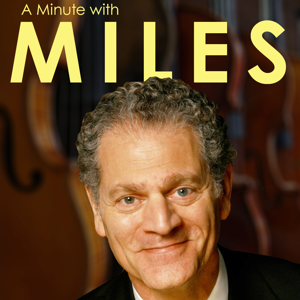
A Minute with Miles

A Minute with Miles

By Miles HoffmanMusic
Download on the App Store

A Minute with Miles episodes

  • Changing Habits - Mark Twain
    One of the things I’ve learned as a string teacher is that good habits can often replace a student’s bad habits quickly, because the good habits make playing easier. But it was Mark Twain, strangely enough, who helped me to realize that the switch can only result from a very conscious and rational process on the student’s part, a process of understanding and acceptance. In his essay “Taming the Bicycle,” Twain wrote, “In order to keep my position, a good many things were required of me, and in
    1 min
  • Sports/Music Connections
    The efficient and graceful use of the body is crucial to both sports and musical performance. But there are certainly many mental parallels as well -- and the experiences of athletes can teach us quite a bit about what musicians do. Years ago I read an interview in the Washington Post with a professional baseball player named Charles Johnson. Johnson had hit a three-run homer to win a game, and this is what he said afterward: “I recognized a curveball right away, and told myself to stay on it. I
    1 min
  • The Colors of White
    In 2004 the Vatican Museum presented an exhibit called “The Colors of White.” What the exhibit showed, in a nutshell, is that our notion that the beauty of ancient Greek and Roman statues lies in their pure, white form is a relatively modern idea, with no basis in historical fact. Scientists working with electron microscopes discovered vestiges of all sorts of bright paint colors on ancient statues, colors that to modern eyes seem hideously garish, and the curators of the Vatican exhibit
    1 min
  • David Popper
    Have you ever heard of a composer named David Popper? If you’re not a cellist, your answer is very likely…“Nope.” But if you are a cellist, your answer is, “Well of course .” There are some composers whose reputations rest almost entirely on their works for one instrument, and who, although they may not have been composers of the first rank, wrote brilliantly for that one instrument. Popper, who was born in Prague, in 1843, is a perfect example. He was a virtuoso cellist himself, and in his

    1 min
  • The Lure of Music
    In 1918 the music critic Olin Downes published a book called The Lure of Music. It’s a collection of biographical sketches of famous composers, and it includes listening suggestions, samples of the composers’ works on Columbia records. Most of the composers Downes writes about—people such as Verdi, Chopin, Berlioz, Dvorák—are among the immortals… They were famous then and they’ll always remain famous. But what’s fascinating to me is that I know hardly any of the performers’ names on the
    1 min
  • Heartless Musicians
    Many years ago I was having dinner with a group of colleagues when the name of a viola player we all knew came up. When I mentioned that this violist had just had his third heart attack, the instantaneous response from an old-timer across the table was, “Really? I didn’t know he had a heart.” As it happens, the heartless violist in question was not a terribly good player, to put it mildly. But we musicians have all known people we’ve found to be thoroughly unpleasant, even cruel, or thoroughly
    1 min
  • Counterpoint
    Counterpoint, also called polyphony , is the art, in musical composition, of combining two or more simultaneous lines of music. The word counterpoint comes from the Latin punctus contra punctum , meaning “note against note,” and the adjective derived from the word counterpoint is contrapuntal . Now you might ask, why isn’t it called contrapuntal writing when a melody is combined with an accompaniment? The answer is that in contrapuntal writing, the simultaneous musical lines are distinct and
    1 min
  • Pizzicato
    There are many musical terms that get translated into several languages, depending on the native language of the composer who’s using the terms. The Italian term Allegro , for example, might appear as “Lively,” in English, or “Vif,” in French, or “Lebhaft,” in German. But there’s one musical term that for some reason you’ll only ever see…or hear …in the original Italian, and that’s Pizzicato. Pizzicato is the Italian word for “plucked.” To play pizzicato on a stringed instrument means to make
    1 min
  • Program Music Imagery
    “Program music” is instrumental music that attempts to tell a story, paint a scene or picture, or convey impressions of a character, place, or event. But no matter how sonically descriptive, music is always open to a range of interpretations—sometimes far removed from the composer’s intentions—and no two people will ever hear the same work in exactly the same way. I’ll go further: in most cases, without descriptive titles we wouldn’t have the first foggiest clue of what an instrumental piece was
    1 min
  • Hayes - Olivier: "I Don't Know How I Did It"
    Your strange job as a performing artist—musician, actor, or dancer—is to immerse yourself completely in the work of art you’re performing—to lose yourself, in a sense—and yet at all times to remain aware of precisely what you’re doing and how you’re doing it. It’s not easy, and sometimes the process—which is complicated to begin with—becomes downright mysterious. I once heard the actress Helen Hayes tell a story about Sir Laurence Olivier. She was performing in a play with Olivier, and one night
    1 min

About A Minute with Miles

From the publisher's feed

Illuminating 60-second flights through the world of classical music with host and longtime NPR commentator Miles Hoffman. Produced by South Carolina Public Radio.You can enjoy an archive of these…