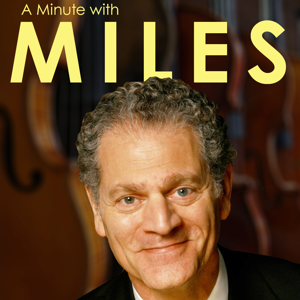
A Minute with Miles

A Minute with Miles

By Miles HoffmanMusic
Download on the App Store

A Minute with Miles episodes

  • Composer Friends and Colleagues
    I find it fascinating that many of the greatest composers of the 19 th century—composers such as Berlioz, Schumann, Chopin, Mendelssohn, Wagner, Brahms, Dvorák, and Tchaikovsky—knew one another, and in many cases had very friendly personal and musical relationships. Schumann, for example, wrote his piano quintet for his wife, Clara, a great piano virtuoso …and Clara played the first public performance of the piece. But the very first performance of the piece was at a party for friends, and the

    1 min
  • Opus Numbers
    In 1950 a musicologist named Wolfgang Schmieder published an enormous catalogue of J.S. Bach’s works, but Schmieder organized it by category, that is, by type of composition, not by date of composition. The catalogue is known in German as the Bach-Werke-Verzeichnis, or BWV, and that’s why you often see Bach’s works listed in programs with their BWV numbers. Mozart’s works have “K” numbers, for Ludwig Köchel, who published a chronological Mozart catalogue in 1862, and Schubert’s compositions are
    1 min
  • Concert Etiquette
    Concert etiquette. It’s really just a matter of common sense and good manners. If you think you may be at risk of a coughing or sneezing fit, sit on the end of a row, not in the middle. If you’re bringing a child to the concert and the child tends to fidget, sit in the back, not the front. Don’t take pictures or make videos if you’ve been asked not to or if you may be blocking somebody else’s view, and don’t use a flash even if you haven’t been asked not to. But etiquette is a two-way street,
    1 min
  • The "Glamour" of Touring
    Do you find traveling glamorous? Sitting around in airports, waiting in lines, carrying luggage, eating in unfamiliar places, sleeping in unfamiliar beds? Well imagine doing that for about ten months a year, and imagine doing it alone, while having to prove , over and over again every single week, that you’re one of the best in the world at what you do. And when you’ve imagined all that, and added in lots more hours spent alone practicing, you’ve imagined the glamorous life of a touring soloist.
    1 min
  • Paradox of Integrity
    Musicians, like actors, have to deal with something a drama teacher once called the “paradox of integrity.” On the one hand, you have to be completely “in character” when you’re performing—moved yourself by the music in order to make it moving for others, and merged with the music, in a way… almost submerged in it. On the other hand, you have to remember where to put your fingers, and not to make the same mistake tonight you made at the rehearsal yesterday morning, and not to rush in the third
    1 min
  • Conflict
    I won’t mention any names, but many years ago there was a great string quartet that was famous for its members not getting along. People joked that it was a tragedy for this quartet if they showed up in a town that only had three hotels. I don’t know if we can blame this particular quartet, but one theory that took hold was that the best results for chamber music groups are produced by conflict, and the resolution of conflict. I would like to on record as saying that I think this theory is a
    1 min
  • Pronunciation
    Classical music lovers tend to worry about correct pronunciation, so here are a few refreshers that I hope will be helpful. In America, people who play the flute call themselves flutists, not flautists, and we who play the viola, which looks like vie-ola, are called violists. Handel’s Messiah was written by Handel, not "Hondle", and though you can say Haendel if you’re feeling German, Handel himself changed it to Handel, so I’d stick with that. Mozart is "Motzart," not "Moe-zart," but before we
    1 min
  • Program Notes - George Bernard Shaw
    If you’re allergic to highly technical program notes for classical music concerts, you’re not alone. Most musicians I know find such notes boring and irrelevant, and most non-musicians find them useless, not to mention seriously off-putting. Well, it turns out it’s an old problem, as I discovered when I read a wonderful essay by George Bernard Shaw from 1896. “[Thirty years ago],” Shaw wrote, “the average programmist would unblushingly write, ‘Here the composer, by one of those licenses [which
    1 min
  • Original Sentiment
    Walter Pater was an influential 19 th -century English author and critic, and in 1870 he wrote a fascinating essay about the Italian Renaissance painter Sandro Botticelli. In one passage that particularly caught my eye, Pater wrote, “If [Botticelli] painted religious incidents, [he] painted them with an undercurrent of original sentiment, which touches you as the real matter of the picture through the veil of its ostensible subject.” When I read this, I thought immediately of J.S. Bach. I have
    1 min
  • Interpretation
    Composers write pieces, and performers perform them. But for the performers, just about everything the composer writes, with the exception of the notes themselves, is a matter of interpretation. The composer indicates that a passage should be played softly? Fine. But how softly? It should get louder? Okay, but how much louder? Faster, slower? – same thing, it’s a matter of interpretation and personal taste. And tastes and interpretations can change, sometimes from one performance to the next.
    1 min

About A Minute with Miles

From the publisher's feed

Illuminating 60-second flights through the world of classical music with host and longtime NPR commentator Miles Hoffman. Produced by South Carolina Public Radio.You can enjoy an archive of these…